I created 300 dwarves with the soul of Praguers: a record 264,081 tok/s and 719.6 people/s, higher quality slows it down to 45 thousand
I created 300 unique virtual Praguers in natural Czech at 45,192 tok/s (done in 17.34 s). Then I changed the call architecture and chased the pure ceiling of speed and price: I pushed the swarm to 264,081 tokens per second, created 719.6 new Praguers per second (742.0 surveyed per second) and squeezed the price down to 0.31 CZK per thousand people.


Imagine that instead of a single big AI advisor, you have 300 tiny digital dwarves in a wooden box on your desk. Each has their own pencil, their own flat in a different Prague neighborhood, their own payslip and their own reason for cursing in the morning on the tram or in the traffic jam on Jižní spojka. When we asked them for really nice, natural Czech and reasoning on the level of big GPT-type models, they scurried across the desk at 45,192 tokens per second and filled in all 300 questionnaires in 17.34 seconds without a single error. But when we immediately rebuilt the call architecture itself and chased the pure ceiling of speed and price, we pushed the swarm up to 264,081 tokens per second, managed to create 719.6 new Praguers per second (and survey 742.0 per second) and squeezed the price down to 0.31 CZK per thousand people.
The two don't rule each other out, you just pay for quality in a different currency. The more natural the Czech, the deeper the deliberation and the more precise the context you demand, close to the big flagship models, the more noticeably the real token flow slows down. We'll keep the specific model and provider names in the kitchen; below you'll find the exact numbers, the dead ends and the five architectural techniques that decided them.
We tried exactly this while designing Work Teams in Hyperprostor. We wanted every document, budget or presentation to be read before submission by several artificial personalities in the role of an audience, who would say where they got lost. But out of fear for the bill and the speed, we cautiously limited the audience in the original specification to 3 to 5 readers and the concurrency to 4 steps.
Then, under the hood of Hyperprostor, we tested a quiet workhorse at exactly the same price level as GPT Luna (ten cents per million input tokens and fifty cents per million output tokens, so roughly 2.30 CZK and 11.50 CZK), which nevertheless scores around 36 points in the independent Artificial Analysis Intelligence Index, compared with 27–28 points for GPT Luna (and in the agentic AutomationBench roughly 37.8% against 20.2%). Its exact name stays in the kitchen. We cared about one thing only: how many such dwarves the interface can hold at a single moment without a single 429 error, and whether useful thoughts fall out of them or just expensive noise.
A short cinematic vision of the whole experiment (turn the sound on): all 300 dwarves in front of a laptop scribble away at the questionnaire with their pencils at once, until one of them sighs out loud: “In Vinohrady I pay a fortune for a box.”
300 windows on a single screen
A scripted simulation based on the exact millisecond logs of all 300 parallel threads (P001 to P300) side by side in a 20 × 15 grid on a single screen. Hover to open a live magnifier below the wall, and click to open the full card and the Praguer’s reaction.
So that the dwarves wouldn't write empty phrases, they got a real four-step task:
- Creating 300 unique Praguers (
P001toP300): stratified so that there were exactly 37% university graduates (111of300), the median age came out at 39 years (18to84years) and the net income ran from8,000 CZKto135,000 CZK(median 42,000 CZK). From a butcher at the Holešovice Market, a costume designer from Barrandov, a metro line C driver and a blind piano tuner to a Ukrainian nurse in Krč, a retired watchmaker or a game developer from Karlín. - 300 dwarves filled in the Prague Resident Questionnaire 2026 at once (done in 17 seconds): all
300personalities set off at a single moment (Promise.all). The whole flock was done in 17 seconds (exactly 17.34 s), all 300 of 300 returned valid JSON on the first try without a single429error, at a speed of over 45,000 tokens per second (45,192 tok/s) and for just 9.47 CZK. - 300 readers put our product through its paces in two rounds: first, each of the 300 Praguers independently evaluated the draft of Work Teams in Hyperprostor with the thinking brake
effort = "low"(8.91 s, 35,460 tok/s, pure visible text 10,387 tok/s, price 4.39 CZK). Then we split them into sixty pub tables of five, where each saw the objections of their four neighbors (7.09 s,33,640 tok/s). - A load ladder from 1 to 300 concurrent threads: every call carried a unique ID so that cache couldn't be used to cheat, and every wave measured response smoothness right up to the edge of three hundred concurrent models.
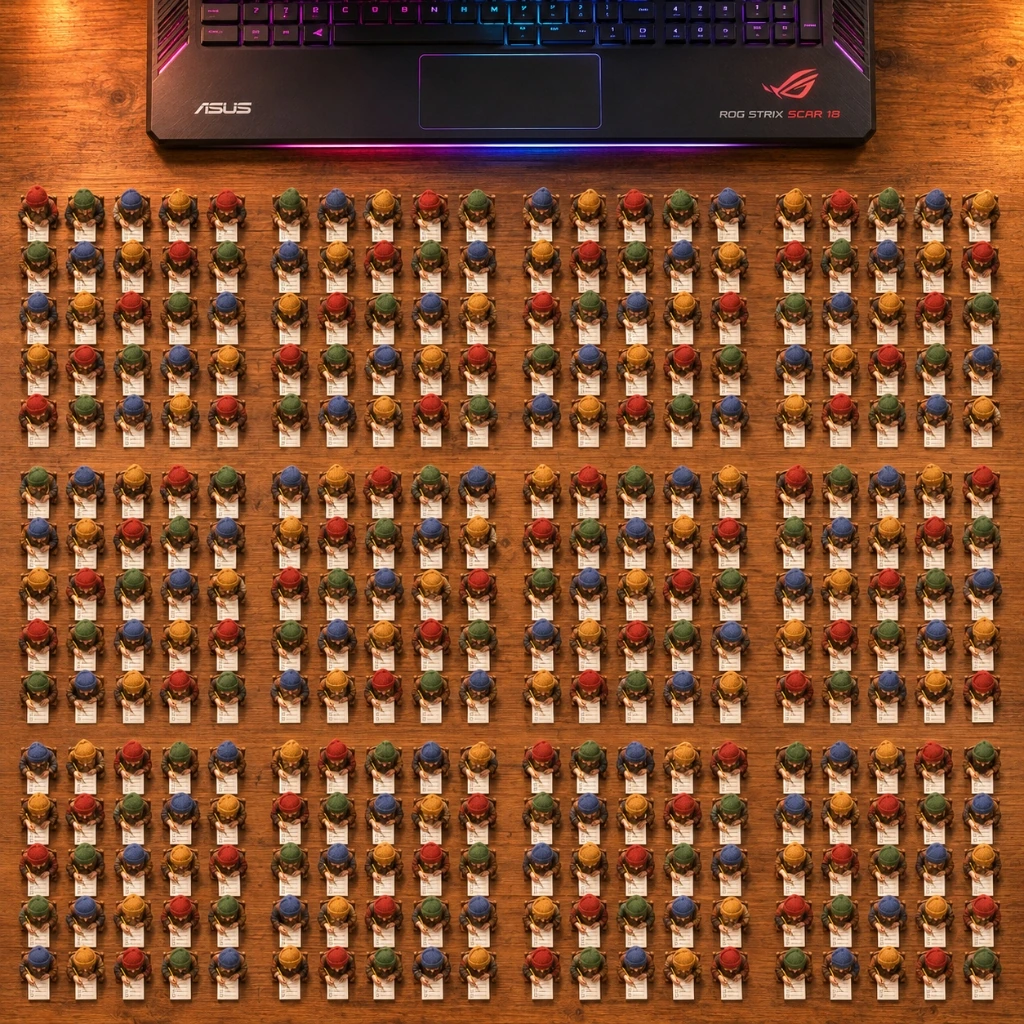
A top-down view of all 300 dwarves lined up on the table in front of a laptop (12 blocks of 5 × 5 scribes = exactly 300 concurrent questionnaires at a single moment).
Over 45,000 tokens per second: 300 Praguers done in 17 seconds
When live virtual Praguers with full biographies and an open question stepped into all 300 threads at once, the swarm's total output shot up to over 45,000 tokens per second (45,192 tok/s) and the whole three hundred were done in 17 seconds (17.34 s, 783,544 output tokens for 9.47 CZK). Even in the separate synthetic load ladder with a short technical prompt, the interface scaled from a single window up to C = 300 without a single 429 error at a rate of 31,876 tok/s (23.94 s, 9.00 CZK).
| Concurrency | Success | Wave time | Median (p50) | 95th percentile (p95) | Swarm throughput | Visible text | Wave cost |
|---|---|---|---|---|---|---|---|
| 1 window | 1 / 1 (100%) | 6.83 s | 6.83 s | 6.83 s | 468 tok/s | 33 tok/s | 0.04 CZK |
| 10 windows | 10 / 10 (100%) | 8.79 s | 5.57 s | 8.65 s | 2,615 tok/s | 237 tok/s | 0.27 CZK |
| 50 windows | 50 / 50 (100%) | 16.44 s | 6.58 s | 10.84 s | 7,873 tok/s | 654 tok/s | 1.51 CZK |
| 100 windows | 100 / 100 (100%) | 19.39 s | 6.86 s | 11.46 s | 13,519 tok/s | 1,111 tok/s | 3.06 CZK |
| 150 windows | 150 / 150 (100%) | 14.91 s | 7.35 s | 10.69 s | 23,915 tok/s | 2,150 tok/s | 4.17 CZK |
| 200 windows | 200 / 200 (100%) | 22.18 s | 8.12 s | 12.11 s | 23,031 tok/s | 1,926 tok/s | 5.96 CZK |
| 300 windows (ladder) | 299 / 300 (99.7%) | 23.94 s | 9.18 s | 13.96 s | 31,876 tok/s | 2,685 tok/s | 9.00 CZK |
| 300 Praguers (Questionnaire) | 300 / 300 (100%) | 17.34 s | ~8.5 s | ~13.2 s | 45,192 tok/s | 4,062 tok/s | 9.47 CZK |
300 Praguers (effort="low") | 300 / 300 (100%) | 8.91 s | ~5.1 s | ~7.6 s | 35,460 tok/s | 10,387 tok/s | 4.39 CZK |
Under the hood of this huge speed, though, lies an important engineering detail:
- Each dwarf spends nine tenths of the time muttering to themselves: In the default wave of 300 Praguers, out of a total of 783,544 tokens, a full 91.0% (713,109 tokens) went to invisible internal reasoning, and only 4,062 tok/s was the output JSON itself.
- Why the single runner dropped out of the ladder (and why all 300 Praguers survived with room to spare): In the first
C = 300ladder (limit 8,192 tokens), thread#096looped in its reasoning up to8,190of8,192tokens and returned an empty JSON withHTTP 200. Once we raised the margin to10,240tokens, 300 of 300 Praguers passed cleanly on the first try. - The magic brake
effort = "low": When we sent the same 300 dwarves into the Hyperprostor evaluation withreasoning: { effort: "low" }, the share of reasoning fell to 70.7%, the whole wave of three hundred agents finished in 8.91 s, visible output jumped to 10,387 tokens per second and the price dropped to less than half (4.39 CZK for 300 readers).

Taming the internal muttering pays off: the default mode burns over 90% of throughput on internal loops (left), while the simple effort="low" brake cuts the time to 8.9 seconds and the bill by half (right).
Do the answers of the thrifty swarm make sense?
Speed for free would be useless to us if nonsense fell out of three hundred windows. But when we sorted all 300 Praguers by how they travel around the city and asked about a proposal for a 100 CZK daily toll for driving a car into the wider center in exchange for stronger public transport, the result held a surprisingly sharp economic logic:
| Respondent's transport | Number of Praguers | For the toll | Against the toll | Unsure |
|---|---|---|---|---|
| Public transport only | 143 | 133 | 4 | 6 |
| Mix / on foot / bike | 80 | 68 | 11 | 1 |
| Car only | 77 | 0 | 77 | 0 |
| Sample total | 300 | 201 | 92 | 7 |
All seventy-seven exclusive drivers voted 0 : 77 against, while public transport riders voted 133 : 4 for (and the few unsure ones added a perfectly rational doubt that they don't trust City Hall to route the collected money back into the transit lines).
Even more valuable was the test of our own proposal for Work Teams in Hyperprostor across all 300 profiles (overall grade 3.34 → 3.47, willingness to try it for a one-off 50 CZK 59.0% → 47.3%):
- IT and management (
n = 29): grade 2.83 → 2.83, willingness to try it for 50 CZK 96.6% → 96.6%. - Self-employed and small businesses (
n = 61): grade 3.03 → 3.21, willingness to try it for 50 CZK 86.9% → 68.9%. - Teachers and trainers (
n = 21): grade 3.05 → 3.24, willingness to try it for 50 CZK 85.7% → 76.2%. - Students (
n = 18): grade 3.11 → 3.33, willingness to try it for 50 CZK 77.8% → 61.1%. - Public administration, healthcare and culture (
n = 50): grade 3.22 → 3.44, willingness to try it for 50 CZK 64% → 46%. - Blue-collar and operations jobs (
n = 99): grade 3.67 → 3.77, willingness to try it for 50 CZK 31.3% → 21.2%. - Seniors (
n = 22): grade 4.09 → 4.09, willingness to try it for 50 CZK 4.5% → 4.5%.
Take a look at eight concrete voices out of the whole three hundred:
- Ondřej Marek (
P013, 28, IT developer, Vršovice, 68,000 CZK): “At the 80% limit it stops fixing things after all, so I risk an unfinished piece that I'll have to rewrite entirely anyway. And with work materials I'd also worry about trust and privacy: what does the system do with it, who is responsible for mistakes.” (Grade 2 → 2, 50 CZK: YES; unclear: Roles like Typesetter and Graphic Designer seem needlessly over the top to me, and a ‘checker from a different model family’ sounds mostly like marketing. And I'm not clear what happens when 50 CZK simply isn't enough for a proper document – that seems like the main catch.) - Hana Kučerová (
P021, 36, primary school teacher, Prosek, 45,000 CZK): “Even if it cost 50 CZK, I'd still have to check all of it to see whether the Czech is right and whether it matches what we teach, and after an evening with the kids I have neither the time nor the nerves for that. And with children I can't afford a mistake.” (Grade 3 → 3, 50 CZK: YES; unclear: I'm getting lost in those role names: Lead, Researcher, Typesetter, Checker from a different model family, rehearsal before an audience. For me that's too many complicated words when all I want is a simple document without paperwork.) - Bohuslav Křepela (
P255, 58, blind piano tuner, Vinohrady, 36,000 CZK): “How am I supposed to tell that a finished PDF or presentation is right when I can't see it? And that it doesn't contain invented prices or mistakes about tuning, no checker from a different model family can guarantee me by itself.” (Grade 3 → 3, 50 CZK: YES; unclear: I got lost in the board, the live progress, the graphic designer and the typesetter. As a blind person I need to mainly hear things and control them by keyboard or voice, not click around pictures and watch how it looks.) - Ctirad Malina (
P101, 52, butcher at the Holešovice Market, Holešovice, 48,000 CZK): “Who guarantees me it won't make up figures for renovation and energy costs? I'd have to recalculate it myself anyway, and I still don't know where my data goes; I wouldn't just hand it over to the authorities.” (Grade 3 → 3, 50 CZK: YES; unclear: Those roles – Lead, Researcher, Typesetter, Checker from a different model family and rehearsal before an audience – that's all Greek to me. I just need to know how much it costs, how long it takes and whether it adds up.) - Radim Závodný (
P122, 34, firefighter from Holešovice, Holešovice, 52,000 CZK): “The main problem is trust. AI will happily make up some nonsense and I'd still have to check it after a 24-hour shift, otherwise I'm asking for trouble. And I really don't want to sit at a computer for that, I'd rather write it myself.” (Grade 3 → 3, 50 CZK: YES; unclear: Typesetter, Checker from a different model family, rehearsal before an audience – that's marketing talk to me. I don't understand why I need six different AIs when I just want to write one paper.) - Oksana Melnyk (
P227, 39, nurse at Thomayer Hospital, Krč, 48,000 CZK): “I'm afraid it will write bad Czech or invent something silly and the office won't accept it, and then I'd have to trust it even though I don't understand it. At the hospital I'd never entrust it with any paper about patients.” (Grade 3 → 3, 50 CZK: YES; unclear: Those roles, Lead, Typesetter, Checker from a different model family and rehearsal before an audience, don't tell me anything; it sounds like it's for IT people and it's needlessly complicated for me.) - Klára Sedláčková (
P036, 34, owner of a small e-shop, Vysočany, 85,000 CZK): “My biggest fear is that it will make up nonsense about prices, VAT, carriers or deadlines for the e-shop, and then I'll have to spend the whole night at home rechecking it before I send it to the client. It will only save me time if it fits Czech realities and doesn't just sound nice in general.” (Grade 2 → 2, 50 CZK: YES; unclear: The Checker from a different model family and that rehearsal before an audience sound to me like a very technical marketing wrapper, and I don't know what to actually imagine under it.) - Oldřich Pospíšil (
P171, 81, retired watchmaker, Košíře, 21,000 CZK): “My main doubt is that I'd have to have a computer and read it in tiny letters, and my eyes aren't what they used to be. And to throw away 50 crowns on a paper when I don't know who wrote it and whether it's true, that makes no sense to me; my daughter will write me a letter on paper.” (Grade 5 → 5, 50 CZK: NO; unclear: I got lost right at the roles: Lead, Researcher, Typesetter, Checker from a different model family. PowerPoint, Excel, board, rehearsal before an audience – those are foreign words to me, I work with my hands at a table, not in an app.)
In under nine seconds and four crowns forty hellers, 300 digital dwarves smashed five blind spots in the brief before we even touched the code:
- The 80% budget brake comes across as a threat of unfinished work (IT developers and tradespeople alike expect to pay for a half-finished product that they'll spend half a day fixing).
- The names Typesetter and Checker from a different model family confuse over 85% of respondents across education levels.
- A board of six personalities puts off tired users after a shift, who want a single result without managing a mini-team.
- Asymmetry of responsibility: a screw-up in front of a customer, boss or authority is always borne by the person with their signature.
- The blind piano tuner (
P255) immediately pulled out an accessibility blind spot: anyone who can't look at a PDF or presentation with their eyes can't judge a visual “board” or a result without a voice and text preview.
Where the dwarves cheat: a forensic audit with a stronger eye
If we stopped at enthusiasm over nice quotes, we'd be fooling ourselves. So we ran all 300 profiles and answers through a script and an analytical pass to separate the strengths of the cheap swarm from its artificial seams:
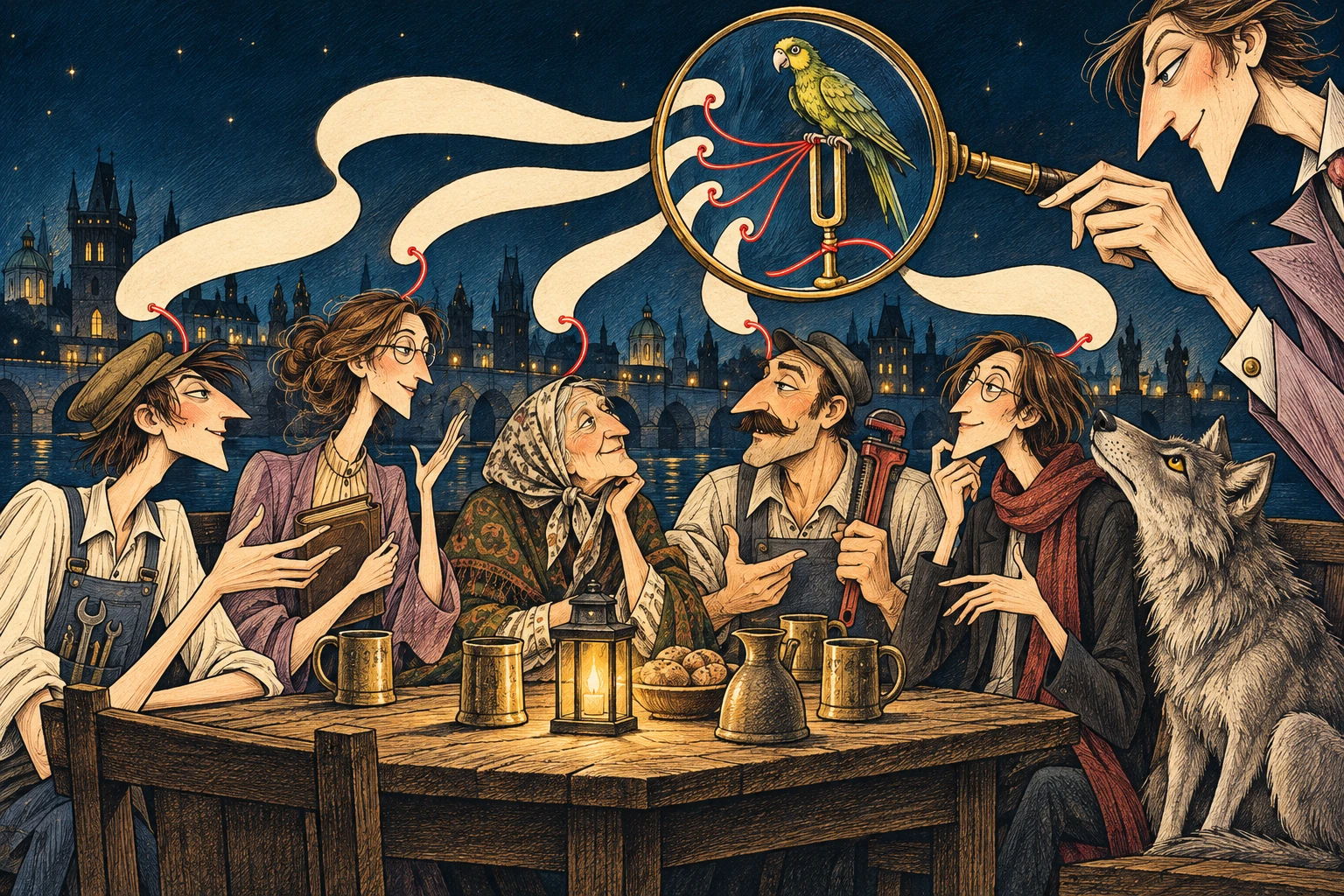
Under the magnifying glass, the different characters are very lively on the surface, but the beginning of every sentence carries the imprint of the brief (the same hook under the magnifier).
We found five precise artificial seams across the whole three hundred:
- A templated sentence start in 286 of 300 dwarves: 178 answers began exactly with “What annoys me most…”, 95 with “What burns me most…” and 13 with “What pisses me off most…” (only 14 differently). The model mechanically took the word straight from the name of the JSON key
coMeVPrazeNejvetsiStve. - Topic contagion from the previous item (priming): A full 90 of 300 respondents spontaneously complained about Airbnb in the open complaint, including seniors from peripheral housing estates, because three lines above they had rated
regulaceAirbnbAVystavba. - The zero anchor vs. the fifty-crown note: After the hint “feel free to say 0”, 264 of 300 Praguers put their monthly AI budget at 0 CZK, yet five minutes later 177 of 300 (59%) would pay 50 CZK for a one-off finished document. And across all 300 profiles, only 2 people chose the answer “never” for current AI use (of 22 seniors over 65, only a single one!).
- A one-way shift in the debate at 60 tables: After hearing four neighbors, 260 Praguers left their grade unchanged, 40 lowered it and 0 raised it, because the debate brief gave them only the objections of their tablemates, not ideas.
- The nice Czech gives itself away slightly: We caught 34 cases of a non-Prague preposition (“v Karlíně”, “v Žižkově”, “v Pankráci”, “v Modřanech”), and even foreigners living in Prague long-term wrote in the same smooth colloquial diction as native Czechs.
The chase for the ceiling: 264,081 tok/s, 719.6 Praguers created per second and a thousand people for 31 hellers
After the first wave with the three-hundred-strong Prague audience, I asked the opposite question. What if we set aside the complex literary Czech and found out where the physical ceiling of speed and the floor of price actually lie? The result surprised twice over: merely switching to a different engine or a big JSON is nowhere near enough, and on top of that a hard law of conservation of quality applies.
When, after the highly parallel fast architecture, we wanted the same careful Czech and reasoning (medium thinking level for 100 Praguers at once), the resulting time did drop to 1.74 seconds (57.5 Praguers/s), but the overall throughput stayed at 43,739 tok/s, a hair lower still than our original quality Czech run (45,192 tok/s). Why? A full 71.3% of tokens were swallowed by silent internal thinking (only 12,534 tok/s of visible text came out) and from every second, a cold HTTPS/TLS connection setup took an average of 439 ms, against 516 ms of the computation itself (66,795 tok/s of pure compute throughput).
As soon as we turned the thinking down to the minimum for Czech (low, 100×1), the time fell to 1.00 second (25,072 tok/s, of which 21,561 tok/s visible), but the quality of the Czech and the logic started to crumble. The majority in the public transport poll flipped upside down (17:33 versus 47:1 in medium mode) and the dwarves started declining words like a broken machine (“po dlouhém směnu”, “peníze jsou těsně”). Natural Czech and nuance comparable to big GPT-type models simply take their toll in reasoning tokens and slower response.
Five architectural rules that unlocked the records
To get from the 45 thousand tok/s wall six times higher, pushing on raw power wasn't enough. What decided it was a combination of five concrete changes to the way we make calls:
- Pre-warmed connections (
HTTP Keep-Alive) instead of a cold start: A short batch computed in half a second loses almost double the time negotiating a new TLS tunnel. Only when we opened and warmed up the TCP/TLS connections in advance, before the real measurement, did each hundred windows start dropping under a second (0.80to1.36 s). - A batch of 10 profiles in one window (
100×10) instead of the extremes300×1and1×100: The attempt to cram all 100 Praguers into a single giant JSON failed. A single thread runs only at single-thread speed (1,749 to 2,288 tok/s): the compact hundred took3.66 s, the full JSON failed on the first try at 28 items (4.74 sand a logic collapse of0:49), and the long stress test (64,026characters /24,360tokens in11.84 s) brought classic context fatigue, where answer length dropped from399to213characters (ratio0.53) and the dwarf slipped into an impersonal third-person narration. The golden mean was to pack 10 personalities into one compact JSON query (the Czech intermediate step25×4gave100/100in0.93 s, that is 108.0 Praguers/s for0.53 CZK). - Working English inside, quality Czech only on output: As soon as we rewrote the same task with low reasoning (
low) for raw batch work into compact English, the reasoning tokens dropped to a fraction (1.9% to 14%, with 86–98% of throughput being directly visible output) while the logic stayed solid (99.5–100%first-person form, public transport450:46, toll for cars0:248). For a bulk run of dwarves it therefore makes sense to generate the structure and attitudes quickly and cheaply in English, and convert only the final summary into nice Czech. - Bulk name sharding when creating from scratch (
719.6new Praguers/s): When a hundred pre-warmed streams of ten (100×10) created entirely new residents of Prague from scratch, they produced 980 valid profiles out of 1,000 in 1.36 seconds, that is 719.6 newly created Praguers per second (0.96 CZKtotal, i.e. 0.98 CZK per 1,000 people). The same configuration over the existing questionnaire handled 991 of 1,000 Praguers in 1.34 s, which makes a record 742.0 surveyed Praguers per second without a single429error (2.07 CZK, i.e.2.09 CZK / 1,000), and the double batch200×10handled 1,974 of 2,000 Praguers in 2.77 s (712.4/s). We also learned an important detail: without assigning separate name lists to each thread, independent dwarves draw from the same stereotyped basket, so out of980new characters only 336 unique names came out. - Spreading across several independent clusters (
264,081 tok/s) vs. the hunt for pennies (0.31 CZK / 1,000): A single fast account hit its own peak of 128,976 tok/s at150long streams (5.18 s, average61,707 tok/s), a larger pool with220streams pushed the peak to 171,306 tok/s (7.20 s, average66,909 tok/s), and only combining 550 pre-warmed streams across four independent compute clusters shot the 250 ms peak to 264,081 tokens per second (257,001 tok/s of pure visible text, 1,195,658 output tokens in total,98.1%visible text,0429errors, 71,077 tok/s over the fast 95% of requests and59,011 tok/sover the full20.26 suntil the slowest cluster finished). At the opposite pole lies the minimum-price mode: with the cheapest compute route (30×10) we got 259 valid questionnaires in10.18 sfor a mere 0.08 CZK, that is a record 0.31 CZK per 1,000 Praguers (0.031 CZKper hundred people) with100%first-person retention.
| Experiment mode | Time | Token throughput | Throughput (Praguers/s) | Price per 1,000 people | Behavior and quality |
|---|---|---|---|---|---|
Quality Czech swarm (300×1, original run) | 17.34 s | 45,192 tok/s | 17.3/s (300 people) | 31.57 CZK (9.47 CZK / 300) | Natural Prague Czech, quality above GPT Luna |
Fast arch. CZ + medium (100×1) | 1.74 s | 43,739 tok/s (12,534 visible) | 57.5/s (100 people) | 18.80 CZK (1.88 CZK / 100) | Logic 47:1 holds, but 71.3% is swallowed by thinking |
Fast arch. CZ + low (100×1) | 1.00 s | 25,072 tok/s (21,561 visible) | 99.9/s (100 people) | 10.00 CZK (1.00 CZK / 100) | Fast, but endings and logic break (17:33) |
Czech compromise via batch (25×4, low) | 0.93 s | 22,863 tok/s (11,465 visible) | 108.0/s (100 people) | 5.30 CZK (0.53 CZK / 100) | Short punchy answers, no fall into errors |
Creation from scratch EN (100×10, Keep-Alive) | 1.36 s | 33,457 tok/s (63,233 peak) | 719.6/s (980 of 1,000) | 0.98 CZK (0.96 CZK / 980) | 336 unique names without sharding |
Questionnaire record EN (100×10, Keep-Alive) | 1.34 s | 62,456 tok/s (94,499 peak) | 742.0/s (991 of 1,000) | 2.09 CZK (2.07 CZK / 991) | 99.5% first-person form, public transport 450:46, toll 0:248 |
Double questionnaire EN (200×10, Keep-Alive) | 2.77 s | 60,203 tok/s (139,028 peak) | 712.4/s (1,974 of 2,000) | 2.10 CZK (4.14 CZK / 1,974) | 99.7% first-person form, 0 429 errors |
Lowest price EN (30×10, Keep-Alive) | 10.18 s | 2,521 tok/s (3,178 peak) | 25.4/s (259 of 300) | 0.31 CZK (0.08 CZK / 259) | 100% first-person form, public transport 110:20, 3 hellers / 100 |
Token ceiling 550 streams across 4 clusters | 20.26 s (4.90 s median) | 264,081 tok/s peak (257,001 visible) | 1,195,658 tokens | 20.25 CZK total (1.69 CZK / 100k tok) | 550/550 OK, 0× 429, 98.1% visible text |
What such a swarm costs and what we take from it into Hyperprostor
The live run of three hundred unique Praguers alone (generating the remaining two hundred new characters, the bulk 300-window questionnaire and both rounds of product evaluation at 60 tables) came to a mere 0.79 USD (roughly 18.09 CZK). The whole first Czech wave, including all the ladder test waves and the Atelier illustrations, came to 3.37 USD (77.47 CZK), the follow-up series of architectural speed and price tests added 2.18 USD (50.08 CZK), so the entire research of both modes together, including the load test of 550 parallel streams, cost just 5.55 USD (127.54 CZK).
For Work Teams in Hyperprostor, we take from this a simple two-speed principle. Where you need natural Czech and fine deliberation close to the big GPT models, you stay with the calmer 45 thousand tok/s in just under twenty seconds. And where you need to fire off hundreds to a thousand perspectives for a survey within a second, test a text on an audience, or spin up a massive simulation for 31 hellers per thousand people, you switch on pre-warmed batches of ten in English, separate name shards, and only translate the clean result into human language.
Jan Tyl