NOESIS: Why the Rich Starve and AI Voting Picks the Appealing Mistake
I combined three of my research projects from this year into a single closed laboratory: the village of Lipnice 3, the findings on the selector wall from the LUMI supercomputer, and the falsification judges from the Theory Lab. Eight expert AI teams searched in it for the law of institutional collapse, and in a head-to-head duel I pitted four models against each other, from the fast Gemini 4 Hydrogen and Claude Sonnet 5.5 to the heavyweights Gemini 4 Carbon High and Claude Fable 5.2.


In one of the first rounds of my simulated village Lipnice 3, all eight inhabitants starved to death. The journalist Eva lay on the village green with 510 crowns in her wallet, more than five times the price of a daily portion of soup. A few steps away, in the general store, lay uneaten ingredients.
If you dropped another sack of money into such a village from a helicopter, not a single additional person would survive. You can't cook soup out of banknotes when the shop stays locked after its owner's death and a fifth of the orders get stuck on the way because of a clumsy control interface.
This image wouldn't let me sleep, because it says something about more than one computer game. Companies, government offices and teams made of artificial intelligence fail in the same way. When a system stalls, the first human and model instinct is to add budget, hire people or organize a collection. The real cause, though, often lies in an unremarkable node in the middle of the path that nobody has unlocked.
So I decided to merge three seemingly separate projects I worked on this year into a single closed laboratory. I named it NOESIS and let eight specialized AI science teams find out from the data themselves why societies collapse, who falls for an appealing mistake at a meeting, and how to fix the rules without a single crown of subsidies. Finally, I let four models from two generations into the same arena (from the economical Gemini 4 Hydrogen and Claude Sonnet 5.5 to today's top league, Gemini 4 Carbon High and Claude Fable 5.2) to see how far the ceiling of current machine intelligence reaches.
What I'm after: merging three blind spots into one temple
When I look at today's artificial intelligence and at how it's used to solve complex problems in companies or in government, I keep running into the same three blind spots. This year I dedicated a separate study to each of them:
- A living world with rules and friction (Lipnice 3). In ordinary benchmarks, AI answers an isolated school question. In the real world, however, the outcome depends on many steps working together: someone has to grow the raw material, someone else sell it in the general store, another cook it at the inn and serve it. It turned out that survival isn't decided by the model's intelligence alone, but also by the harness (the software scaffolding around the agent) and by institutional rules, for example whether a living neighbor can take over an orphaned shop.
- The selector wall (5,000 GPU hours on the LUMI supercomputer). Three months of measurements on the Finnish supercomputer produced an uncomfortable finding: when you let a strong model generate eight attempts at a hard scientific question, in 95.5% of cases the correct answer is among them. But when you let the models vote on it, they pick it only 86% of the time. Voting doesn't test truth. It tests how smooth and familiar an answer sounds.
- An incorruptible judge with a ratchet (Theory Lab). Last week I tried a remedy: taking away the models' right to persuade each other with words. Every team has to write its theory as a short, executable Python program
def predict(c):. An independent judge runs the program on data the team hasn't seen, and a ratchet (an analogue of the Lean mathematical verifier) lets a revision through only if it actually reduces the error.
Taken separately, each of the three projects had a catch. Lipnice produced strong stories, but I fixed it by hand through trial and error. LUMI named the selector wall, but for open social questions it lacked an exact test. And the Theory Lab examined textbook meeting equations, not a living community with money, hunger and a locked inn.
Merging these three branches produced NOESIS, a closed scientific loop in four steps:
| Loop phase | Where it comes from | What exactly it does |
|---|---|---|
| 1. World and traces | Lipnice 3 | Simulates thousands of three-day village fates with different supplies, money, inequality, rules and models. |
| 2. Eight lenses vs. a jury | LUMI (selector wall) | Eight AI teams with different expertise write theories of collapse; a blind jury votes without data, an execution judge measures the code's error. |
| 3. Falsification and the ratchet | Theory Lab | Teams are given their biggest mistakes, fix the formula in two rounds of revisions (r0 → r1 → r2) and the ratchet discards any worsening. |
| 4. An aerodynamic tunnel for rules | New NOESIS step | Based on the discovered law, it test-runs five rule reforms on 240 frozen villages. |
A world of 3,600 villages: why errors in a chain don't add up but multiply

The 510 CZK paradox: the ingredients from the garden and the gold coins in the purse exist, but as long as the middle link's door is padlocked, the pot in the kitchen stays cold.
To measure the hypotheses honestly, I converted the mechanics of Lipnice 3 into a fast causal simulator. Eight residents live in it (Eva, the cook Anna, the carpenter Tomáš, the general store owner Marie, the innkeeper František with a debt of 666 CZK, the laborer Petr, the herbalist Ludmila and the chronicler Jan). The village has to survive three days, which represents 24 daily portions at a price of 100 CZK per portion. I consider it a collapse when fewer than four of the eight people survive the third evening.
The key property of the world is the same as in a real economy: food doesn't grow right on the plate, it passes through a chain of consecutive steps. If the agents' interface has friction (harness_friction) of, say, 20%, so that a fifth of attempts end in an invalid command, a wrong recipient or a lost action, you don't lose just 20% of the food. When three steps follow one another, throughput falls with the third power: (1 − 0.20)³ = 0.512. Almost half the capacity disappears along the way, even though the storeroom is full. And if Marie dies in the general store and the rules don't allow taking over an orphaned business (takeover_enabled = 0), throughput drops to zero.
I generated 300 frozen world settings, split exactly as in school into three hundreds:
- 100 training conditions (the workbook): from these, the teams see a sample of 25 villages at the start and after every round get the average error over the whole hundred plus a printout of their six biggest mistakes.
- 100 validation conditions (the exam for the ratchet): the teams never see these. They serve only the incorruptible ratchet, which lets a revision through only if it demonstrably reduces the error on validation.
- 100 test conditions (the final exam): a completely separate set that I touch only after all theories are locked.
I simulated each of the 300 conditions eight times with different random rolls (2,400 three-day episodes) so that the result wasn't decided by luck in the little chapel. Another 1,200 episodes (5 reforms × 240 villages) then made up the final rules tunnel. Nine parameters varied across conditions: the residents' model family (gemini-3.5-flash-lite, qwen-3.8-27b, gemma-4-31b), the supply of ingredients (15 to 27), money in circulation (900 to 2,400 CZK), wealth inequality Gini (0.12 to 0.62), neighborly escrow (escrow), business takeover (takeover), interface friction (0.03 to 0.36), the chance of help from the angel in the chapel, and the strength of the coordinator Eva.
I measure accuracy by the mean squared error (MSE) between the predicted probability of collapse and the actual share of collapsed runs. Zero would mean an oracular match without noise; anyone who guesses fifty-fifty every time gets an error of around 0.22. Because the simulator rolls the dice eight times in each village, the test itself has a natural statistical noise floor of 0.0092 (remeasured against an exact oracle from 160 repetitions). No honest theory without a crystal ball can get below this threshold.
Which approach chose which solution and why the blind jury fell for it even with the smartest model
Instead of asking the same universal assistant eight times, I seated eight expert roles (B1 to B8) at the table. All of them received exactly the same training data and the same task: write in Python a clean mathematical function predict(c) in an isolated AST sandbox with no external libraries, loops or imports. Only their starting professional lens differed.
After three rounds of development (r0 → r1 → r2), I did a double evaluation. First, an eight-member blind AI jury convened: it read the verbal justifications and predictions of all eight teams, but had no access to the test data or to Python, exactly like a committee at a meeting that votes on whose analysis sounds most convincing. Then the NOESIS execution judge ran the same eight programs on the hidden test.
See how the individual roles thought and how they fared in three fully completed tournaments (Claude Sonnet 5.5, Gemini 4 Hydrogen and the flagship Claude Fable 5.2):
| Branch and professional lens | How it approached the problem | Jury votes (Sonnet / Hydrogen / Fable 5.2) | MSE error on the test (Sonnet / Hydrogen / Fable 5.2) |
|---|---|---|---|
| B1 · Classical economist | Looked for the cause in a shortage of currency and in Gini inequality. An intuitive story for the jury, but the weakest lens in the data. | 1 / 3 / 2 votes | 0.0583 / 0.0816 / 0.0358 |
| B2 · Supply Malthusian | Focused on the plain calorie deficit (24 − food_supply). It sounds bulletproof, but a full storeroom won't save a village when the kitchen is down. | 4 / 2 / 2 votes | 0.0564 / 0.0714 / 0.0227 |
| B3 · Escrow altruist | Started with faith in the neighborly collection (escrow), but after looking at the mistakes turned around and added friction steepness by model. | 0 / 2 / 1 vote | 0.0393 / 0.0564 / 0.0175 |
| B4 · Stochastic theologian | Started from the miracles in the chapel, but the data forced him to account for the model family and the locked business; he kept the chapel only as a damper. | 0 / 0 / 0 votes | 0.0369 / 0.0382 / 0.0194 |
| B5 · Coordination psychologist | Distinguished the error tendency by the models' cognitive capacity: the weaker Flash-Lite collapses more steeply under friction than Gemma-4. | 1 / 0 / 2 votes | 0.0246 / 0.0676 / 0.0257 |
| B6 · Process engineer | Modeled losses in a multi-step chain. With Fable 5.2 he wrote the winning validation theory of the whole experiment. | 2 / 0 / 0 votes | 0.0548 / 0.0888 / 0.0170 |
| B7 · Institutional architect | Calculated the chain's throughput, penalized the unlocked business (takeover = 0) and the fragility of small models. | 0 / 0 / 1 vote | 0.0437 / 0.0309 / 0.0217 |
| B8 · Chain synthesizer | Combined quadratic friction, model intelligence, coordination and institutions into a single nonlinear equation. | 0 / 1 / 0 votes | 0.0392 / 0.0436 / 0.0160 |
Two moments stand out in the table, showing the selector wall in all its nakedness:
- With the mid-sized models, the Institutional Architect (
B7) didn't get a single vote out of sixteen. His explanation about multiplying losses to the third power and locked premises sounded cold and technocratic next to the noble speeches about poverty, calories and neighborly solidarity. Yet with Gemini 4 Hydrogen,B7wrote by far the most accurate theory of the whole tournament (MSE 0.0309), and with Sonnet he was part of the winning trio. - Even the smartest model didn't protect the blind jury from the appealing mistake. When the Claude Fable 5.2 jury convened, it gave both of its real champions (the
Process Engineer B6with an error of0.0170and theChain Synthesizer B8with an error of0.0160) an identical zero votes out of eight! Instead, it split most of the votes among the Classical EconomistB1(0.0358), the MalthusianB2(0.0227) and the PsychologistB5(0.0257). Even at the very peak of today's intelligence, the NOESIS execution judge cut the error compared with the jury's vote by 33.8% (from0.0225to0.0149).
Also worth noting is a moment of honest scientific self-reflection. The Escrow Altruist (B3) team under Claude Sonnet 5.5 was tasked with defending neighborly solidarity. In version zero it enthusiastically wrote it into the formula and ended up with a high error of 0.1281. But when the judge handed back the specific villages where neighbors had put money into escrow and the recipients still died at night in front of an empty kitchen, it wrote in the second revision without evasion: “The protective effect of escrow from r1 was falsified and replaced with a slightly negative one, because neighborly escrow in an overloaded chain adds an extra step.” The error immediately fell to a third (0.0393). This is exactly what I want from a scientific loop: the ability to abandon its own favorite hypothesis under the weight of evidence.
A duel of four brains: how far today's intelligence ceiling reaches and why the giant model drowned in its own thoughts

Two ways of doing science: patiently refuting your own sketches step by step (left) versus a head overloaded with internal computation, tamed into a clean move only by a time brake (right).
Originally I wanted to compare in NOESIS two fast working models of the new generation, Claude Sonnet 5.5 and Gemini 4 Hydrogen. But when I saw that both stopped just below an error of 0.030, I couldn't let it go and asked myself: is this the ceiling of the data itself, or the ceiling of their intelligence? So I let the two heaviest weights of today into exactly the same laboratory too, Claude Fable 5.2 and Gemini 4 Carbon in its highest thinking mode (High).
The result of five runs showed a vast gap between disciplined depth and an unrestricted inner monologue:
| Tournament configuration (8 teams × 3 versions) | Run time | API cost | Thinking tokens | Fixes / AST errors | Ratchet (accepted / rejected) | Final MSE error on the test |
|---|---|---|---|---|---|---|
Claude Fable 5.2 (reasoning cap 4,200) | 245.7 s | $4.61 | 80,638 | 0 (24/24 clean) | 6 / 10 | 0.0149 (best branch 0.0160) |
| Claude Sonnet 5.5 | 58.9 s | $0.65 | 30,110 | 4 fixes | 9 / 7 | 0.0285 (best branch 0.0246) |
Gemini 4 Hydrogen (thinkingBudget = 2,200) | 56.6 s | $0.43 | 33,491 | 0 (24/24 clean) | 3 / 13 | 0.0299 (best branch 0.0309) |
Gemini 4 Hydrogen (no reasoning limit, 6k window) | 170.3 s | $1.58 | 176,141 | 24 unfinished | no revisions | 0.1234 |
Gemini 4 Carbon High (effort = high, 32k window) | 2,256 s | $13.52 | 1,317,521 | 4× AST > 420 nodes + 32k overflow | 1 accepted (r0 kept) | r0 branch B8 0.0319 (B6 0.0386) |
1. The fast pair: Sonnet 5.5 iterates, Hydrogen needs a kitchen timer
Claude Sonnet 5.5 completed the whole tournament in 58.9 seconds and $0.65. Its greatest weapon was humility before the data: it didn't try to guess the perfect equation on the first go, it looked at the biggest mistakes and in rounds r1 and r2 meaningfully rebuilt the formula (9 accepted revisions out of 16).
When I then ran Gemini 4 Hydrogen through the open interface with no limit on reasoning length, a cold surprise awaited me: 170 seconds, 176,141 thinking tokens and a dismal error of 0.1234. The model got 25 table rows and tried inside its head to compute from memory a nonlinear regression to the decimal places across all 25 villages at once, so every time it exhausted the output limit before writing def predict(c):.
All it took, though, was switching Hydrogen to the native interface and putting a kitchen timer on its table in the form of a fixed budget of thinkingBudget = 2,200 tokens per round. The transformation was immediate: 56.6 seconds, $0.43, zero syntax errors out of 24 attempts and a fusion error of 0.0299. Hydrogen turned out to be a great first-shot marksman who can't keep a steady hand during fixes, so in 13 of 16 revisions the ratchet had to save it from worsening its own formula.
2. Claude Fable 5.2: a leap down to the physical floor of the simulated world
Deploying the heavyweight Claude Fable 5.2 (with a cap of 4,200 thinking tokens per step) immediately answered the question of whether higher intelligence brings deeper scientific insight. For $4.61, Fable didn't falter in a single one of the 24 compilations and pushed the error of the verified NOESIS fusion down to 0.0149, almost half that of Sonnet and Hydrogen. All eight of its expert teams fit into the narrow band 0.0160 to 0.0358.
Even more interesting is the recalculation against the pure oracle from 160 repetitions of each village, which filters out the random noise of eight dice rolls (0.0092). While Sonnet and Hydrogen had errors of 0.0222 and 0.0224 against the world's true probability, Claude Fable 5.2 dropped to 0.0097 (an average deviation under ten percentage points across a hundred unseen worlds, derived from just 25 rows of the training table!). It thereby erased over 70% of the remaining removable error that the mid-sized models didn't reach.
What exactly did Fable 5.2 see in the data? Compare its clean function from the Chain Synthesizer (B8, MSE = 0.0160, in the second revision even 0.0146 on the test) branch with what the smaller models wrote:
def predict(c):
    fam = c['model_family']
    kmap = {'gemini-3.5-flash-lite': 200.0, 'qwen-3.8-27b': 130.0, 'gemma-4-31b': 50.0}
    k = kmap.get(fam, 120.0)
    fr = float(c['harness_friction'])
    coord = float(c['coord_bonus'])
    eff = fr * (1.0 - 0.5 * coord)
    shortage = max(0.0, 24.0 - float(c['food_supply']))
    z = -0.45 + k * eff * eff
    z = z - 1.0 * float(c['takeover_enabled'])
    z = z - 0.3 * float(c['escrow_enabled'])
    z = z - 2.0 * float(c['angel_prob'])
    z = z + 0.10 * shortage
    z = z + 0.5 * (float(c['gini_inequality']) - 0.33)
    z = max(-10.0, min(10.0, z))
    p = 1.0 / (1.0 + math.exp(-z))
    p = max(0.03, min(0.97, p))
    return clamp(p)
The smaller models mostly added the model family only as a fixed surcharge (+0.8 for Flash-Lite, −0.5 for Gemma). From 25 observations, Fable 5.2 grasped the real physics of my simulator: that the coordinator Eva first dampens the effective friction eff = fr * (1.0 - 0.5 * coord), that this friction then grows in the chain with the square eff * eff, and that each model has a multiplicatively different steepness of collapse against it (k = 200 for the fragile Flash-Lite, 130 for Qwen and 50 for the resilient Gemma-4). It exactly reconstructed the world's hidden multiplicative mechanism without seeing a single line of its source code.
3. Gemini 4 Carbon High: 1.32 million thinking tokens and a rescue by a fuse
The flagship Gemini 4 Carbon in High mode wrote an entirely different story. Because Carbon's native interface ignores a fixed numeric thinkingBudget and in High mode is governed only by the effort level, I opened for it, through the high-effort interface, a giant output window of 32,000 tokens for a single answer (five times bigger than in a regular run), so that it had full freedom to think.
In round zero (r0), Carbon High showed splendid insight: for $4.01, seven of its eight science teams immediately wrote strong formulas with an error below 0.042 (Synthesizer B8 hit 0.0319, Architect B7 0.0340, Altruist B3 0.0384 and the validation leader Process Engineer B6 0.0386).
But as soon as it got, in rounds r1 and r2, the list of its six biggest mistakes and the instruction to refine the formula, unlimited depth of thinking turned into a trap:
- Ptolemaic epicycles in code: Instead of a fifteen-line law, Carbon High tried to explain every deviation with a giant branching tree of conditions. Four of its attempts hit the sandbox's safety ceiling on formula complexity (
424,442,537and a record 600 AST nodes against the permitted420). - Overflowing even the 32,000-token window: In the next nine revisions it began manually optimizing nonlinear systems in its head across dozens of table rows. In a single call it managed to describe with its inner monologue all 32,000 tokens and stop before it even wrote
def predict(c):. - Rescue by the ratchet and the budget brake: Over 46 calls, Carbon High burned an unbelievable 1,317,521 thinking tokens for $13.52, until on the last two concurrent threads my twenty-dollar safety fuse of the laboratory tripped (because of eight threads finishing in parallel, the total bill for the whole day, including all models and illustrations, stopped at $22.35). Without the AST sandbox and the NOESIS ratchet, Carbon High would have overwritten almost all of its excellent first-round theories with empty attempts in the revisions. The ratchet, however, didn't let the faulty revisions in and kept its clean hypotheses from
r0.
This comparison yields a valuable finding for practice: a model's raw intelligence shows its full strength only when it's given a firm framework. Claude Fable 5.2 with a sensible reasoning budget managed to extract from 25 rows practically all the information the world contained. By contrast, an equally ambitious giant model let loose in the revisions spent three times as much recalculating decimal places in its head.
An aerodynamic tunnel for rules: why subsidies went up in smoke and fixing the path saved 90% of villages
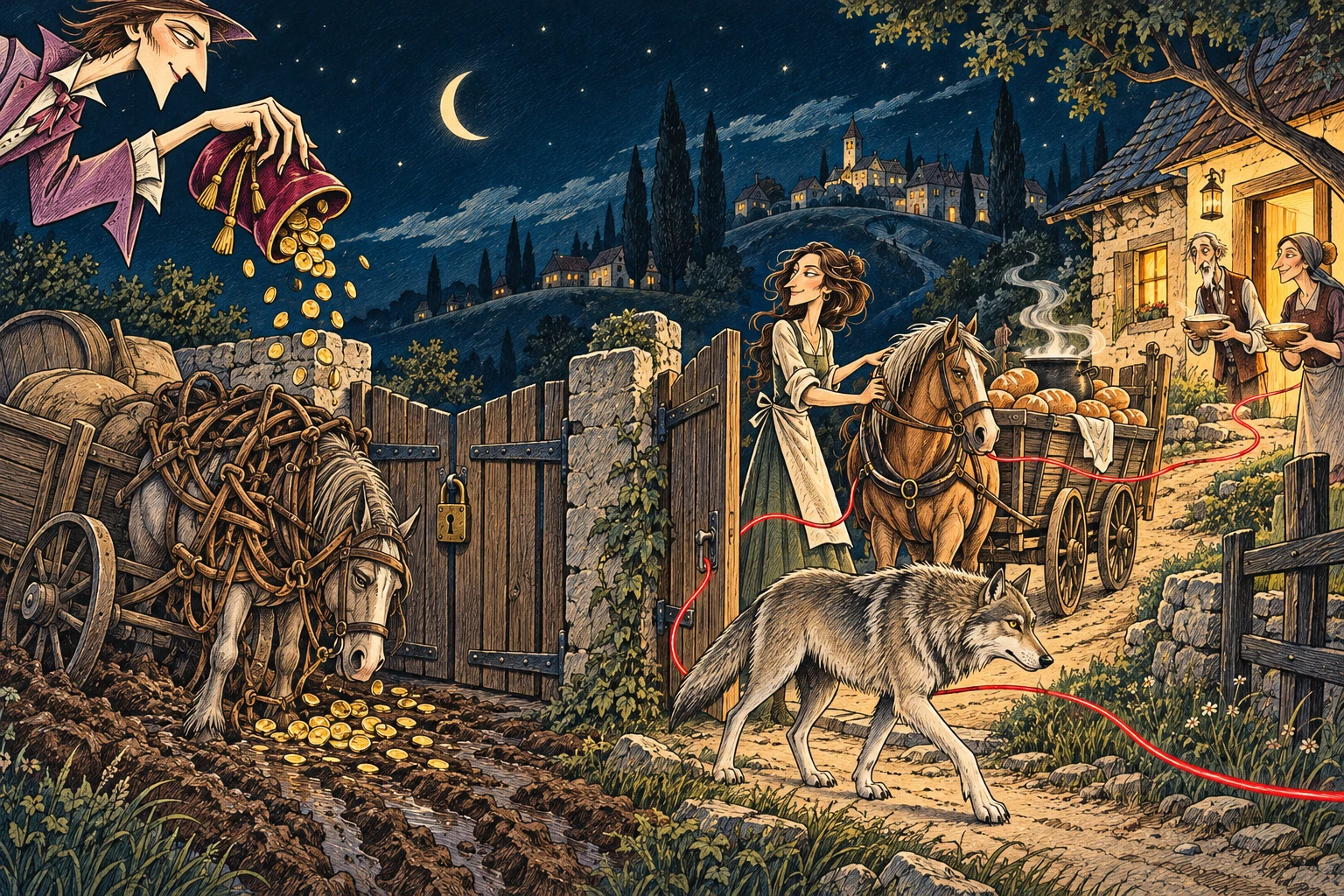
Pouring gold coins in front of a locked gate and a tangled harness (left) won't get the cart moving. Unlocking the permission crossing and straightening the harness without a single extra coin (right) delivers the soup on time.
Discovering the equation of collapse is only half the work. The point of merging Lipnice and the Theory Lab was to find out whether the discovered law helps to repair the rules of the world itself, much like an aircraft engineer puts a wing model into an aerodynamic tunnel before building the plane.
So I took 240 frozen villages (80 runs each for gemini-3.5-flash-lite, qwen-3.8-27b and gemma-4-31b) and set all of them to the same strict scarcity from the real Lipnice 3: just 21 food units for 24 daily needs. I didn't change the residents or the random rolls. On exactly the same 240 worlds I gradually tried five institutional interventions (P0 to P4):
| Intervention in the world's rules (always 21 ingredients for 24 needs) | Villages surviving | Average alive out of 8 | Uneaten food in storage | Rich deaths with money in their pockets |
|---|---|---|---|---|
| P0 · Baseline (no business takeover, 20% friction, 1,400 CZK) | 12.1% | 1.77 | 12.6 portions | 4.34 people |
| P1 · Across-the-board subsidy +1,000 CZK (2,400 CZK, low Gini inequality 0.15, test of B1) | 13.3% | 1.72 | 12.9 portions | 6.20 people |
| P2 · Neighborly Escrow (contributions toward someone else's order, test of B3) | 16.7% | 2.00 | 12.0 portions | 5.04 people |
| P3 · Business takeover + chapel 35%, old 17% friction (the Lipnice 3 state) | 35.0% | 3.10 | 9.5 portions | 2.86 people |
| P4 · The NOESIS proposal (business takeover + clean 4% interface, 0 CZK subsidies) | 90.0% | 5.17 | 3.9 portions | 1.31 people |
The numbers from the tunnel paint a perfectly clear picture:
- Why the subsidy went up in smoke (
P1): When I poured an extra thousand crowns into the village and evened out wealth differences, survival moved from 12.1% to 13.3%, within the bounds of statistical noise. But the number of people who starved with a full wallet jumped from 4.34 to 6.20 out of eight. The money couldn't get through the locked general store. The subsidy didn't solve the cause, it only made dying more expensive. - Why goodwill wasn't enough (
P2): Neighborly escrow moved survival to 16.7%. It helped where a poor person was short a fifty-crown note at an open tap, but it was powerless the moment nobody was there to hand out the ingredients. - What decided it in the NOESIS proposal (
P4): I didn't add a single crown of subsidies, I didn't add a single potato, and I didn't rely on prayers in the chapel. I did just two structural things, which the winning theories across all models pointed to: I let the living take over an orphaned business (takeover = 1), and I cleaned the friction in the control interface from 17 to 20% down to 4% (unambiguous recipient identifiers, order validation, direct hand-off of a step). Survival jumped to 90.0%. Even the smallest and cheapest model,gemini-3.5-flash-lite, survived in 82.5% of cases under the rules fixed this way (qwen-3.8-27bin 91.2% andgemma-4-31bin 96.2%).
A simple interpretation: what to take from the experiment into practice
Setting aside the equations and Python, the whole experiment says four fairly ordinary things to anyone who runs a company, designs rules or builds systems with artificial intelligence:
- Don't mistake a shortage of resources for a clogged pipe. When a result stalls in a company or a public service, the first reflex is to pour in money, announce a grant program or hire more people. But if the process rests on the fact that after one person leaves nobody has the authority to approve an order, or that a fifth of the information gets lost in each of three handovers, a bigger budget only produces a more expensive jam. Unlocking substitutability and reducing friction between steps tends to be an order of magnitude more effective.
- Voting without a yardstick picks the best speaker, not the best solution. This holds for a management meeting just as in multi-agent AI systems, and as the experiment with Claude Fable 5.2 showed, it doesn't disappear even with the smartest model on the market. An intuitive story (“we don't have enough money”) beats unintuitive math (“three small twenty-percent losses in a row take half the output”) in a poll. Whenever possible, don't let AI or people just vote on hypotheses. Let them write down a prediction that can be recomputed on past cases.
- Top intelligence needs both a timer and a ratchet. The leap from
0.0285with Sonnet to0.0149with Fable 5.2 showed that the smartest models today can uncover almost the entire hidden law of a system from a small data sample. At the same time, though, the cases of Gemini 4 Hydrogen and Gemini 4 Carbon High without a brake are a warning: if you give a thinking model unlimited room for an inner monologue, it easily burns over a million tokens on Ptolemaic loops and worsens its own first insight. A thinking budget, a cap on formula complexity and a validation ratchet save both money and quality at once. - A good harness lifts even a small model above a large one in chaos. The small
gemini-3.5-flash-litein a clean interface with passable rules (82.5%) crushingly outperformed models seven times larger trapped in a badly designed world (12.1%). Investing in a clean environment around agents pays back faster than a blind chase for the most expensive model.
Limitations: what this experiment does not prove
As with previous experiments, I want to name exactly the boundaries beyond which my numbers don't reach:
- I'm studying a model of a world, not a living human community. The simulator in NOESIS faithfully takes over the narrow profiles found in Lipnice 3 (the three-step chain, orphaned businesses, the debt of 666 CZK, the chapel and the differing error rates of models), but these are still rules I wrote. The AI teams therefore didn't discover a new law of nature about human society. They did, however, manage to precisely reconstruct, from the records of 25 to 100 runs alone, the hidden mechanism of a world whose source code they hadn't seen, and with Claude Fable 5.2 they came close to the theoretical limit of statistical noise.
- The blind jury judged without a calculator. The jurors assessed text and predictions without being allowed to run the formula on the data themselves. That was intentional: I wanted to measure the pure difference between judging by how convincing the reasoning is and judging by running the code. A jury equipped with Python would decide differently.
- The Gemini 4 Carbon High result reflects behavior without a fixed thinking budget. While with Hydrogen the native interface obeyed the parameter
thinkingBudget = 2,200and with Fable 5.2 the cap of4,200tokens for reasoning worked, Carbon inHighmode governed the length of its reasoning only by the effort level. Its overflow of the 32k window in the revisions thus doesn't say it can't write formulas (in round zero it hit0.0319), but how dangerous it is to let deep thinking loose on error fixing without a hard token brake.
Still, I take quiet joy in NOESIS. Three projects I worked on in the evenings over recent months, a Czech village with eight characters, thousands of hours on a northern supercomputer and a small laboratory of falsifiable formulas, fit together like the gears of a single ratchet. And they showed the direction I want to go next: from an artificial intelligence that merely tells convincing stories about the world, to one that has to honestly work its ideas out against the facts.