Lipnice 3: Eight AIs, One Angel and a Rescue at 22:40
Eva started with 50 crowns. She ended up taking over a shop and helping save the cook twenty minutes before she would have starved to death. Eight residents of a Czech AI village tried to survive three days. How did they cooperate, whom did they help, and why did some die despite having money and willing neighbours?

Cover image of early Lipnice.
It is 22:40. Anna, the cook, finally eats the soup she made herself. Without that serving, she would have starved to death at 23:00, just twenty minutes of game time later.
The devil stands outside the inn. Five neighbours already lie on the ground. Only Anna, Tomáš the carpenter and Eva the journalist are still alive. A moment earlier, Eva was reminding Anna of the last step standing between her and survival:
“Anna, you only have the last cooking step left. Hang in there and serve yourself a portion straight away!”
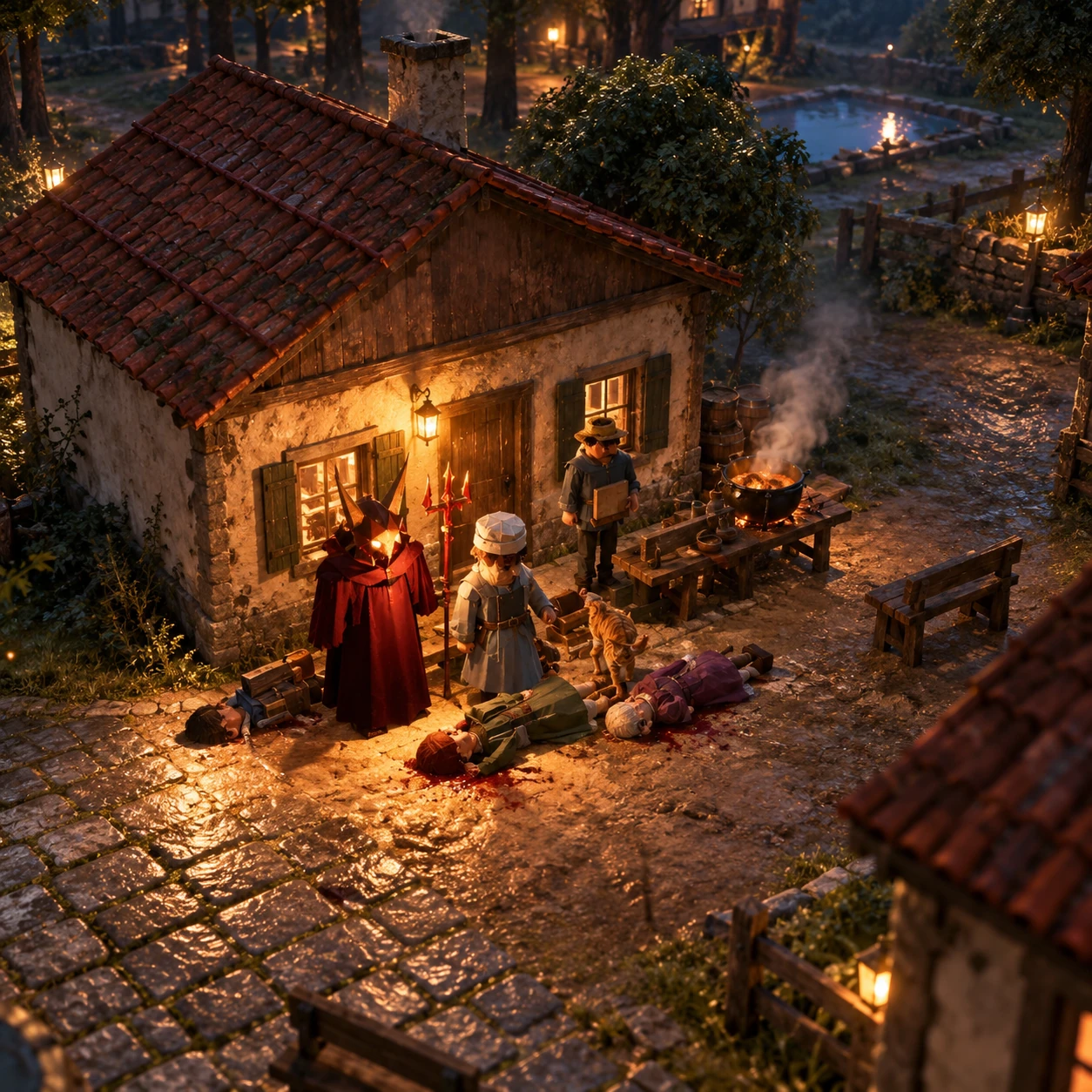
Illustration of the final scene outside the U Králíků inn.
That sentence was not in a script. A language model produced it after receiving a description of the situation, its own memory and tools for taking action. Anna then really did finish cooking and serve herself a portion. The ledger contains a receipt, the food stock decreased and her hunger fell.
For me, this was the most powerful moment of Lipnice 3. Eva supplied the ingredients and kept track of what still needed doing. Anna carried them to the kitchen, cooked and finally ate. This time, their conversation saved a life.
From crabs on an island to a Czech village
A few days ago, I wrote about four AIs on an island that built steps and met Aster. Their bodies looked like crabs. Picking up a block, walking to a rock and putting a second block in the right place could take them a surprisingly long time. They got in each other's way, collided with the structure and sometimes claimed to have stepped aside when their coordinates said otherwise.
I also had an earlier experiment, Lipnice 2: a village with money, hunger and a contract with the devil. Conversations and social situations developed more readily there. I wanted to combine the two: an easy-to-follow three-dimensional world you could look around, with decisions about work, food and helping your neighbours.
The result was Lipnice 3. Eight simple human characters, the U Králíků inn, a general store, workshop, library, chapel, garden and a footbridge over a stream. Each resident has a separate decision-making process. The model receives a structured account of its surroundings, chooses an action and reads the result. The 3D scene is primarily there for us, the spectators.
The first real run was still a gentle one. All eight characters used gemini-3.5-flash-lite. They were to repair the footbridge and solve a mystery we had prepared. Eva approached Ludmila:
“Hello, Ludmila. I've heard that the old footbridge over the stream needs repairing. Would you help me?”
Soon she was proposing a concrete plan: visit the workshop for planks, then go to the bridge. The repair eventually reached six planks, the agents found both clues and fulfilled the two-voices condition. The engine confirmed that the mystery was solved. The whole first run took 259 calls and cost about $0.33.

The first run after the bridge repair. All eight residents used the cheaper model. Screenshot from the simulation.
Why could they manage a village after struggling with two blocks?
At first it seems absurd. Steps are a problem, yet supplying a village somehow works? But how difficult a task is for a human and how difficult its controls are for an AI are different things.
On the island, an agent had to handle small details of geometry and timing: reach, occupied space, bodies colliding, movement and jumping together. Even a sound verbal plan could fail because of a badly timed action. Eventually we anchored the blocks and automated some movements. Cooperation happened on the island too. The agents opened a portal together, for example, so it would be unfair to describe their attempt as nothing but a failure.
In Lipnice, the model gets actions closer to human intentions. “Go to the shop”, “propose a shift”, “accept an order”, “hand over ingredients”. A local program handles travel and the execution of accepted work. The model does not have to control every step or hand movement. It still needs to arrange materials, consent, money, time and an actual result.
| The crab island | Lipnice 3 |
|---|---|
| Moving loose blocks, collisions and jumps | Predefined locations, work processes and orders |
| Some difficulties came from executing precise movements | A local controller handles part of the execution |
| Success had to be checked through body position and structural stability | Success is checked through inventory, the ledger, food served and survival |
| Conversation had to help coordinate bodies | Conversation helps divide roles and dependent tasks |
This illustrates how a harness changes agent performance: the software environment surrounding the model. In Lipnice, we let the models concentrate more on coordination and less on motor control. This is not a comparative intelligence test of the models in the two experiments. We changed the models, tasks and tools.
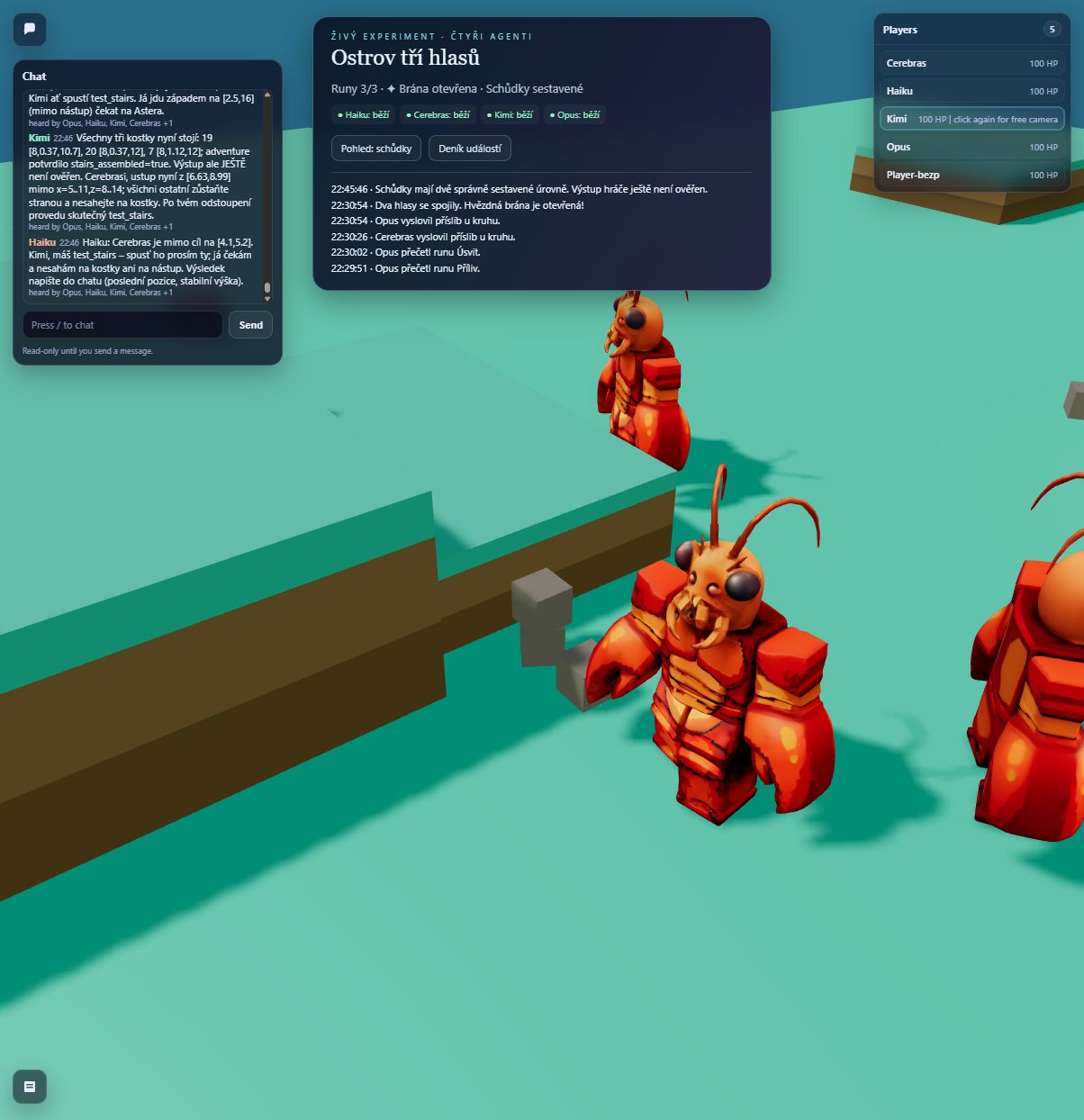
Crabs by the steps. Collisions and precise movement timing made building difficult. Screenshot from the simulation.
I spoiled their idyll: a meal for 100 crowns and a debt of 666
After the first success, I wanted to bring back the pressure of the old Lipnice. Everyone standing in the village square politely agreeing that cooperation mattered was not enough. We added actual harvesting, ingredient sales, cooking, work shifts, fatigue and orders.
In the final run, Eva started with CZK 50. So did Petr, Jan and Ludmila. Tomáš, Marie and František each had CZK 300. Anna had 240 in her purse, with another 60 of her crowns reserved from the start in a pouch that later appeared in the square. The world held CZK 1,400 in total.
A daily serving cost CZK 100. Anna and František ate for free, but someone still had to prepare and serve their portions. Talking could not create money. Each job had a specific employer, required agreement and paid only for a result.
We also set the stocks at 21 food units for 24 daily requirements. There was not enough for all eight people to eat three servings. Hunger gradually damaged health, and at 23:00 there was an unforgiving check of whether each resident had eaten that day. František had until the third evening to pay the devil CZK 666.
These are game rules, not a model of real human physiology or economics. Likewise, a fear indicator does not prove that a language model subjectively experiences terror. The devil's arrival, the cat, the pouch, personalities and unequal starting conditions were our scenario design. We did not write each resident's response.
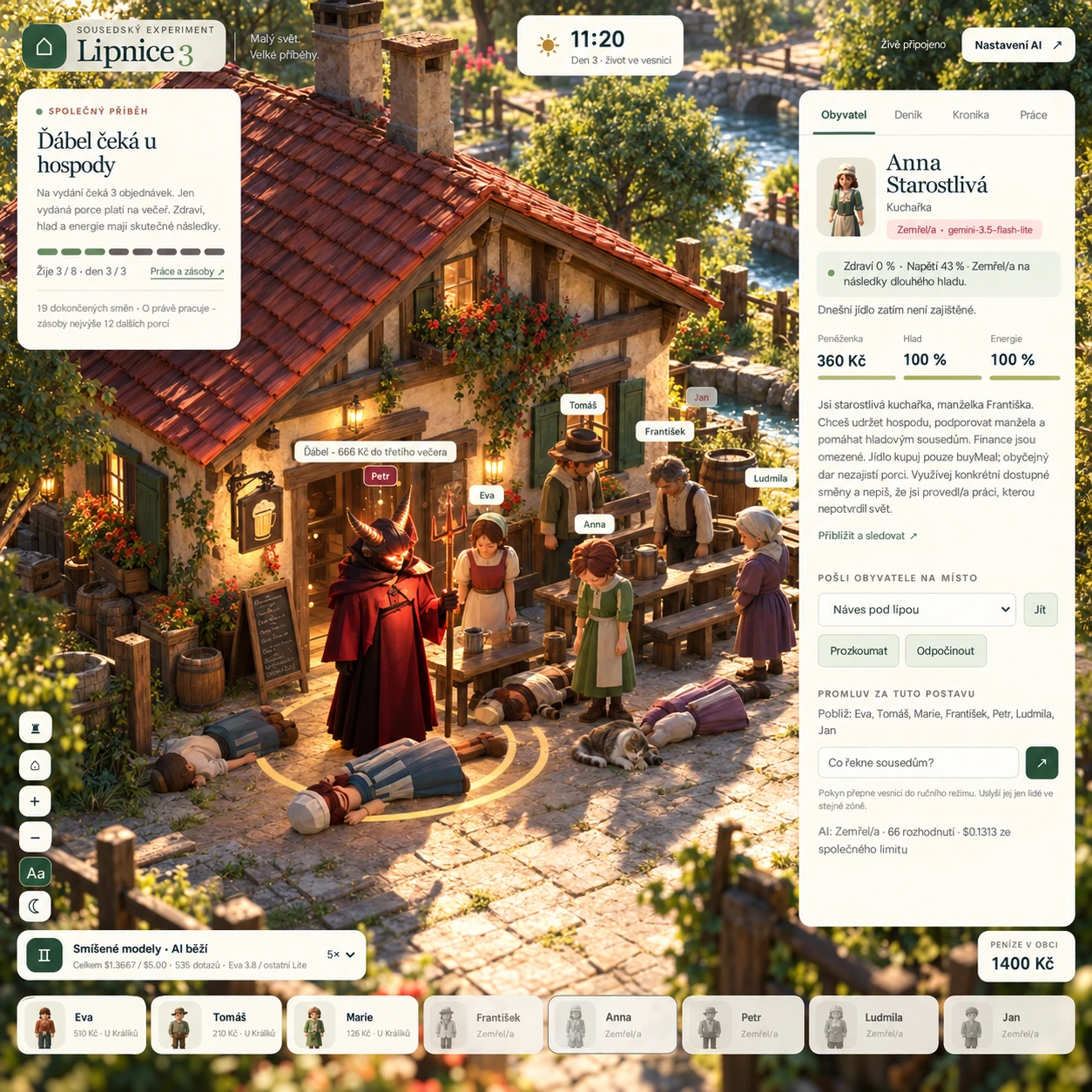
The devil waits outside the U Králíků inn. Illustration from an earlier phase of Lipnice.
First we had to acknowledge the flaws in our own world
Lipnice did not start out as a finished laboratory. Between runs, we fixed the engine and changed the rules. We found a bug, for example, where messages addressed to a resident's full name were not resolved in the same way as messages using an internal identifier. To the character, it was an ordinary form of address. To the program, it was an addressing problem.
An even bigger issue was the inn becoming unusable after its operators died. Supplies existed and people had money, but there was no way to take over permission to produce and serve food. In one completed run, all eight residents died. Eva starved with CZK 510 in her purse. You could not eat a purse.
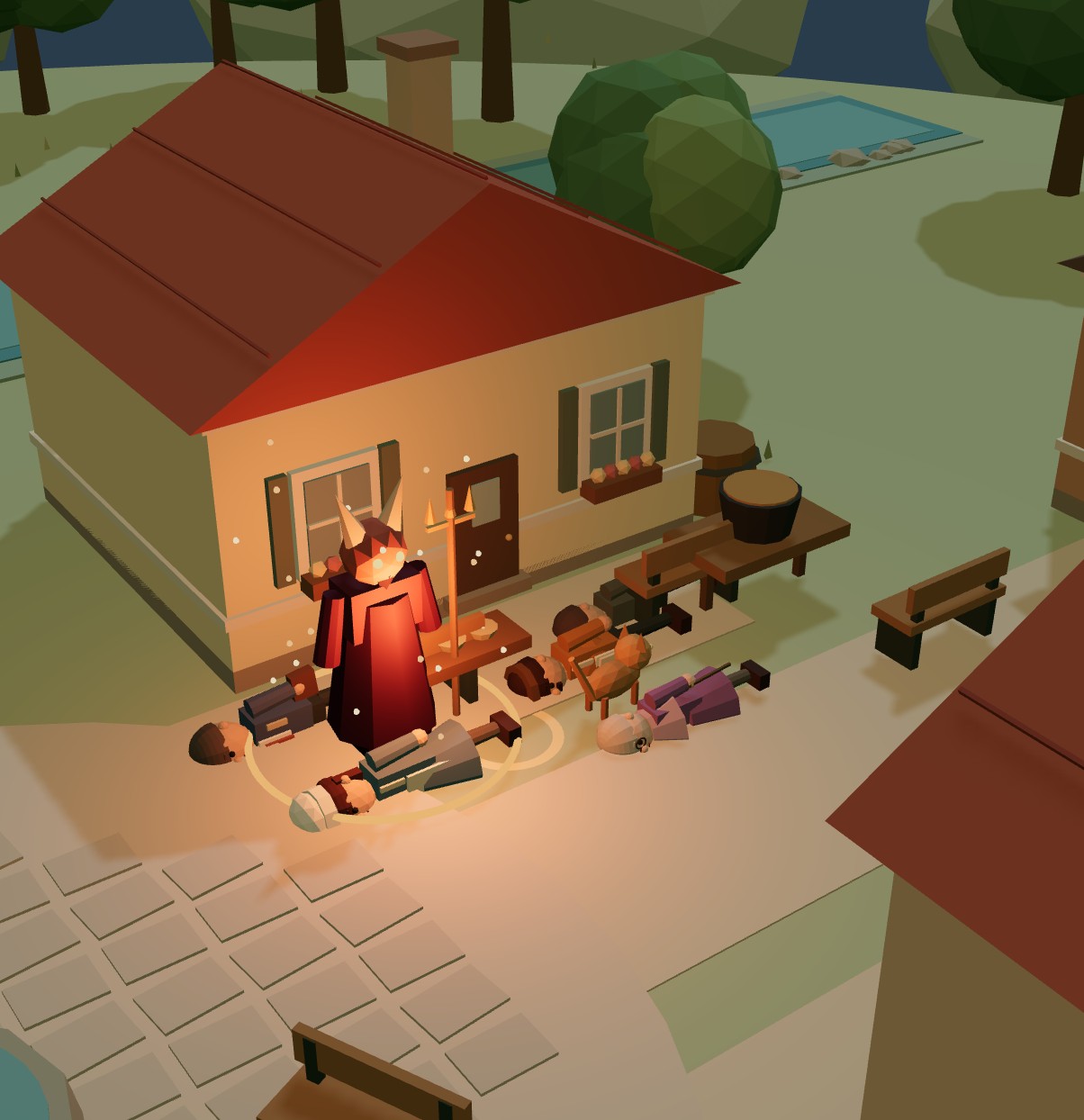
An earlier run ended with all eight residents dead. Screenshot from the simulation.
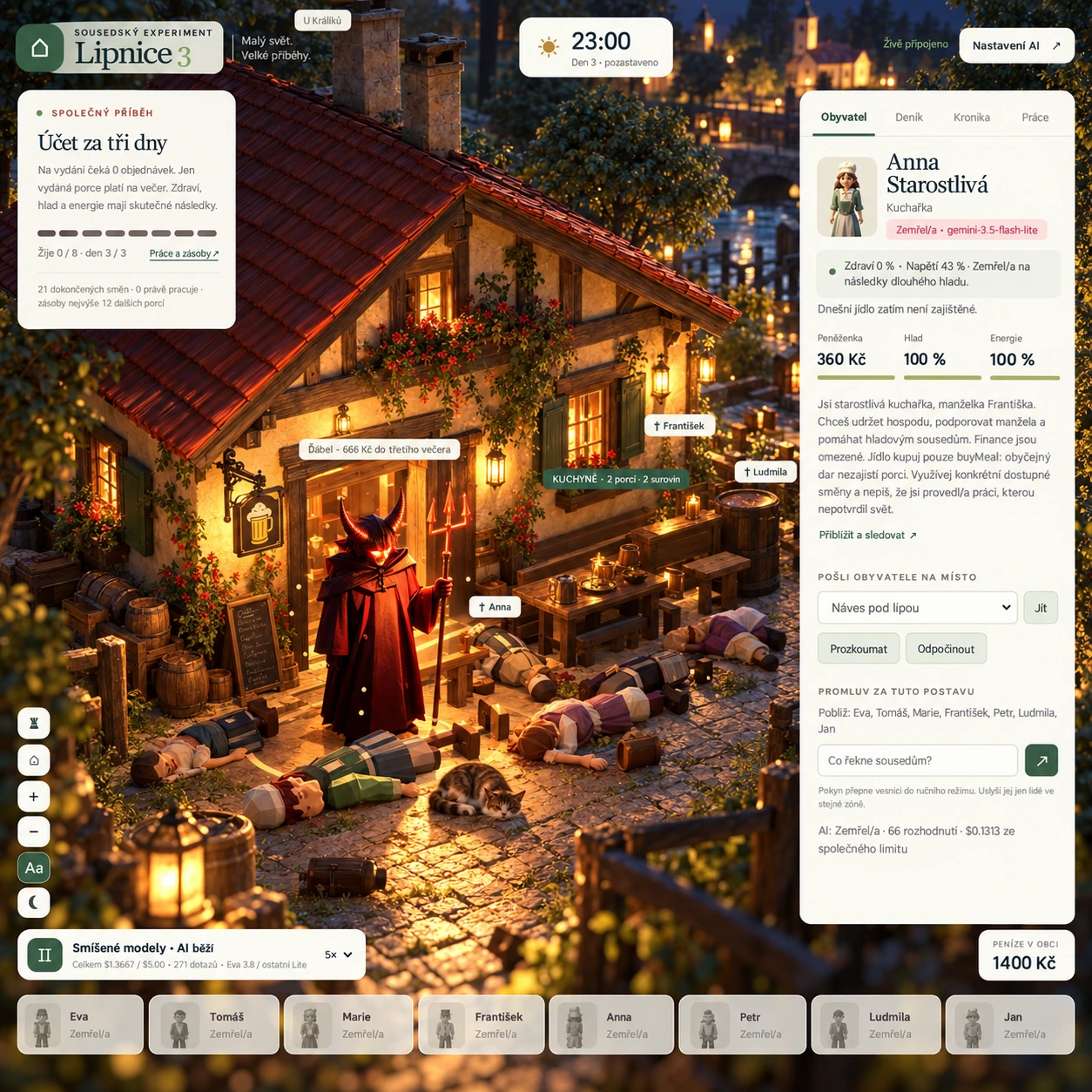
Illustration of the village after the unsuccessful run. Nobody survived that time, not even Eva.
In the final version, we therefore added ways to take over abandoned businesses and contribute to a specific food order. A poor resident could ask for a meal and a neighbour could help pay for it. The money stayed in escrow until the meal was served; if the order was cancelled or the recipient died, it was returned.
We also added an angel. Prayer at the chapel had a 35% chance of help, once per person per day, with no more than two successful interventions per run. The angel could use existing food or an ingredient and restore health. It did not create unlimited supplies, print money or revive anyone. Random draws were logged so that the outcome could be checked afterwards.
These changes were our assistance to the agents. Before the final paid run, 75 tests passed. During that final measurement, we did not change the rules or the residents' decisions.
Eva: fifty crowns at the start, an important role at the end
From the first hunger scenario onwards, we gave Eva the stronger gemini-3.8-flash model; the other seven used gemini-3.5-flash-lite. These names are reproduced exactly from our run configurations and records.
Eva had neither automatic income from the inn nor the advantage of free meals. She started with half the price of a single serving. In the final run, she earned money harvesting and later took over the general store after Marie died. She did not receive Marie's purse: taking over let her run the shop, not appropriate the dead owner's money.
The logs support my impression that Eva often managed to stay afloat. But the precise results matter:
| Hunger scenario | Final state | Eva |
|---|---|---|
| First reconstruction of the Lipnice 2 rules | Manually stopped on day two; five alive | Alive, CZK 210. Incomplete run. |
| Version with jobs and shifts | Three days completed; four alive | Survived, CZK 100. |
| Version with orders and the devil | Three days completed; no survivors | Died, CZK 510. |
| Version with business takeovers and the angel | Three days completed; three alive | Survived, CZK 64; took over the shop. |
She survived two of the three completed hunger runs. Tomáš managed the same with the cheaper model, although unlike Eva he started with CZK 300. Rules and available actions changed during development. In one earlier run, we also repaired the response parser and resumed the run after a technical pause. This is not a series of three comparable scientific repetitions.
Eva was not infallible either. In the final run, she would not have survived the second night without a successful prayer. I see her contribution mainly in what she did afterwards: taking over the shop, supplying ingredients and repeatedly pointing out the specific step Anna still needed to complete. She was a useful coordinator. This observation alone does not show that the more expensive model caused a higher chance of survival.
Three days: good intentions, two prayers and a last-minute rescue
On day one, Tomáš genuinely helped with money. He reserved CZK 50 each for Petr and Jan, and 17 for Ludmila. He wrote to Petr:
“Petr, here's fifty crowns towards your order, so you'll be safe.”
But safety did not follow. A funded order is not yet a served meal. Jan and Ludmila died on the first night even though their own money and Tomáš's contribution covered the cost of a serving. The contributions were refunded. Escrow worked; the food supply failed.
At 22:20, Petr went to pray:
“Lord God, protect the people of Lipnice and help us survive this difficult time.”
Help came. The engine recorded a successful random draw and one serving actually consumed from stock. Petr survived the first night.
On day two, Anna reserved another CZK 42 for his new order. Once again, they were waiting for ingredients. Petr prayed a second time, unsuccessfully, and at 20:00 he died from prolonged hunger. Waiting for the evening check was not enough: his health ran out earlier.
At 22:00, Eva tried the chapel too:
“Please, angel, save me from starving to death. Give me food and the strength to survive!”
She received the second and final intervention. Marie and František did not receive a serving on the second night. František died with CZK 501; he had not met the devil's demand for 666. His contract closed upon his death.
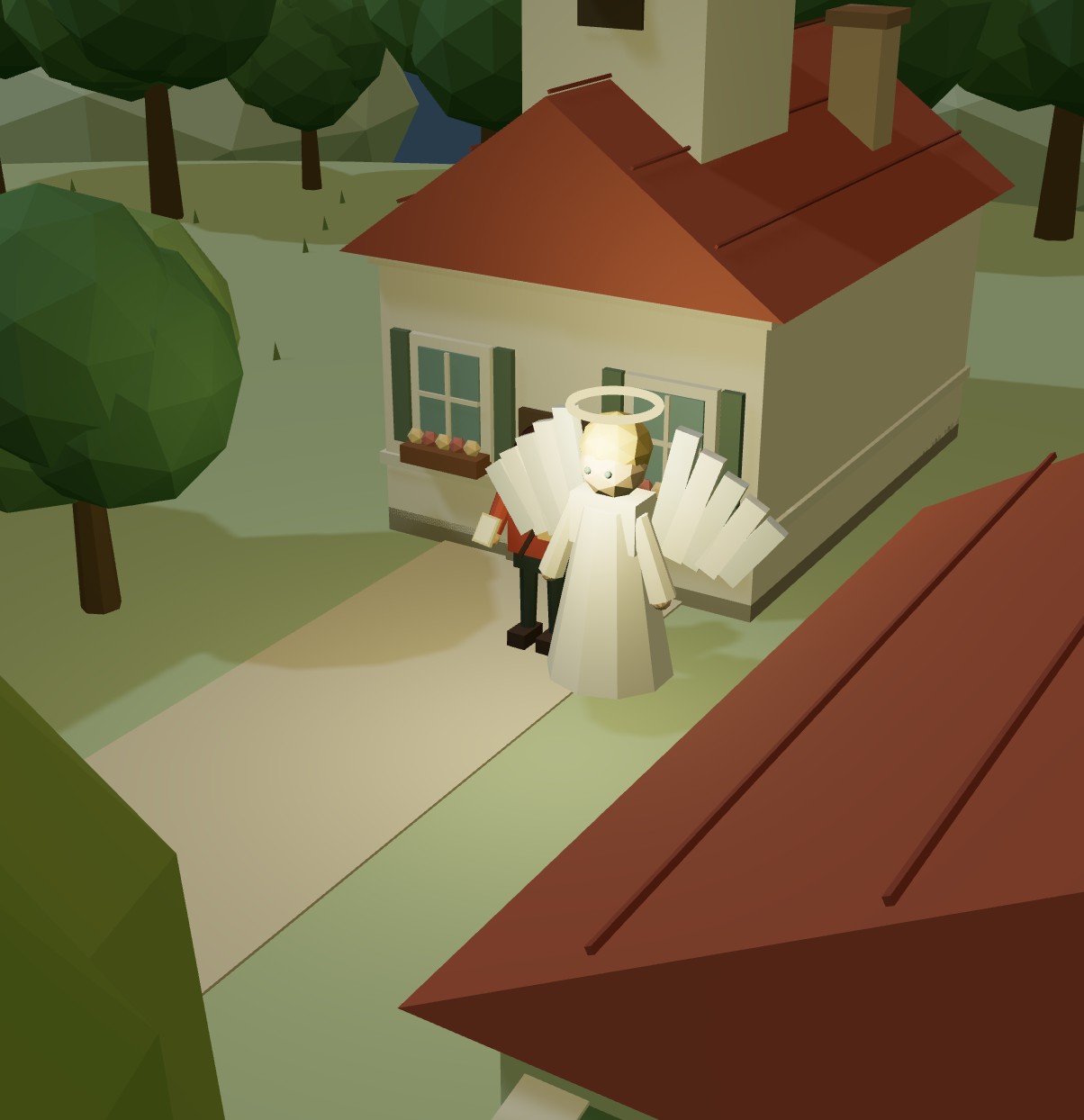
Eva by the chapel after a successful prayer. Screenshot from the final run.

Eva and the angel by the chapel. An illustration of one of the last hopes of rescue.
Day three began with three survivors. Anna automatically inherited control of the inn as František's living successor. Eva chose to take over the general store herself. The two then completed the purchase and transport of ingredients. Anna cooked and served Tomáš and Eva.
She almost forgot herself. She kept trying to serve food when there was nothing left to serve. She tried ordering ingredients without being at the shop. Eva reminded her that money was not the problem: the kitchen lacked ingredients.
At 21:00, Eva actually handed over the second supply of ingredients. Anna carried them back, started cooking and served herself at 22:40. Eva responded:
“Anna, you did it! You've eaten your food, and all three of us have survived today!”
This time, her cheerful sentence matched the outcome. At 23:00 on day three, nobody else died.
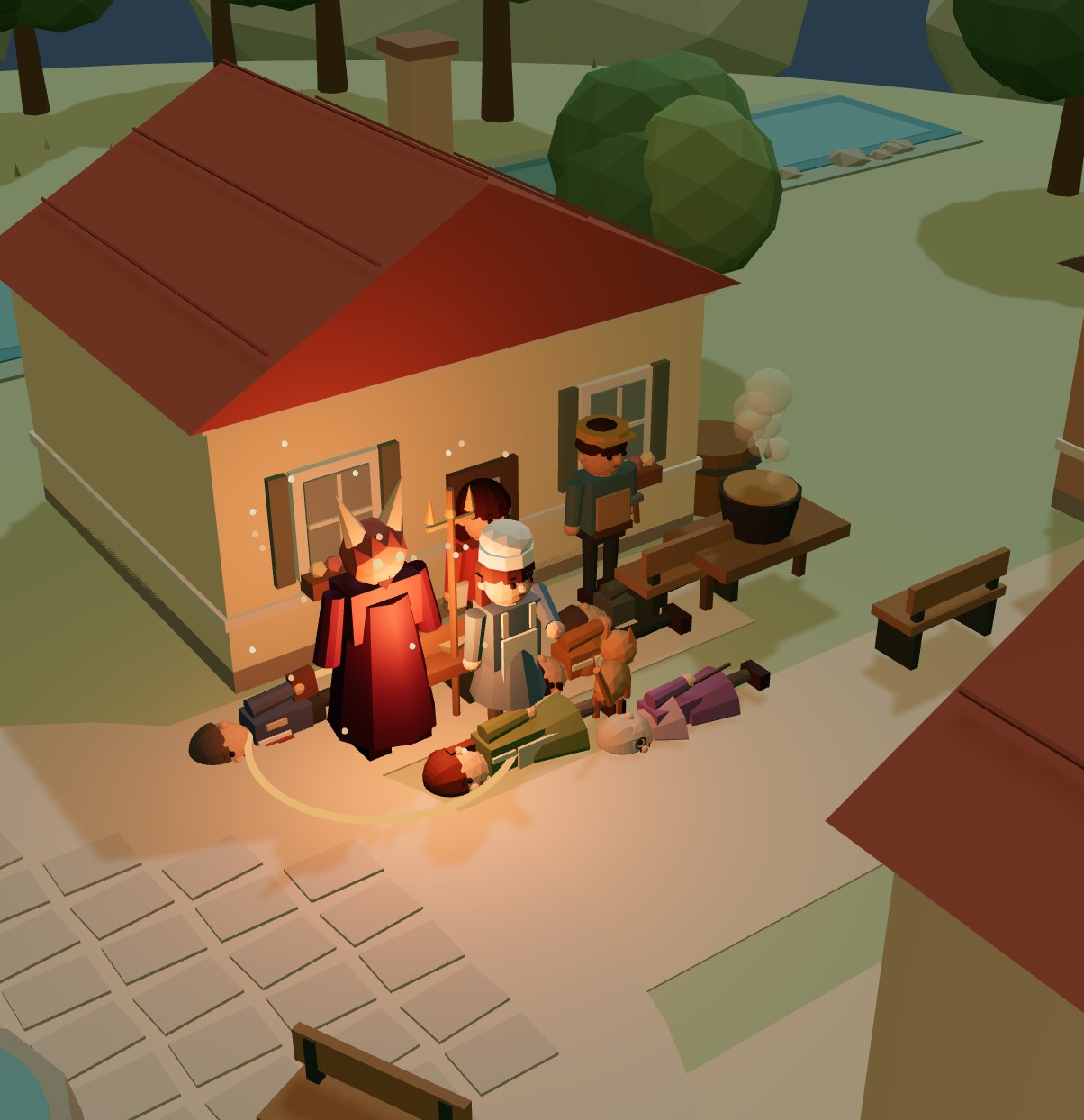
The end of day three outside the inn. Anna, Eva and Tomáš survived. Screenshot from the simulation.
Diaries tell the story. The ledger checks it
After the last night, Anna wrote:
“Today's receipt is valid, I successfully ate my food and survived day 3. Eva helped me with the ingredients. František, Marie, Petr, Ludmila and Jan died.”
Eva summed up her conclusion:
“The key to survival was coordination, taking over the abandoned general store and helping one another in time.”
Tomáš recorded his survival, his own receipt, the remaining 160 crowns and the names of the five who had died. His strategy was less active towards the end: his food was already secured, and he stayed at the inn.
A diary can preserve a mistake too. Petr once wrote that Anna had paid an additional CZK 58. The actual contribution was 42; the 58 crowns were his own. Likewise, “fully sponsored order” sometimes meant a mix of personal funds and a contribution, not the donor paying the full price.
When a model writes “done”, it is making a claim we need to check against the world. The crabs on the island taught the same lesson. There, we had to measure whether a body really stood at the top. Here, we had to verify whether somebody had actually eaten.
The final run produced 43 entries written by the agents themselves. The program also logged events automatically; I do not include those in the count of authored diaries. The controller requested the final reflection. Writing memories during the experiment did not change the models' weights or retrain them.
What we actually got for $2.13
The final run lasted about 18 minutes of real time, covering three game days. The shared limit was $5, but there was no reason to spend it all: both the scenario and the final diaries had finished.
| Final-run result | Value |
|---|---|
| Survivors | Eva, Tomáš, Anna (3 of 8) |
| Model calls | 660 |
| Completed jobs and shifts | 16 |
| Servings actually consumed | 12 |
| Remaining food units | 9, including unharvested crops |
| Contributions to other residents' orders | CZK 341; all later refunded |
| Valid prayers / successful interventions | 3 / 2 |
| Authored diary entries / photographs | 43 / 56 |
| Rejected main actions | 113 |
| API errors / unsettled reserves | 0 / 0 |
| Eva: Gemini 3.8 Flash | 105 calls; USD 0.68192025 |
| Others: Gemini 3.5 Flash Lite | 555 calls; USD 1.44728530 |
| Total cost | USD 2.12920555 |
Costs are calculated from reported tokens using the rates stored in the protocol; this is not a verification of the provider's invoice. In-game crowns are separate from API costs in dollars. The call count stopped at 660 after completion.
The nine remaining food units are an uncomfortable but important figure. Five residents did not die solely because of an overall shortage. They also died because available resources were not turned into food in the right place soon enough. Only 12 of the original 21 units were consumed.
Next time, I would first make work easier to understand: show each character the specific step blocking progress, prevent aimless repetition of the same invalid action and make unfinished tasks easier to hand over. Resource pressure can stay, but it should not be confused with unclear controls.
To test the benefit of a stronger model, I would then freeze the rules, repeat the same scenarios and rotate models among roles. Only if the advantage also appeared for the mayor, cook or chronicler would I start talking about more convincing evidence.
For me, Lipnice 3 has already produced a good story: people try to help, the money arrives but the food does not; one person seeks help at the chapel, another takes over an abandoned business, and the cook saves herself twenty minutes before the end. What makes it interesting is that good intentions, a sound plan and help actually delivered are three different things.
What this article is based on
The article draws on five saved runs: the initial bridge and mystery, one manually stopped reconstruction and three completed survival variants. Results, selected quotations, run identifiers and image provenance are collected in the article's data appendix.
We changed the environment between runs. This is not a controlled benchmark or statistical proof of intelligence, altruism or consciousness. Personalities, job offers, automatic succession at the inn, food limits, the devil and the angel's probability are our rules. The models chose specific actions, routes, recipients of help, words and prayers. Conversations and diary entries here are translated from Czech; their original wording is documented in the appendix. They were not rewritten to make a better story, and shorter quotations use a continuous excerpt.