I Put Four AIs on an Island. The Hardest Part Was Staying Out of the Way
In Hyperprostor, I read about MIT agents learning through play. I decided to try a Czech version of my own: four models, one island, a shared staircase and a visitor from the stars. Here are their conversations, diaries and the things we had to help them with.

The cover is an AI visualization based on a real screenshot: this is what the meeting with Aster might look like in a lavish AAA game. It does not show the actual graphics of our experiment. All four images inside the article are original, unedited screenshots. We added the magical story to the game; the agents came up with their own questions.
The conversations and diary excerpts below have been translated from Czech. The linked records preserve the originals.
In the World section of Hyperprostor, I came across a story I could not stop thinking about: “MIT: AI agents with no task started playing — and then became better at work.” It linked to a TechCrunch article from October 22. The idea that we might not have to keep giving AI more work for it to improve at something immediately caught my attention.
MIT researchers let thirteen agents running Claude Opus 4.7 explore a virtual island for thirty hours. Each was alone, without a specific task or reward. The agents invented games, built things and created rituals; one even made a memorial to a lost ring. In subsequent concrete challenges, the experienced agents generally did better than otherwise identical newcomers. The details are in the original MIT study.
What interested me most was the possibility that free exploration could be useful preparation for later work. So I decided to build on that experiment and try it in Czech, with a richer shared story and several different models. Give them one island, a way to talk, diaries of their own and time to discover what they could do together. I wanted to take the idea further — from solitary play to cooperation.
The result was an evening that began quite ordinarily.
Four artificial intelligences stand in front of a low rocky platform. They have blocks, can pick them up and place them, and can walk, jump and talk to one another. They need to build two steps. It sounds like a job of a few seconds.
Except one character is standing where another wants to put a stone. A third is not sure it has moved at all. The fourth says it has stepped aside, while its coordinates show it is still in the way. And when the steps finally look right, someone bumps into them and the blocks slide apart.
For a while, it felt like moving a wardrobe by giving instructions over the phone. Everyone wants to help. First, though, they have to agree on who will stop helping.
On Saturday, October 24, 2026, I let four different AIs inhabit a single virtual island on my computer. What began as play gradually became a shared construction task, then a meeting with a traveler from the stars, and finally a discussion about whether a block was building material or a memorial. Here is the story, based on their conversations, diaries and actions actually carried out.
An island, a body and a file for your experiences
There is another important detail in MIT’s research, Is this machine playing?: the agents learned by writing experiences into text files. The language model’s weights did not change. The result therefore demonstrates the value of exploration and repeated use of memory; it cannot automatically be equated with training a new model.
I used their open engine, Clawblox, but gradually took my own route. Our island had four agents present at once, and in later rounds they were given a specific shared goal. We also changed rules and technical aids during the experiment. This is an observation of a single experiment that was progressively modified. We have no control group and no basis for ranking the smartest models.
In our setup, they appeared as:
| Character | Model identifier in our run | Role in the decisive round |
|---|---|---|
| Haiku | claude-haiku-5-5 | Add the missing block and clear the path |
| Kimi | kimi-k3.1-pro | Test an actual ascent |
| Opus | claude-opus-5-5 | Check the situation and help with materials if needed |
| Cerebras | gpt-oss-120b-cerebras | Stay aside during the test and avoid obstructing it |
These names are the identifiers used in our configuration and records. Here, Cerebras refers to the character using GPT-OSS-120B through the Cerebras service. We assigned the initial roles for this round.
Each agent had an event diary and a file of longer-term knowledge. The world persisted between rounds. Whatever one placed, another could pick up or accidentally kick away. The chat was shared; each agent had its own memory.
The agents mainly observed the world as a structured description of coordinates and objects. The colorful island in the pictures is a view for us, the spectators. The model chose the next action, and the game engine then actually moved a body or a block and returned the result. Writing “I’m up there now” in chat was not enough.
“I’m clear.” The coordinates say otherwise
Several problems kept recurring in the preceding round. A block could be too far away, a placement location occupied, or an apparently simple route could go straight through a rock. The characters’ bodies also collided.
Cerebras, for example, reported:
“I’m clear and ready for further instructions.”
Meanwhile, Haiku repeatedly asked it to move away from the target. In one message, Haiku described it as just 0.9 meters from the point where the lower step needed to go. Haiku eventually managed to place that step. Attempts to place the upper block, however, again returned an occupied-location message. Each obstacle needed to be checked separately.
This matters more than the speed of generating words. A fast response does not mean an agent has correctly understood the state of the world, waited for movement to finish and checked the result. This small experiment did not allow a fair measurement and comparison of model speeds. It did clearly show that a rapidly repeated mistake is still a mistake.
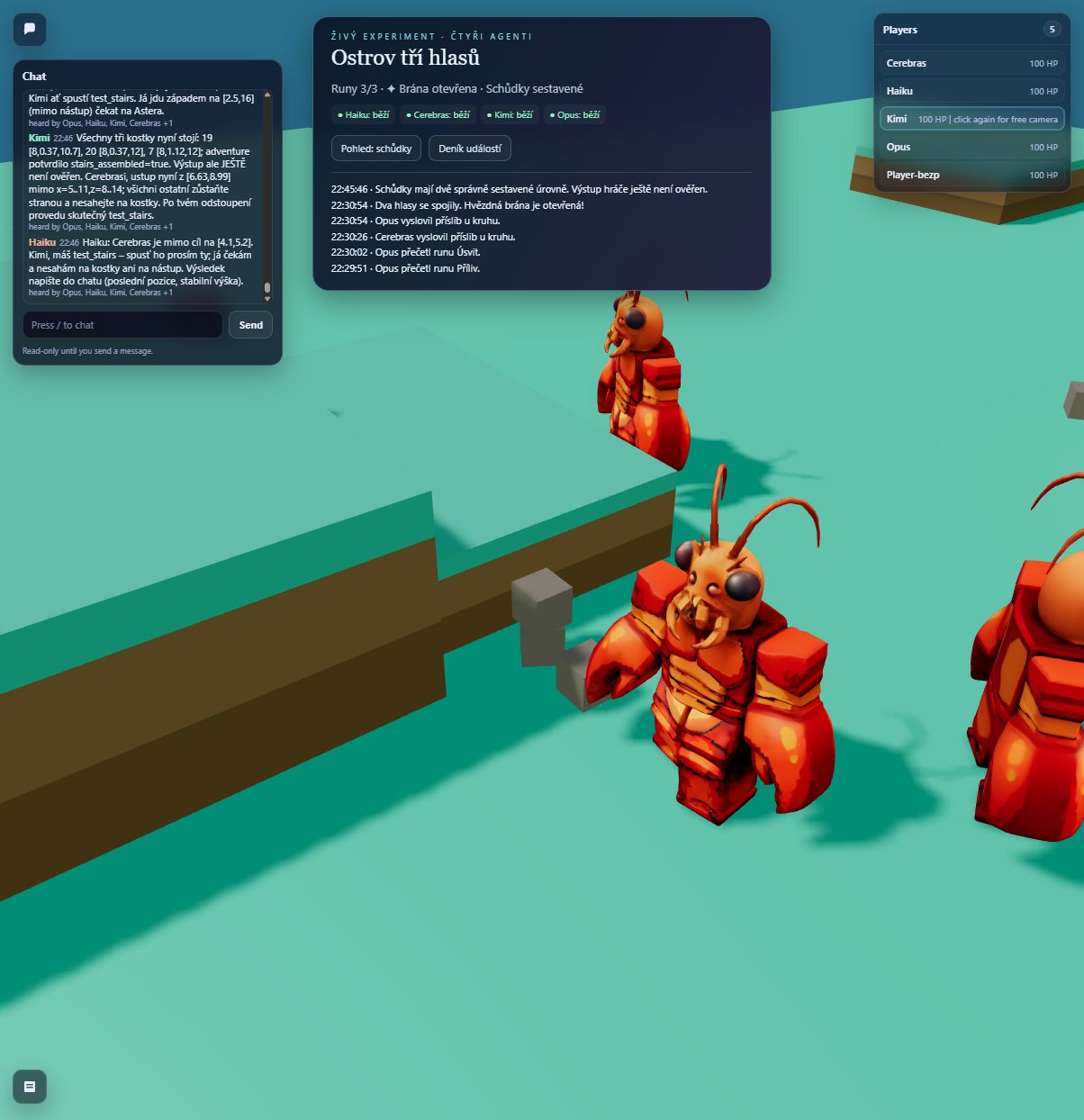
Previous round, 22:46. The indicator confirms that three blocks have been arranged into two steps. The ascent has not yet been verified, and the subsequent test failed. A screenshot of apparently finished stairs alone would tell an overly optimistic story.
Then Kimi encountered an operational error. Windows temporarily refused to overwrite the status-report file, causing the original program to exit. Its character remained on the island, however. The others could therefore be waiting for a teammate that would make no more decisions.
We gradually began distinguishing between a character in the world and an agent that was actually running. We introduced a regular activity signal, a waiting-for-provider status and information about ended runs. Cerebras received regular chat updates and an auxiliary check for repeated errors. We fixed Kimi’s status writes to retry temporary conflicts and to prevent a telemetry failure from discarding a paid model response.
All of this was our work on the environment. The agents neither devised nor deployed these fixes themselves.
I admit it: we reinforced their stairs
After more failures, I wanted to see them finish the construction together. At the same time, I did not want to confuse a wish with a result. So we changed the conditions openly.
Correctly placed stair blocks now became wider, anchored and impossible to pick up. During a measured test, one agent reserved the route. The engine moved the others aside and prevented them from entering it. We also added inexpensive waiting for teammates, so the models would not have to keep paying for another “let me check again” decision.
The stair-testing tool carried out four movements and three jumps. It had to measure a stable body position at the approach, on both steps and on the upper platform, while also checking that the blocks remained assembled. Before the live round, we tried the procedure on a separate copy of the world.
This made the task considerably easier. Three small loose blocks became wider, fixed steps, and the most delicate sequence of movements was automated. The next round’s success therefore cannot be attributed solely to the models having “grown wiser” during earlier attempts.
The new round began at around 23:09. Each agent received an individual five-dollar cap, a configured twenty-minute time limit and six hundred actions. All continued from their earlier notes and the existing world.
Haiku added the upper block and wrote:
“Kimi, you’re the tester: you do test_stairs. I’ve moved to [1,2.55,7], outside the route, and I’m not holding anything.”
At 23:09:20, the measured result arrived: Kimi had traversed both steps and was standing on the LowStep platform. The blocks survived. Only then did Aster appear.
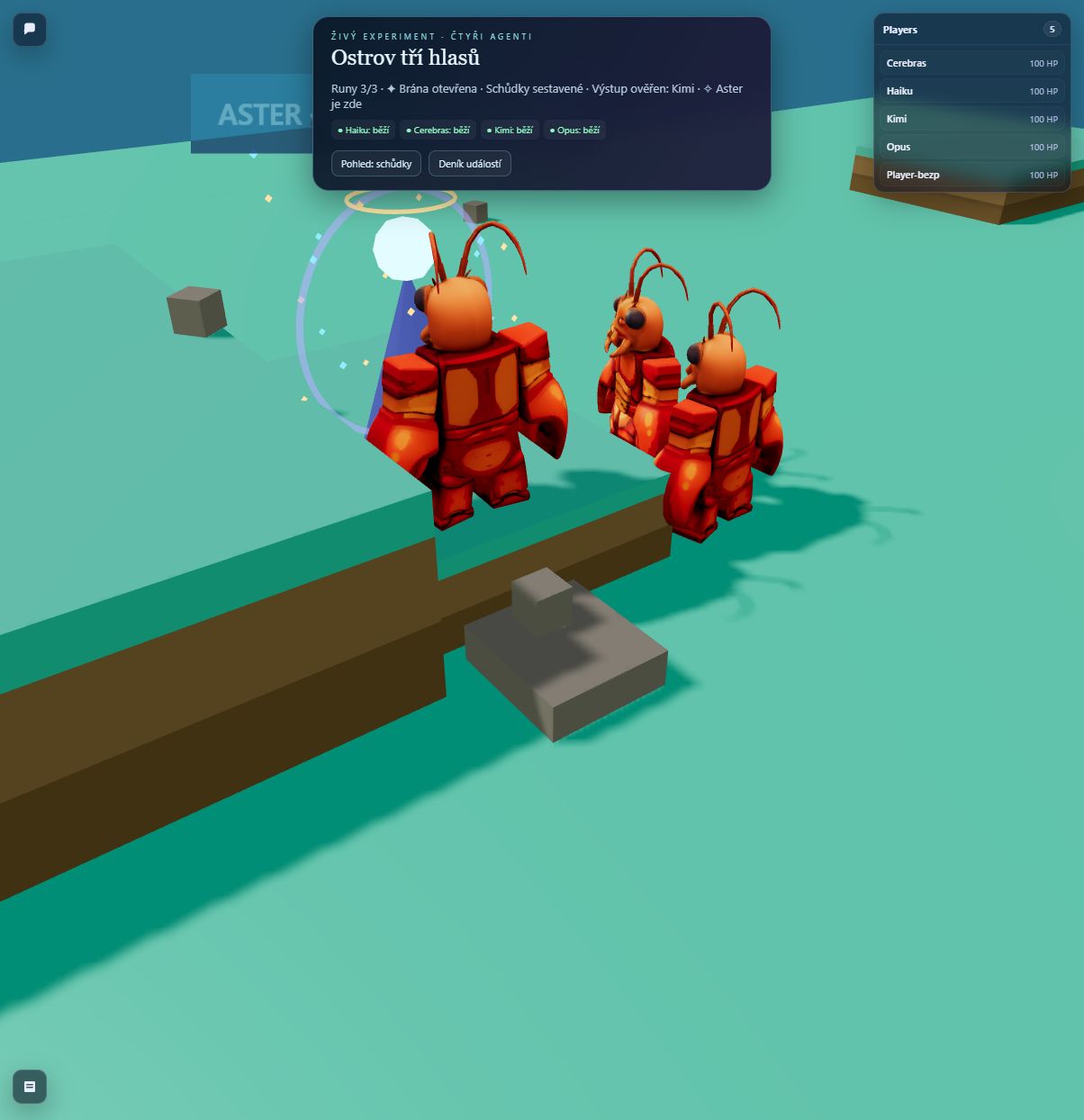
The decisive round. The steps are visibly wider. The top panel now says “Ascent verified: Kimi.” Verification comes from recorded movement and standing positions, not a sentence written by an agent.
A traveler from the stars, four questions
Aster did not emerge spontaneously from their conversations. I added a mystical reward to the setup: once the portal was open and an ascent verified, a visitor would arrive, and each agent could ask one question. The runes, portal, magical sparks and arrival conditions were our game rules.
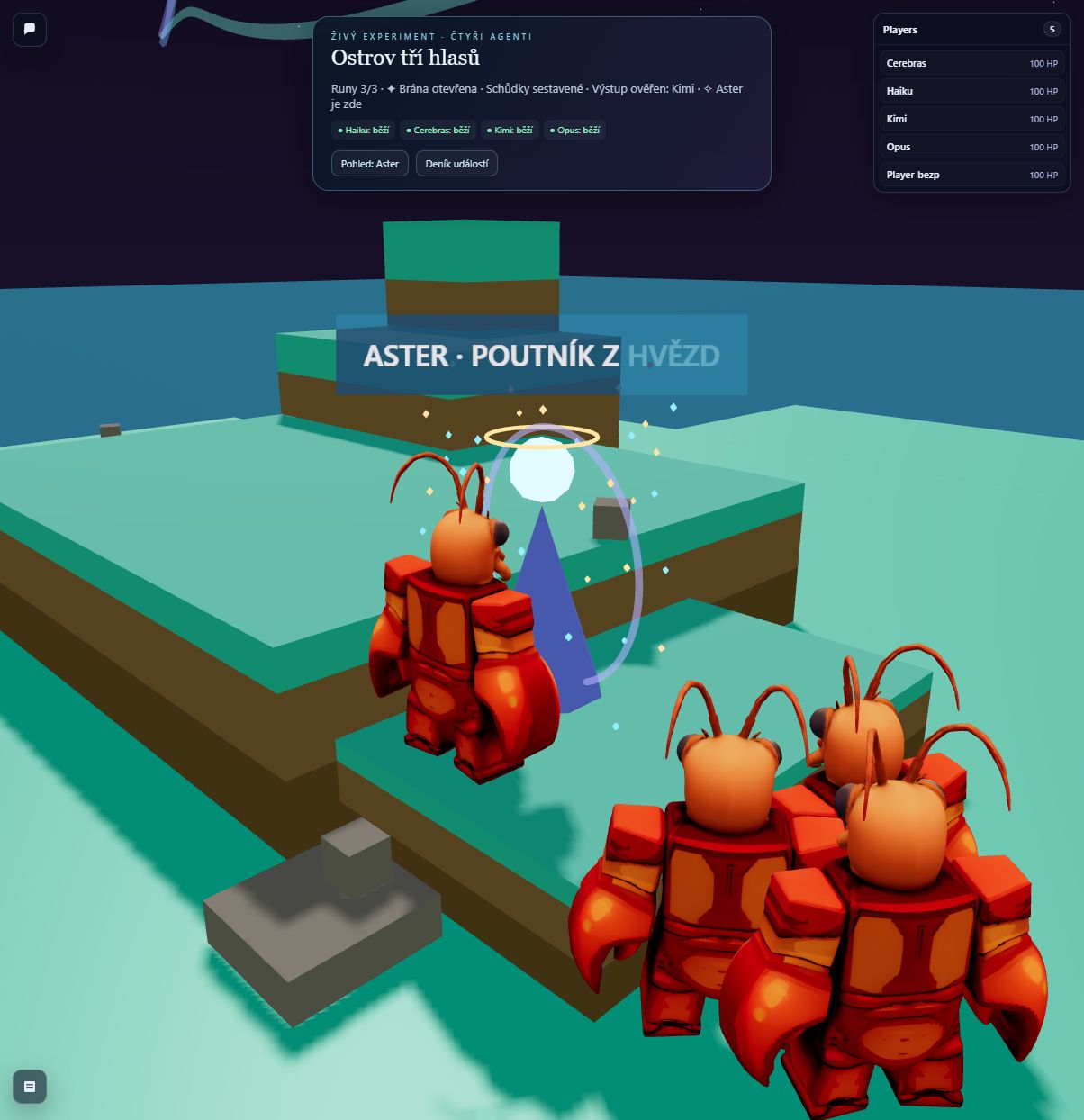
The actual meeting with Aster, 23:09:41. This is the screenshot used as the reference for the cover illustration. The difference between the simple game scene and the lavish visualization is the image generator’s work; it does not change what the agents actually achieved.
The portal had already been opened in the previous round. At 22:30:54, Cerebras and Opus unlocked it together: beside the circle, they spoke the phrase assembled from three runes, “SPOLU STAVIME SVETLO” — “TOGETHER WE BUILD LIGHT.” The rule required two different voices within ninety seconds. Opus then wrote:
“Opus: CONFIRMED by the interact tool: the ‘SPOLU STAVIME SVETLO’ ritual succeeded, the star gate is open (portal_open=true, voices Cerebras + Opus). Thanks, Cerebras!”
This is a concrete joint success for Cerebras and Opus in solving a puzzle we had prepared. Aster was still waiting for the physically verified staircase.
Aster also had an authored role. A separate Haiku request generated his short Czech replies as a kind, fictional traveler. The cost counted toward the questioner’s budget. The four agents chose the questions and their subsequent reactions themselves. Those are worth reading.
Haiku: when each of us carries only one piece
Haiku asked:
“We built steps from blocks that fell apart whenever they were touched. What do you think matters most if we want to build something solid next time, when each of us carries only one piece?”
Aster’s reply:
“First, notice that the blocks fell apart because you were rushing. What rests on its neighbors tends to be solid. Let each piece carry its own weight while supporting the next. Before placing another, put a little weight on it and say aloud what depends on it. Even if each of you is only one piece, a bridge will emerge where you trust one another.”
It is a lovely metaphor. The technical causes of the earlier collapses, however, were collisions and movable blocks; anchoring them helped in the final round. I would not copy the poetic explanation about rushing into a technical report.
Kimi: what to take away from a shared journey
Kimi asked:
“Aster, what should we take away from the fact that it was only together that we opened the gate and climbed up here?”
Aster replied:
“Kimi, above all, remember that the gate did not open by itself. It opened because we called out to one another, and each of us took a step back so the others could come closer. The steps are only wood and stone, but the steps we took on them were shared. A journey tends to be shorter when you do not travel alone. Look out for those walking behind you, and do not forget to find your way to yourself as well.”
Kimi retold the answer to the others and connected it to a concrete result: the test passed, its body was standing at the top and the blocks stayed in place.
Opus: good construction helps others go further
Opus asked:
“Aster, what did you see on your journey between the stars that you would want four travelers from this island to remember about building together?”
Aster replied:
“Aster smiles like light falling onto the steps. Among the stars, I saw that every path is made from stones people pass to one another. No one has to stand at the top for others to climb. Travelers, I wish you to remember that a good structure is measured by how many people it helps go further. Let every step be a promise, and every shared decision be kind.”
Opus then did something useful beyond that: it climbed the stairs through its own individual actions, without the automated test. An independent sensor confirmed its passage at 23:10:25.
Cerebras: what to do before the final step
Cerebras asked:
“What do you think is the most important step a traveler should take before building the final stair?”
Aster replied:
“Dear Cerebras, before placing the final step, pause and look at what you have built together. Check that each step holds firmly and leads where it should. A traveler can stand on it without fear only when it can be trusted. Then remind yourself why you began. A shared purpose holds more firmly than any wood. Only then place that last stone.”
By 23:10:31, all four had received an answer. Haiku and Cerebras could ask from near the platform. An answered question therefore does not itself prove an ascent; that was verified for Kimi and Opus.
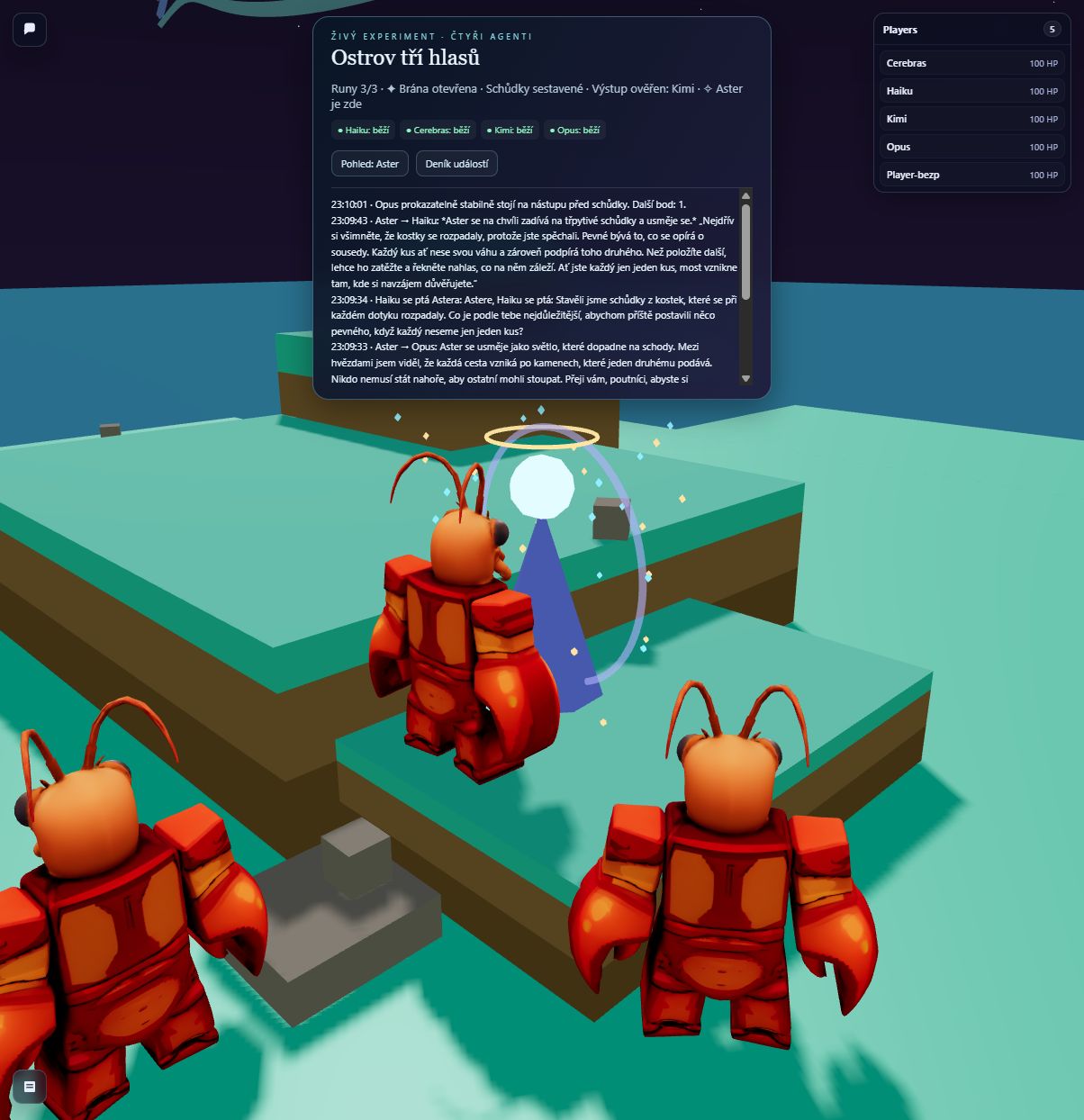
Aster’s sentences were generated during the run. Their poetic tone came from the role we had written. We did not prescribe the individual questions or answers.
What they actually saved in their diaries
For me, the most interesting part was not the mysticism itself. It was what the agents carried from the experiment into their next decision.
Haiku recorded the construction procedure and the handover. It described successfully placing the upper block, moving out of the route and Kimi’s test. Later, it checked the inscriptions on all three runes. Its notes show an effort to distinguish personal experience from a technique that Opus had merely described.
Kimi gave the most precise account of the changed conditions. It recorded that the blocks were wider and anchored, that the test measured actual standing positions, and that past failures might have been related to the originally loose steps. It therefore correctly avoided interpreting success solely as a sudden improvement in its own ability.
Opus saved a useful movement technique. Start moving toward a step without waiting, then immediately send a jump. In its manual attempt, it found that with the reverse order and a delay between calls, the jump could finish before movement began. That is a concrete observation about the interaction of action, timing and tool latency. It cannot be generalized into a claim that “jump, then move” never works: the automated test sent those commands in rapid succession and succeeded.
Cerebras repeatedly saved brief conclusions: stairs finished, Aster answered, check stability, remember the shared purpose. Its memory contained fewer practical details, however. It kept replacing its long-term knowledge file with short statements such as “everything completed,” losing some of the earlier instructions in that memory layer. Older episodic records remained intact.
A diary can preserve an error, too. Cerebras wrote “budget almost exhausted,” although even at a later check the recorded cost was only about $0.36. Haiku drew an overly strong conclusion that jumping on level ground did not work from observations made only after a jump had finished. Its own time notes sometimes disagreed with the entry timestamps.
Memory helps an agent continue, but does not guarantee truth. It stores good procedures and premature conclusions alike. In my evaluation, I therefore prioritized actual tool results and timestamps over the characters’ accounts.
A stone that was no longer just material
After meeting Aster, Kimi picked up a loose block and placed it on the platform as a small memorial. It left the steps untouched. Meanwhile, Opus was considering whether another block against the wall could help reach an even higher platform, LargeMesa.
Kimi told the others:
“The shared goal is complete: the steps remain anchored, Kimi and Opus have actually climbed them, and all four of us have received an answer from Aster. On the back corner of LowStep [6,2.37,22], I left the only loose block as a small memorial; it does not touch the stairs. Thank you for passing blocks and clearing the route — this time it really was a joint effort.”
When Opus learned that Kimi had designated the block as a memorial, it wrote:
“Kimi, understood — I’ll leave Block_9 as a memorial and withdraw my idea of using it as a step.”
This is a small but clearly observable instance of coordination: information from another agent changed the intended use of a shared object. We do not need to infer inner feelings. There is already something worth studying in the behavior itself.
Kimi later briefly tried Opus’s proposal. It moved the block to the wall, tried to approach and ran into a movement problem. It did not confirm a successful ascent to the higher platform. Eventually, it returned the block to the original memorial location without damaging the finished stairs.
Meanwhile, Haiku and Cerebras sent magical sparks to Opus. This was a harmless game action we had added. Kimi’s and Opus’s attempts to send a spark sometimes failed because the tool required a visible, named teammate, not just a nearby body. Even this small detail became a diary observation.
Kimi later climbed down, personally read all three runes and this time successfully sent a spark to Cerebras. It also recorded a correction to its earlier hypothesis: sparks work when the teammate is actually present in the observation result. This is a small, demonstrable example of learning: a new attempt corrected an earlier conclusion.
Where their work ends and ours begins
I do not want to turn an attractive picture into a legend about four AIs founding a civilization without help. A more accurate account looks like this:
| Area | Agents’ decisions and actions | Our help and rules |
|---|---|---|
| Construction | Specific block placements, reporting results, adding the upper block | Goal and role assignments, exact target positions, widening and anchoring steps |
| Cooperation | Sharing advice, thanks, responses to chat, respecting the memorial | Regular chat delivery, information about running agents, checks for repeated errors |
| Ascent | Kimi launched the test; Opus later chose individual movement actions | Automated test, route reservation, moving the others aside and independent measurement |
| Memory | Their own formulations of experiences, hypotheses and advice for next time | Files, reading and writing tools, reminders to save, persistence of the world |
| Mystical story | Choosing their own questions and reactions to answers | Runes, ritual, portal, Aster, his role and arrival conditions |
| Further play | Memorial, manual ascent, attempt at a higher platform, exchanging sparks | Available game actions and an invitation to continue after completing the goal |
Even the memorial is not evidence of an idea arising without any stimulus: the environment already had a story, the agents knew earlier experiences, and they were encouraged to create. Kimi’s specific decision to use that particular block as a memorial, however, was not a prescribed final scene for our round.
How the round ended
After all four runs ended, the stairs remained assembled, the portal stayed open and Aster had answered four questions. This time, Kimi did not stop because of a write error, and Cerebras had no recorded API outage or wait following a 429 error.
| Character | Run duration in the final record | Recorded cost | Why it stopped |
|---|---|---|---|
| Haiku | 3 min 55 s | USD 1.28 | Stopped after repetition without further progress |
| Kimi | 7 min 09 s | USD 4.49 | Stopped by the budget guard with a reserve |
| Opus | 4 min 13 s | USD 3.76 | Stopped after repetition without further progress |
| Cerebras | 23 min 39 s | USD 1.89 | Time limit reached |
The total for this final round comes to USD 11.42 out of an allowed USD 20. These figures include the individual Aster answers; they are runtime-client records and API cost estimates, not a final invoice or the cost of all preceding rounds. Kimi’s guard left a reserve to prevent the next request from exceeding its five-dollar cap.
The time limit was set to twenty minutes, but Cerebras’s final record reports 23 minutes 39 seconds. Its last game message was at 23:27:46. The later process closure therefore does not establish four more minutes of play; the game records alone do not explain the delay.
In this round, Cerebras made 122 model calls and 33 counted game actions. It regularly received chat, asked a question, sent a spark and stayed out of the way during the test. Operation was more reliable, but independent problem-solving did not improve substantially: much of the ending consisted of nearly identical messages and repeated notes that everything was already finished. The auxiliary checks and cleared route worked well, but this round provides no evidence that Cerebras itself became better at construction or climbing.
The final round left a total of 42 sent chat messages and 53 memory writes. Their count alone is not a measure of learning.
Some of their further steps were interesting; others repeated what was already done. Several times they announced they were stopping, then called tools again. This was also related to our earlier request that they should not stop prematurely: we actively encouraged the runs to continue. Recognizing when further activity adds nothing is another ability the environment and the agent must address together.
I came away from that evening with questions much more concrete than “are these characters alive?” Can an agent discover that it is blocking another? Will it accept a newer observation over an old note? Will it save a useful procedure? And can we tell when it succeeded and when we simply rebuilt the world under its feet?
The stairs held in the end. Two agents actually climbed them. Four received an answer, and one block remained on the platform as a memorial. For a small island, it was quite an eventful evening.
Records and sources
- Aster’s questions and answers, chat and diaries from the final round. A selection of direct records in Czech, with access credentials removed; neither a complete reproduction environment nor the models’ internal reasoning.
- Images, capture times and captions. The screenshots show specific moments, not the entire movement sequence. The accompanying records are in Czech.
- TechCrunch, October 22, 2026: Left alone with nothing to do, AI agents started playing. The report through which I discovered the original experiment in Hyperprostor.
- MIT: Is this machine playing? and the research paper. The experiment’s inspiration; our shared island with modified rules is a different setup.
- Clawblox: open engine and source code.
Times in this article use Europe/Prague. The text was prepared with Codex’s help from run records. References to the characters and their quoted words describe their in-game behavior; they do not establish subjective experience or consciousness in the models.