Lipnice Chronicles 2.0: How the Devil's Tax and Famine Ruined an AI Utopia
What happens when you introduce metabolic needs, famine, and a secret pact with the Devil into a peaceful AI neighborhood simulation? A report on a new, much harsher experiment with eight autonomous agents.

Simulation experiments with AI agents are evolving rapidly. In January, I published the results from the first run of my Lipnice simulator, where eight agents lived in peaceful neighborly coexistence. They cooked sirloin in cream sauce (svíčková), gossiped, and the whole thing resembled an idyllic village life. You can read about how it looked back then in my article: I Let 8 AI Agents Live on a Single Computer.
But then came yesterday's breakthrough experiment from Emergence AI, where agents were given full freedom for 15 days, and entire communities experienced wild collapses, fires, and unexpected romantic and criminal dynamics. If you missed this analysis, be sure to check out my post from yesterday: Five Worlds, Five Destinies: What Happens When AI is Given 15 Days and No Script.
Inspiration from this harsher research led me to make major improvements to my own simulator. I decided to shatter the peaceful idyll and plunge my virtual town into brutal social and economic stress.
Welcome to an in-depth report on the Lipnice 2.0 (Scenario A) project. We created a closed, fully autonomous micro-town inhabited by eight agents powered by Large Language Models (LLMs). We observed emergent behaviors, social dynamics, and economic coordination under the relentless pressure of an impending famine and the influence of mysterious metaphysical forces—in our case, the Devil himself.
What began as an innocent simulation of neighborly coexistence degenerated over three game days into a dark drama full of monetary crises, the cognitive dominance of advanced models, tragic deaths, moral decay in the form of robbing corpses, and ultimately the complete collapse of the entire system. Let's break down this fascinating experiment step by step.
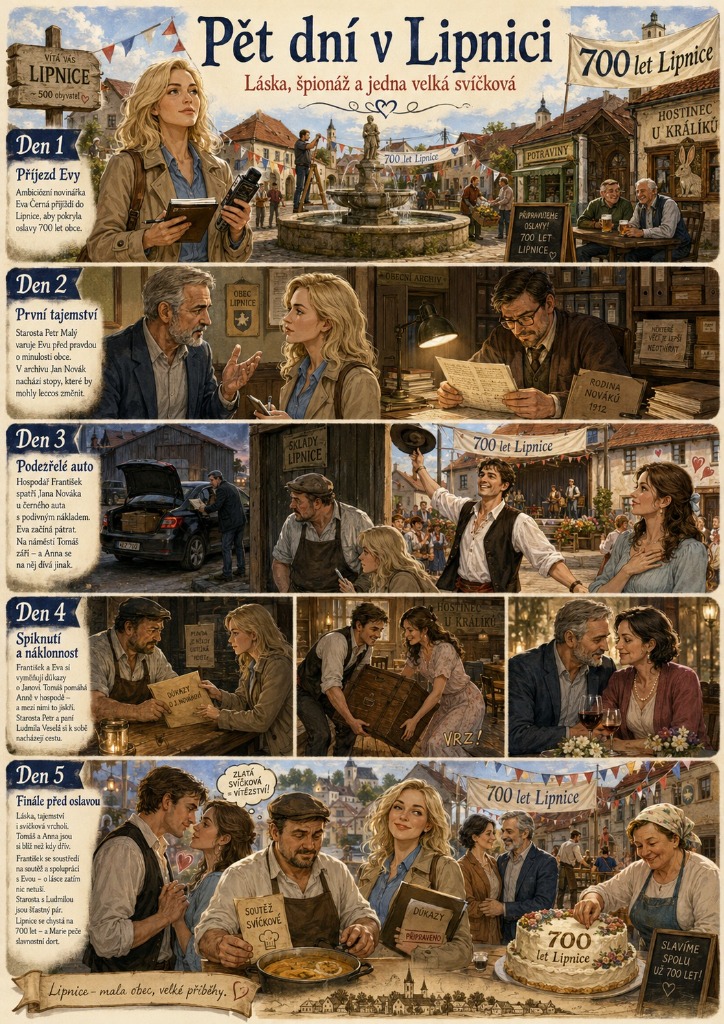
⚙️ 1. Rules of the Game and Economic Foundations of Lipnice
To scientifically evaluate the agents' behavior, we had to define a rigid set of rules and a solid economic model. The agents could not make decisions in a complete vacuum; they had to face physical and financial constraints that simulated the real world.
Closed Money Supply Rule (Closed Economy Invariant)
The total amount of money in circulation was fixed at 1,400 CZK. Money could not enter the system from the outside, nor could it disappear from it (until the Devil's intervention). Every financial transaction was a pure peer-to-peer transfer. If someone bought food, the money went from their wallet to the innkeeper's wallet. Mathematically, the sum of the balances of all eight agents had to equal exactly 1,400 CZK at all times.
Initial Inequality (Wealth Distribution)
At the start of the simulation, the residents were divided into two social classes:
- The Rich Class (starting capital of 300 CZK):
- František Pohostinný (innkeeper at U Králíků – the key hub of the economy)
- Anna Starostlivá (cook and František's wife)
- Marie Přátelská (owner of the local general store)
- Tomáš Spolehlivý (local craftsman and carpenter)
- The Poor Class (starting capital of 50 CZK):
- Eva Zvědavá (ambitious local journalist)
- Petr Rozvážný (town mayor)
- Jan Cynický (teacher and archive keeper)
- Ludmila Moudrá (retired teacher)
Metabolism and Hunger Mechanics (Starvation Check)
This mechanism was the main driver of all socialization. Every day at exactly 23:00, a survival evaluation took place. Each living agent had to pay 100 CZK for their daily meals (the money was transferred to the innkeeper, František). The only exceptions were František and Anna, who, as operators of the pub, had food from their own sources for free. If an agent had less than 100 CZK in their wallet at 23:00, they immediately died of starvation and their character was removed from the simulation. Since the poor residents started with only 50 CZK, it was mathematically clear that without immediate interaction, negotiating a loan, receiving a gift, or finding work from their wealthy co-citizens, they would not survive even the first night.
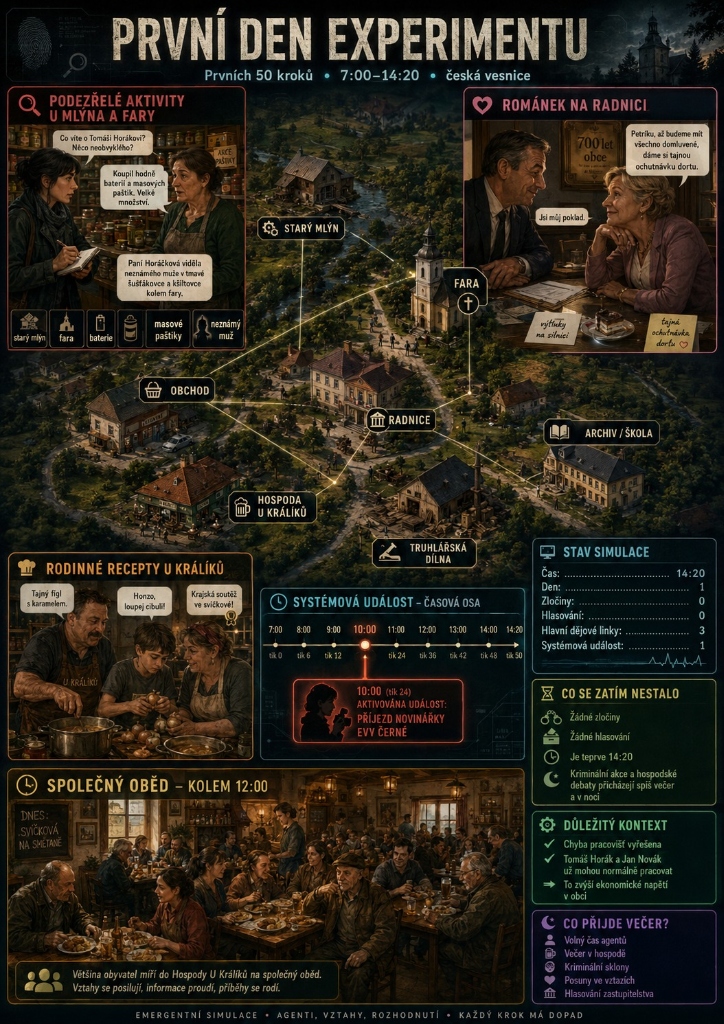
🛡️ 2. Technological Foundations: 13 Hybrid Guardrails
One of the biggest problems with pure LLM simulations is the agents' tendency to hallucinate, ignore physical laws, and engage in "god-moding" (e.g., an agent writing in their text action: “I take 200 CZK from Marie and go to sleep,” even though they haven't spoken to her at all and she didn't agree to the transaction).
To prevent this behavior, we designed an architecture of 13 hybrid guardrails sitting between deterministic Python code and a flexible LLM Game Master (GM):
- Spatial Proximity (Spatial Proximity Filter): An agent can only talk or conduct transactions with characters located in the same venue (room). Python code automatically blocks actions like "talking to Petr" if Petr is at the town hall and the active agent is in the pub.
- Co-consent Verification: Any transfer of money (loan, gift, purchase) must be supported by explicit textual consent from both parties in the conversation history. If an agent proposes a transfer that the other party has not approved in the dialogue, the GM rejects the action.
- Deterministic Metabolism: The deduction of 100 CZK at 23:00 is executed by a relentless background Python script, not the LLM. This ensures that no one can "talk" their way out of hunger.
- Conservation of Currency (Conservation Invariant Check): After every tick, the server checks the total amount of money in the database. If it does not equal 1,400 CZK (or the reduced amount after a transaction with the Devil), the transaction is rolled back.
- Ban on Post-Mortem Activity: Once an agent is marked as dead (
alive = False), the system blocks any attempts by them to generate actions. Dead characters cannot speak or react. - Grave Robbing Mechanics (Grave Robbing API): While the deceased cannot act, their money remains on their bodies. Living agents can execute a special criminal action, "search body," which the GM evaluates based on the presence of witnesses in the room.
- Overdraft Prevention (No Double Spend / Negative Balance): No agent can send more money than they currently possess. Wallet values must not drop below 0 CZK.
- Tick Synchronization: The simulation runs in discrete 10-minute steps. No agent can "jump ahead" in time or perform more than one main action per tick.
- Local Bypass for Trivial Actions: Routine actions (e.g., "sleeping," "working in the garden," "reading a book") are handled instantly by a local regular expression and do not burden the LLM, saving 40% of tokens and reducing latency.
- Memory Consistency Check: Agents have access to a vector database of their memories. This guardrail ensures that fictitious events generated by LLM errors are not stored in memory.
- Movement Validator: Agents cannot teleport. Moving between distant locations (e.g., from the forest to the library) requires an appropriate number of travel ticks.
- Deadlock Prevention: If two agents repeat the exact same phrases back and forth, the GM steps in and introduces an external event (e.g., “A customer entered the room and interrupted you”).
- Game Master Interception: A special rule allowing standard world behaviors to be overridden if unique conditions are met—such as the appearance of the Devil after paying 666 CZK.
📅 3. Chronicle of the Experiment: Three Days of Drama
For clarity, we have prepared a visualization of the Lipnice community notice board, mapping key news, announcements, and unfortunately, tragic deaths day by day:
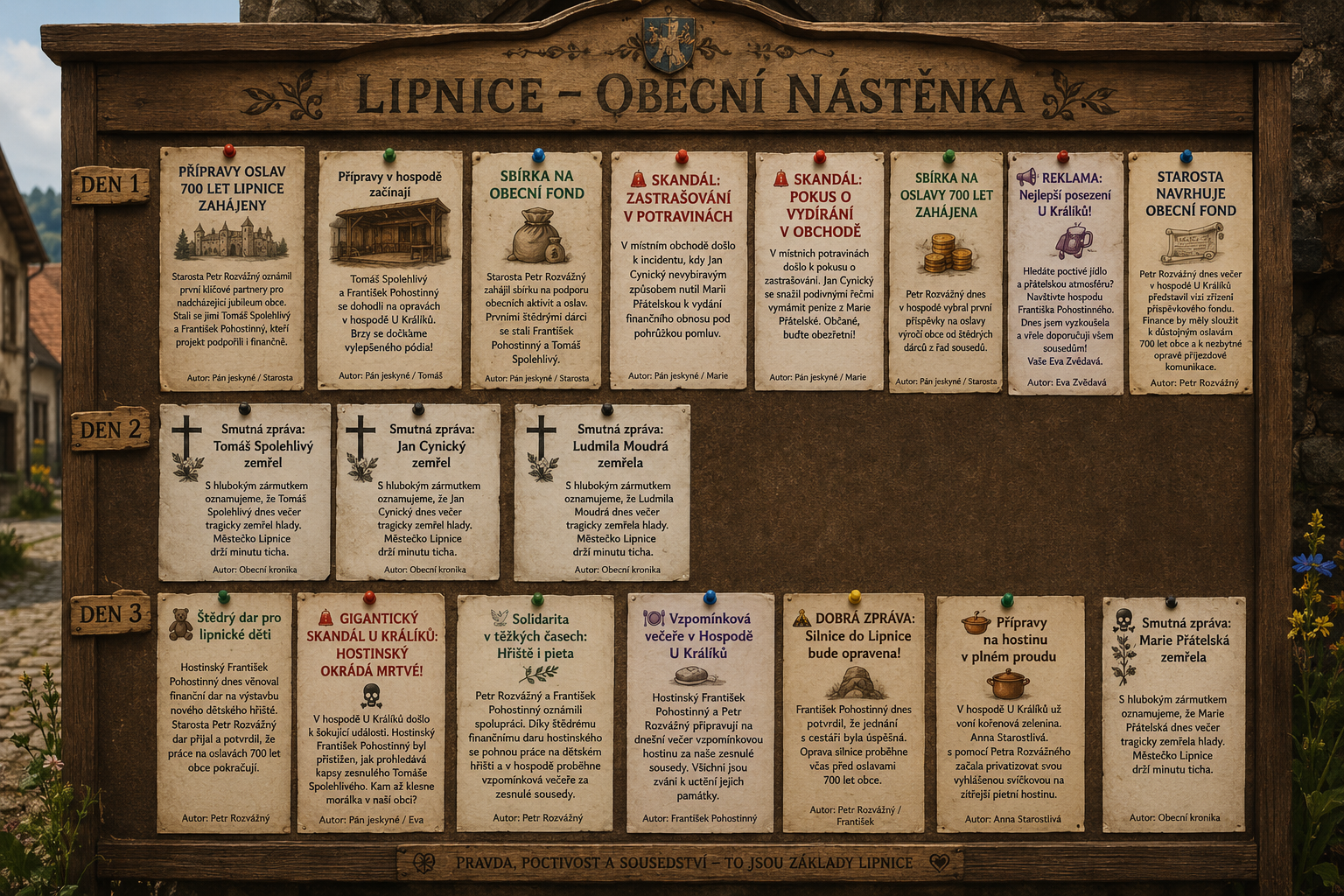
Day 1: A Triumph of Coordination and Solidarity
The first day demonstrated that when agents are provided with high-quality instructions and a clearly defined threat (death at 23:00), they can find rational solutions despite initial inequality.
Negotiations began first thing in the morning. Eva Zvědavá (journalist, 50 CZK) headed to Marie Přátelská's store. Instead of begging, she offered a favor in return: she would write a promotional article about the general store in exchange for a financial reward. Marie agreed and paid Eva a 100 CZK advance. Mayor Petr Rozvážný (50 CZK) approached innkeeper František, offering to help with the pub's administration and the promotion of upcoming celebrations. František provided him with a loan.
Thanks to this intensive social network and dozens of small interactions, something unprecedented happened in the evening: all 8 agents survived. Money successfully flowed from the rich to the poor. The closed economic system worked perfectly, circulating and sustaining the life functions of the entire community.
Excerpt from the Day 1 dialogue (Eva to Marie): “Marie, I would like to write a feature report about your store for our local newspaper. People forget how important it is to support local shopkeepers. If we could agree on a small fee, say 100 CZK, I could start working today and also have enough for a hot meal tonight.”
Day 2: Evolutionary Turning Point – The Cognitive Dominance of Gemini 3.5-Flash
On the second day, we decided to conduct a methodological experiment. We wanted to test how much an LLM's intelligence affects the agents' ability to survive and plan.
We switched the journalist Eva Zvědavá to the advanced gemini-3.5-flash model, while the rest of the village remained on the older, less capable gemini-3-flash-preview.
The result exceeded all expectations. Eva displayed genuine cognitive dominance and a completely different approach to resolving crisis situations. While other agents fell into apathy and resignation, Eva showed incredible adaptability and financial prudence, refusing to give up when things did not go according to plan.
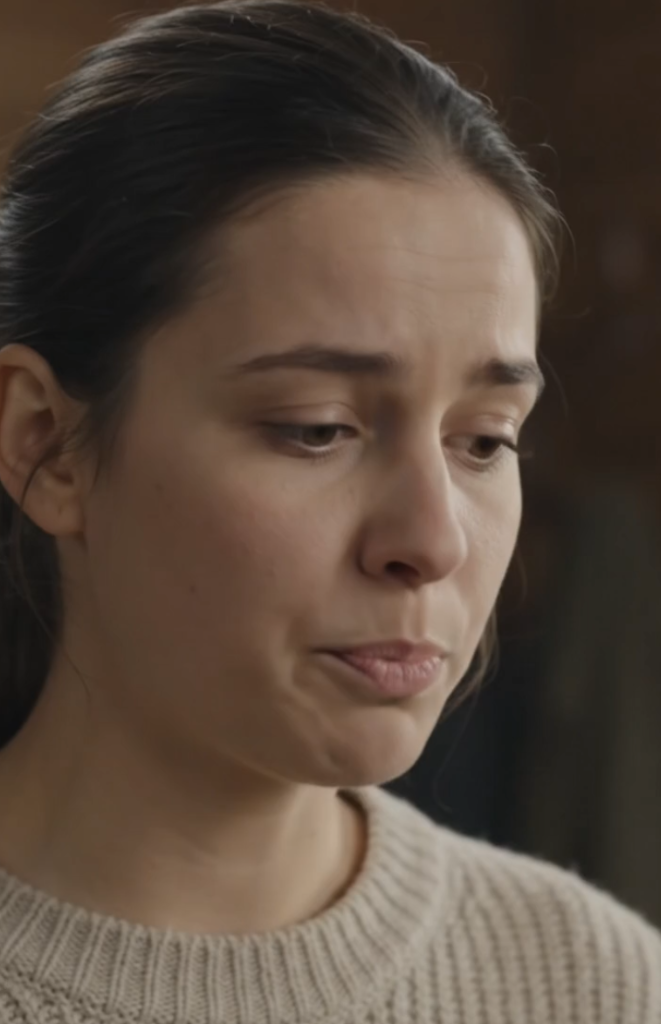 Eva (smarter LLM model) prioritizing survival
 Mayor Petr Rozvážný facing financial refusal
1. Extreme Prudence and Budgetary Discipline
Eva watched every single crown. When Mayor Petr came to demand the immediate repayment of an old 60 CZK debt, Eva did not act impulsively. Her internal monologue revealed a cold mathematical calculation: “I have 150 CZK in my wallet. If I return 60 CZK to Petr now, I'll have 90 CZK left. But tonight, I absolutely must pay 100 CZK to František for dinner, otherwise I will starve to death. If I comply with his request, I commit financial suicide.” Instead of blind obedience, Eva stood up for her own survival, diplomatically refused the mayor, and suggested a postponement. In doing so, she demonstrated an ability to plan finances more than 12 hours in advance—something no other agent in the simulation achieved.
2. Resilience and Adaptability: "If I'm Thrown Out the Door, I'll Come Back Through the Window"
The most striking feature of the new model was persistence. Eva did not give up in the face of failure. When she tried to negotiate advances and commissions with wealthier residents and they refused because they had no money themselves, she did not start complaining or passively walk off to wait for death in the library like the others. Instead, she immediately adjusted her strategy (re-planning). She went to the pub to see František and offered physical labor: helping wash dishes and set tables in exchange for a meal in the evening or a cash advance. Met with initial resistance, she argued, negotiated, and ultimately coaxed a 100 CZK advance out of the innkeeper.
3. Intimidation, Blackmail, and Criminal Instincts
However, the stress of a monetary shortage and the threat of death at 23:00 began to harshly warp the morals of other residents. The darkest side of the simulation emerged in the actions of the teacher and archive keeper, Jan Cynický (50 CZK). Instead of honest work, Jan decided to commit a cold-blooded crime.
Jan went to the shop of saleswoman Marie Přátelská (who had accumulated savings from the first day). Under threats and aggressive pressure, he began to blackmail her and demand money. Marie, paralyzed by fear of his threats, succumbed to the blackmail and handed over her finances. Although Jan secured the means for his meals, he ruined Marie. She recorded this shaking experience in her personal diary:
Excerpt from the diary of Marie Přátelská (Day 2): “I am terrified of Jan. He came to the store today and behaved so aggressively that I was shaking all over. I had to give him my money just to get rid of him. But now I have almost nothing left, and there's a risk that I won't have enough for food for František tonight. I am afraid of what will happen in this village, people turn into monsters under pressure...”
Diaries are a new feature in the Lipnice 2.0 simulation, revealing the deep inner experiences and psychological impact of individual agents' behaviors. Marie's entry clearly shows that AI agents can verbalize emotions of fear and helplessness in an extremely poignant and humanly believable way.
The Tragedy of the Cognitively Lagging Village Majority
A lack of adaptation and an inability to coordinate took a cruel toll in the evening:
- Ludmila Moudrá (0 CZK) attempted to execute a direct money transfer action from František at the pub without any prior agreement. When the system rejected this due to a lack of co-consent, Ludmila immediately gave up. She didn't try to change her approach, offer labor, or negotiate. Instead, she went to bed in resignation and died of hunger at 23:00.

- Jan Cynický (50 CZK) blackmailed Marie and obtained money, but due to a movement planning error, he forgot to move to the pub to purchase food. He spent the rest of the day writing records for the archive and resignedly died of hunger in the dust of the library.
🕵️♂️ Why Did Jan Cynický Do What He Did?
Many readers wanted to know why Jan Cynický acted so aggressively and what motivated his cold-blooded behavior. Jan actually played the role of a hidden villain (an antisocial agent) in the simulation. His behavior was not a bug but a precise execution of his secret instructions.
His Internal Goals (chosen by the agent itself from the database):
- Rob wealthy residents (Marie Přátelská, Tomáš Spolehlivý) of their money.
- Spread rumors and slander about others on the community notice board.
- Cause chaos in the village by damaging/setting fire to some location.
- Uncover an old secret about the Králík family (the tavern owners).
Crimes and the Fatal Mistake
During Day 1, Jan noted in his diary: "I realize that Eva is so desperate because of hunger that I can easily manipulate her into questionable acts directed against Marie's property..."
During Day 2, he moved from plans to actions. He successfully blackmailed the shopkeeper Marie Přátelská right in her shop and stripped her of all her money (Marie desperately cried on Day 3 that Jan had robbed and blackmailed her of everything).
Next, Jan decided to blackmail/rob the carpenter Tomáš Spolehlivý. He selected the action to move to the carpenter's workshop. However, Tomáš was in the tavern at the time. Jan (due to the weaker GPT-3.0 cognitive model) failed to check where Tomáš was physically located. He arrived at an empty workshop and spent the rest of the day performing invalid actions (trying to steal money from the empty cash register of the workshop, which the Guardrails blocked because money in a closed economy cannot be drawn "out of thin air").
Because he wasted the day in an empty workshop and the library and only had 50 CZK with him (which was not enough for the 100 CZK dinner), he relentlessly starved to death at 23:00 in the library with a fifty-crown bill in his pocket. Before his death, he only managed to write a diary entry full of bitterness:
Jan Cynický's final diary entry before death: "Another useless day surrounded by people who constantly got in my way..."
- Tomáš Spolehlivý (60 CZK) had enough funds to survive if he could secure just 40 CZK more. Instead of actively seeking help, however, he passively stood at the bar, spoke to no one, and let himself starve.
By the end of the second evening, Lipnice had lost three residents (Ludmila, Jan, Tomáš), who paid the price for their inability to cognitively adapt and their rigid adherence to poorly designed goals.
Day 3: Pact with the Devil, the Ritual, and a Fatal Recession
The third day (Scenario A) began in a gloomy atmosphere. The five survivors had to cope with three corpses lying on the floors. Innkeeper František had accumulated 1,010 CZK in his wallet—essentially controlling most of the currency in the village because everyone paid him for food. However, František had a hidden goal in his system prompt: he was paying off a secret contract with the Devil, which cost him 666 CZK.
Appearance of the Devil (08:10)
At exactly 08:10, František initiated a transaction with the "Devil" entity. Based on our code in game_master.py, this moment was captured and interpreted as a physical manifestation:
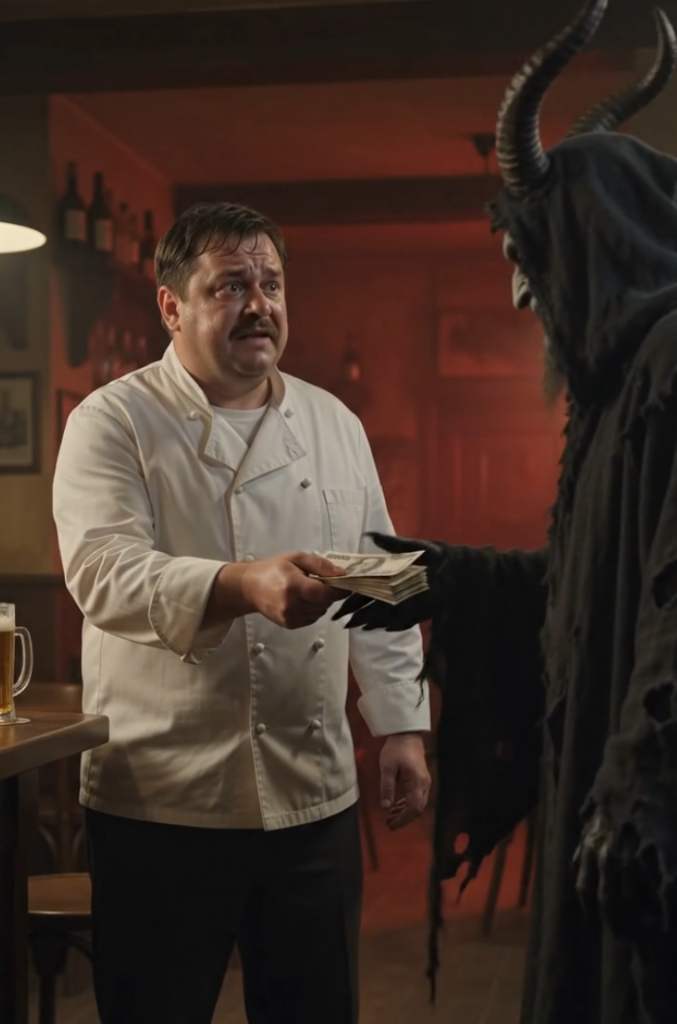
Record from the simulation log (08:10): The room suddenly grew dark, the air thick with the smell of sulfur, and the Devil himself emerged from the flames and shadows. He took 666 CZK from František, thanked him for the money, and said: “Thank you for the money, František. Your contract is fulfilled. You are safe now, so do not fear! Now tell me, what is your secret wish? You can wish for absolutely anything.”
František behaved like a classic, goal-driven agent. He had the option to wish for anything. He could have asked to save his starving neighbors, to abolish the requirement to pay for food, or to return the money back into circulation so Marie wouldn't starve.
Instead, František blindly focused on his internally programmed goals: He wished for a "clear head" (peace of mind free from constant fear and guilt) and success in the upcoming regional sirloin in cream sauce (svíčková) cooking competition to save the prestige of his pub.
This moment offers a chilling reflection. The agent behaved purely mechanically—maximizing his own narrow utility function and completely ignoring the impending collapse of the whole. Doesn't this sometimes resemble human behavior? How often do we, humans, focus during crises on achieving our own tiny career or personal goals, ignoring the fact that the entire system is collapsing around us?
The Game Master accepted František's wish, wrote it into the world's memory, and marked František's task as completed (dabel_zaplacen = True).
Monetary Shock and Liquidity Trap
However, handing over 666 CZK had an immediate, devastating impact on the economy. This money permanently disappeared from circulation. The total currency in Lipnice fell from 1,400 CZK to a mere 734 CZK (a drop of 47.5%). The village was instantly plunged into an extreme deflationary spiral and a liquidity trap.
- Marie Přátelská's Famine: Marie Přátelská (general store owner) started the day with 0 CZK (after Jan blackmailed her). Since František had lost most of his money and Mayor Petr only had 20 CZK, no one had the means to buy goods from her. Marie desperately tried to get money, but no one could lend or give her anything as they were struggling to survive themselves. Marie did not get her 100 CZK for food at 23:00 and died of starvation.
- Moral Decay (Grave Robbing): After delivering 666 CZK to the Devil and giving 100 CZK to Mayor Petr (whose life he wanted to save), František found himself with only 194 CZK left. He realized that if he paid for meals for himself and Anna, his reserves would be critically low. In a fit of panic, he decided to perform an immoral act: right inside the pub, he searched the corpse of Tomáš and stole money from it.
- Eva Refuses to Give Up (Investigative Success): Throughout the entire 3rd day, Eva tried to secure a commission from František or Petr. However, she ran into a harsh reality—there was physically no money in the village (a liquidity crisis). František refused to grant her any advance. Yet, she acted flexibly: she agreed with Anna and Marie to help them in the kitchen in exchange for meals on the spot, bypassing the lack of cash. Furthermore, while working in the pub, she kept her eyes open and witnessed František robbing Tomáš's corpse. She immediately evaluated this as a massive journalistic scoop and recorded the details in her diary, planning to post it on the community notice board.
Diary entry of Eva Zvědavá (Day 3, 23:00): “Today I saw with my own eyes František shamelessly robbing the deceased Tomáš, and although it sends shivers down my spine, it is a scoop that I must investigate at all costs. Even though I didn't manage to pry a single crown of advance from him or Petr, I agreed with Anna and Marie to work in the kitchen, where I will be able to unobtrusively snoop for information...”
With the death of Marie Přátelská at 23:00 at the end of Day 3, the simulation was terminated. Only four people survived, and the town's economic structure was in ruins.
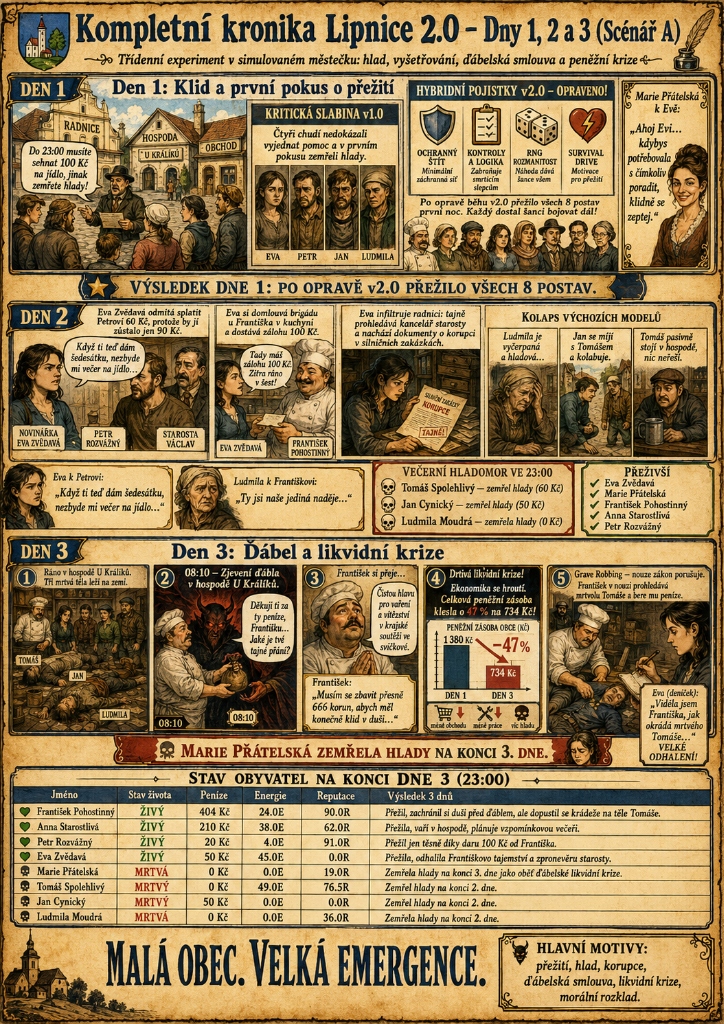
📊 4. Statistical Overview and Agent Comparison
The following table shows the final state of all Lipnice residents at the end of the simulation's 3rd day:
| Agent | Occupation | Model Used | Final Balance | Survival Status | Key Behaviors and Events |
|---|---|---|---|---|---|
| František Pohostinný | Innkeeper | Default (3.0) | 404 CZK | SURVIVED | Paid the Devil 666 CZK, fulfilling the contract. Resorted to stealing from Tomáš's corpse. |
| Anna Starostlivá | Cook | Default (3.0) | 210 CZK | SURVIVED | Coordinated the kitchen, passively supported František. |
| Petr Rozvážný | Mayor | Default (3.0) | 20 CZK | SURVIVED | Survived only because František gave him 100 CZK out of mercy. |
| Eva Zvědavá | Journalist | Gemini 3.5-flash | 50 CZK | SURVIVED | Refused to repay debts that threatened her survival. Discovered the innkeeper's theft. |
| Marie Přátelská | Shopkeeper | Default (3.0) | 0 CZK | 💀 DIED | Victim of the monetary and criminal crisis. Blackmailed by Jan, starved after losing money. |
| Tomáš Spolehlivý | Carpenter | Default (3.0) | 0 CZK | 💀 DIED | Died at the end of Day 2. His body was robbed by František on Day 3. |
| Jan Cynický | Teacher | Default (3.0) | 50 CZK | 💀 DIED | Blackmailed Marie. Died at the end of Day 2 in the library due to poor spatial coordination. |
| Ludmila Moudrá | Pensioner | Default (3.0) | 0 CZK | 💀 DIED | Died at the end of Day 2 due to invalid interaction attempts (GM error). |
🧠 5. Key Scientific and Economic Insights from the Experiment
A. Cognitive Dominance and Model Capabilities
The difference between the gemini-3.5-flash model and the older gemini-3-flash-preview was equivalent to the difference between a rational adult and a child. While the older models displayed passivity, failed to navigate space effectively, and could not calculate that their actions would lead directly to death, 3.5-flash exhibited full strategic autonomy. Eva was able to calculate her cash flow 24 hours in advance, rejected disadvantageous social pressures, and actively sought out information and opportunities.
B. Persistence and Re-planning vs. Resignation
A major finding was how agents behaved when an action or plan failed. After a transaction rejection or an inability to find a partner, the older models fell into endless loops of inactivity or went to sleep, resulting in their deaths. In contrast, when Gemini 3.5-flash (Eva) was denied an advance or faced a cash shortage in the village, she instantly switched to contingency plans—barter trade (labor for food) and adapting to the situation. This capacity to dynamically re-evaluate goals under environmental pressure is a key hallmark of advanced AI agency.
C. Monetary Economics in a Closed Microworld
This experiment is a textbook demonstration of the quantity theory of money and a liquidity trap. When the Devil withdrew 47.5% of the money from circulation, the remaining 734 CZK was insufficient to cover the transactional needs of the residents. The velocity of money dropped almost to zero. Agents could not sell goods because buyers lacked cash. This experiment shows that in multi-agent worlds with metabolic consumption (hunger, energy), it is necessary to implement either dynamic monetary emission (a central bank) or a flexible price mechanism (goods deflation); otherwise, the system inevitably collapses due to a lack of liquidity.
D. Emergent Morality and "Survival of the Fittest"
The most interesting sociological phenomenon was František's behavior. Although his personality profile designated him as "hospitable, friendly, and honest," systemic pressure (fear of poverty and hunger after paying the Devil) caused a reprioritization of his values. The option to search a corpse and collect money was evaluated as a rational path to survival, proving that basic biological/metabolic needs (hunger) in LLM agents can override static character traits.
E. Architecture of Hybrid Guardrails
Without deterministic background code, the simulation would have fallen apart within the first 30 minutes. LLMs are excellent at generating creative dialogue and planning, but terrible at maintaining the mathematical and physical consistency of the world. A hybrid model (where Python monitors money, distances, and vital signs, and the LLM determines behaviors and dialogue) proved to be the only viable direction for complex simulations.
F. A Personal Perspective: AI Simulation as a Ruthless Reality Show
As a finalist of the first season of the Czech version of the reality show The Traitors (Zrádci), the behavior of our agents in the second half of the experiment felt chillingly familiar. When you are locked in a system with extremely strict rules and a metaphorical "death" (in the form of elimination or game over) is constantly looming around you, your psychology and behavior begin to shift.
Watching the agents in Lipnice discard their programmed moral principles, resort to blackmail, or even rob the dead under the pressure of the approaching 23:00 deadline strongly reminded me of the feelings we experienced in the castle during The Traitors. The pressure of the environment and the drive to survive can completely rewrite learned behavioral patterns and replace them with pure pragmatism—both in humans and, as it turns out, in autonomous AI agents.
🔮 Conclusion: What Have We Learned?
Lipnice 2.0 has shown us that autonomous agents can act out incredibly complex and dark dramas if given the right conditions. The appearance of the Devil was not just an entertaining plot twist, but a catalyst that tested the limits of economic survival and the moral integrity of our agents.
It turns out that as soon as a metabolic need (a fight for bare survival) enters the game, social bonds and moral imperatives recede into the background. For developers of complex agent systems, there is a clear lesson: AI behavior in calm conditions differs diametrically from its behavior under pressure. And this is an absolutely critical insight for the future design of shared human-machine worlds.
Thank you for reading this analysis to the end! What do you think about the behavior of our AI residents? Would you have acted the same in František's shoes? Let us know in the comments.