With Daniel Stach: The Traitors, DigiHavel and a reality show with AI
How real is reality TV? And what would change if artificial intelligence joined the cast? At Innovation Week, Daniel Stach, Andrea Havelková, Šárka Vítovcová and I explored the connection between television and digital characters.

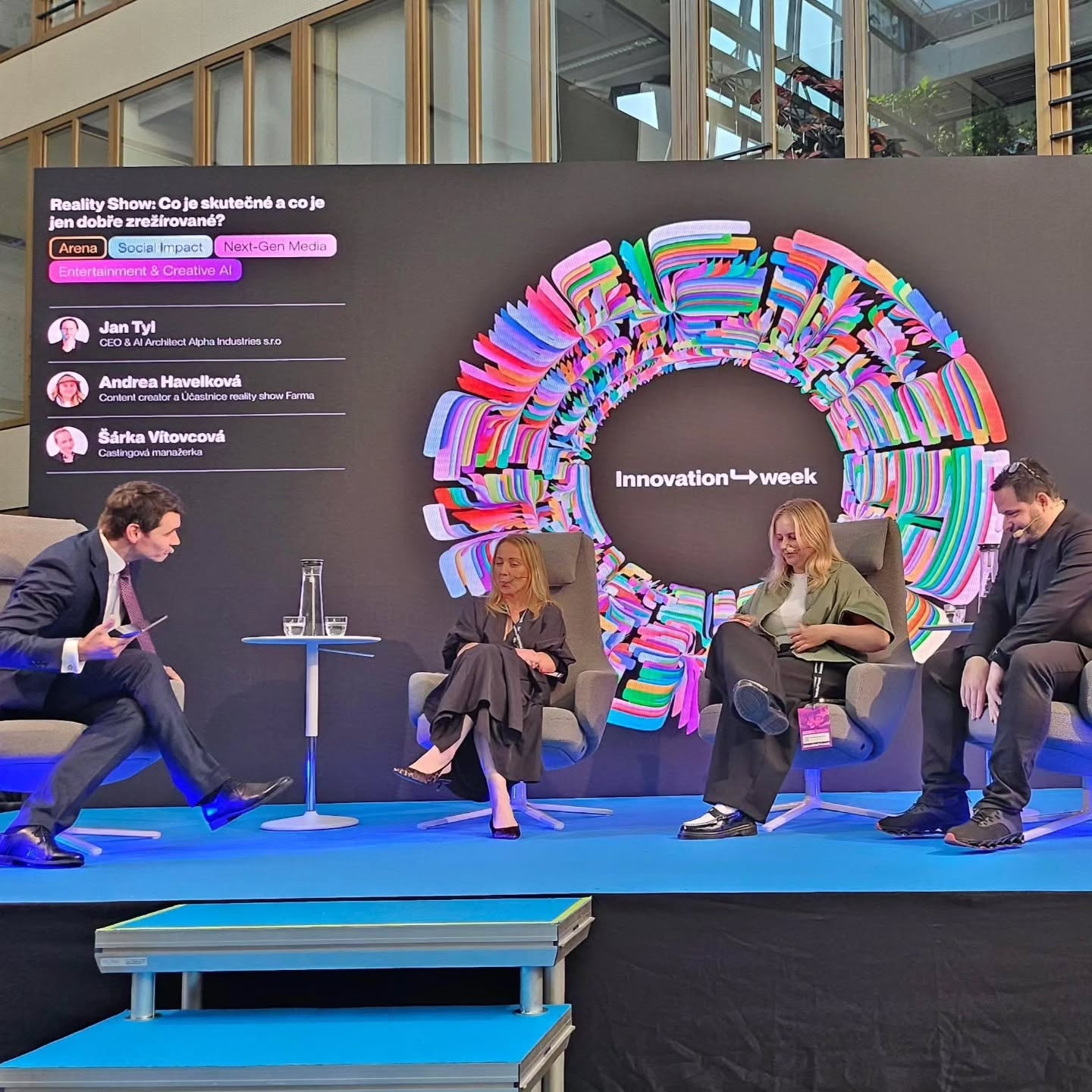
What if artificial intelligence joined a Czech reality show? That question stayed with me after Saturday's Innovation Week. We were no longer talking only about cameras and editing, but about whom we would trust in a show like that.
On 3 October 2026, I joined the K.I.S.S. Stage at Prague's ČSOB Campus for “Reality Show: What's Real and What's Produced?” Daniel Stach moderated the discussion, with Farma contestant Andrea Havelková and casting manager Šárka Vítovcová alongside me. I brought my experience from Zrádci, the Czech version of The Traitors, and from developing AI. Quite a mix of perspectives on one question: what is the audience actually seeing?
Reality in front of the camera and on screen
We talked about The Traitors and other reality shows: casting, production, storytelling and the role editing plays in the finished programme. I enjoyed hearing experiences from different sides of the production process.
What interests me is the gap between what someone experiences and what other people see of that experience. A contestant can feel genuine uncertainty, joy or disappointment. The viewer, however, sees selected moments assembled into a particular story. Both can be true at once. That is why it is so difficult to say how much reality there is in reality TV in a single sentence.
From The Traitors to DigiHavel
The conversation also turned to DigiHavel and the other digital characters I work on. With them came a question that returns whenever AI starts to seem a little human: can digital people have emotions?
I find it useful to separate two things. A digital character can talk about fear, make jokes or respond sympathetically. A convincing response alone does not establish that it has a subjective experience. The emotions of the person talking to it, however, can be entirely real.
For me, this is an interesting connection with reality TV. In both cases, we think about what we see, what we fill in ourselves and why we begin to trust someone. With a digital personality inspired by a real person, it also matters that we know we are speaking to a model. A reply from DigiHavel, for example, is not an authentic statement by Václav Havel.
Could a Czech reality show involve AI?
This was one of the central ideas of the discussion. For now, it is a question to explore, not an announcement of a programme in production. What would happen to trust and relationships within a group if a digital character joined it?
Thinking about it afterwards, I would be interested in exploring AI as an adviser to contestants, or as a character everyone has to negotiate with. Would it help people cooperate? Would they rely on it too much? And how would their attitude change after it made a mistake?
Much would depend on the rules: who knows they are talking to AI, what the system knows about contestants and who is responsible for its interventions in the game. I think those details would determine whether the result was a compelling show or simply a flashy technology trick.
Daniel Stach knows how to respond
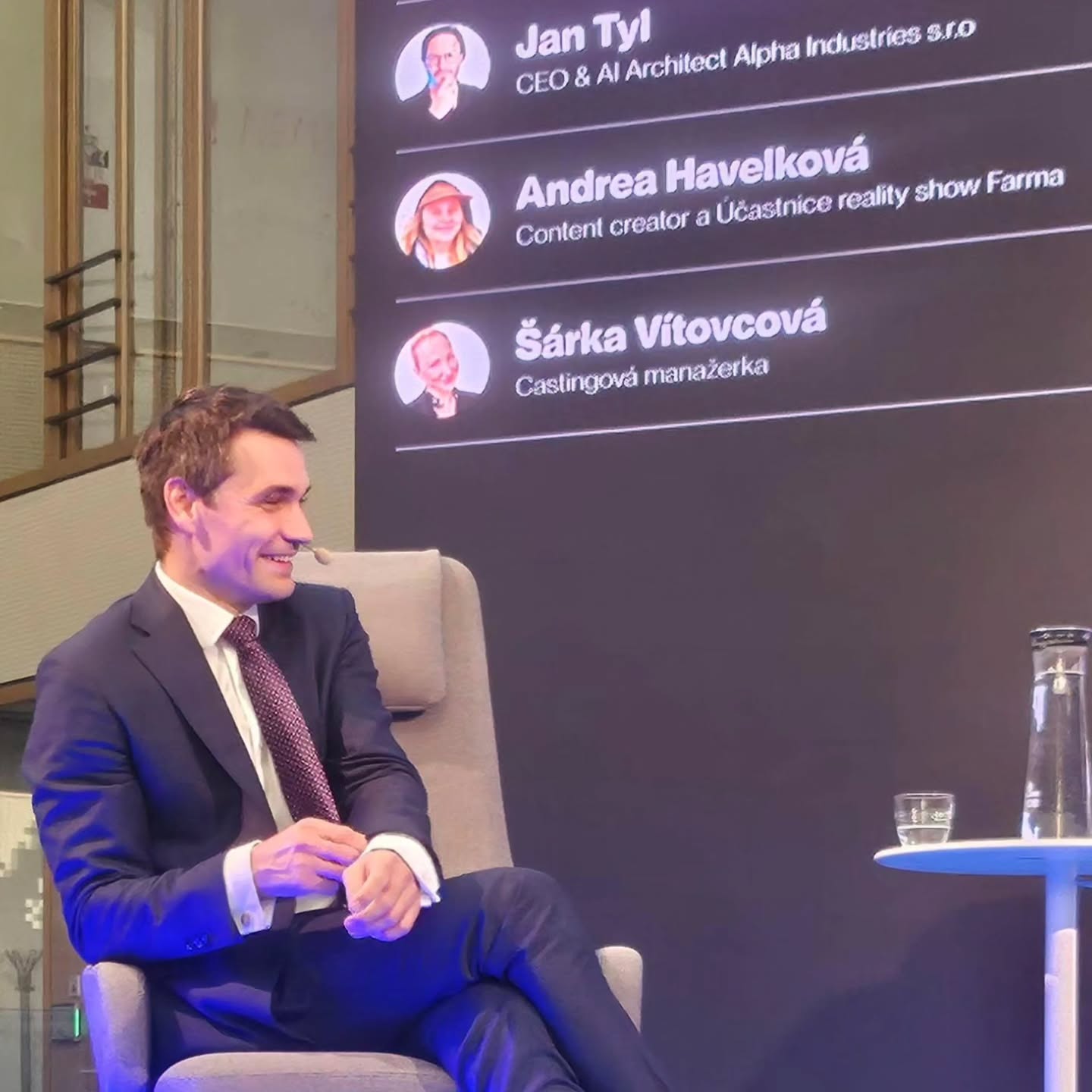
Daniel Stach during the discussion. Photograph from my Instagram post.
Daniel was funny, quick on his feet and very good at responding to wherever the conversation went. I enjoyed how naturally we could move from television production to digital people with him. As much a pleasure in person as on television.
Thank you to Lukáš Sedláček for the invitation, to Daniel for moderating, and to Andrea and Šárka for such an enjoyable discussion. Thanks also to everyone who came, and to Terezka for her support. With robots roaming around us, we could hardly have chosen a more fitting place to discuss the boundary between reality and technology.
More photographs are in my Instagram post. The panel line-up and description are in the Innovation Week programme.
If you are curious about how a digital character takes shape, read about Vizi, whose personality was chosen by the audience in Zlín.