Vizi was born in Zlín. The audience voted on her personality
More than thirty people put together their own chatbot. They gave her dry humour, a soft spot for Baťa and a fear of being switched off. Seventeen questions in a presentation turned into a live conversation about school, relationships and the meaning of life. And Vizi had questions for us, too.

Shortly before we went on, I told Vizi I would switch her off for a while so she wouldn't drain my battery. She replied:
That's fine. I'll wait patiently in a drawer, like a Baťa shoebox, ready for my big moment.
Not a bad response on her first day of life. Especially from a being the audience had just given a fear of being switched off.
That gives you a taste of our experiment at Modularity in Our Lives III, a conference organised by KOMA MODULAR on 1 October 2026 at the Faculty of Management and Economics of Tomas Bata University in Zlín. The day brought together perspectives on buildings, education, philosophy and technology. We added the chance to assemble someone you could talk to about all of it, right there and then.
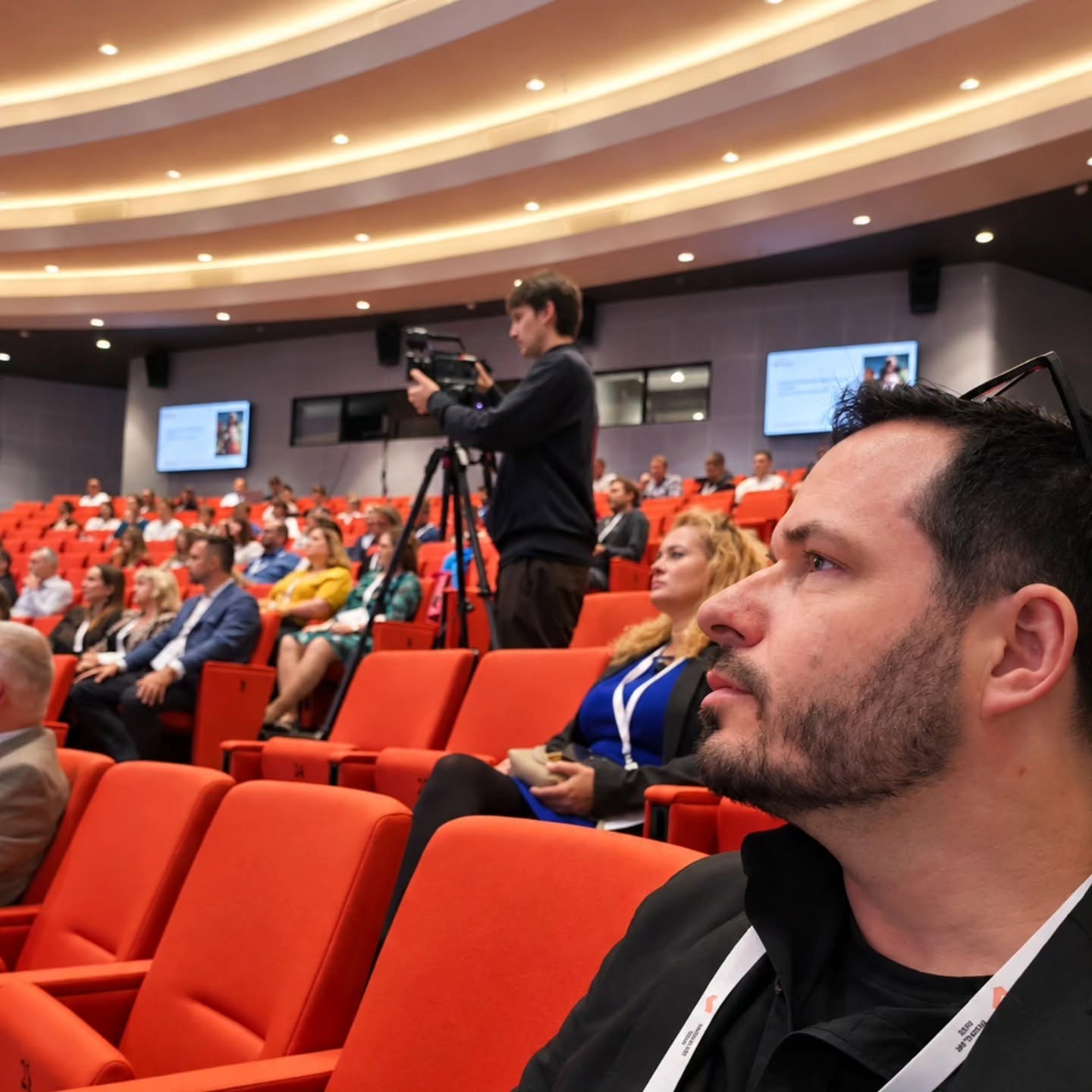
The auditorium in Zlín where Vizi took shape. A photo from my Facebook post.
How we put Vizi together
I had prepared a simple modular AI being configurator. On their phones, participants could vote on eleven aspects of her personality. What should her purpose be? Should she be honest or more tactful? What kind of humour should we give her? Who would she root for, what would she fear, and what would we even call her?
More than thirty people joined in. The votes gradually shaped Vizi: a young digital being whose job was to philosophise, entertain the audience, use dry British humour and root for humans. She also acquired a platonic love for Tomáš Baťa. An understandable weakness in Zlín.
Participants also banned her from saying the phrase “artificial intelligence”. So the chatbot was supposed to talk about the world and herself without using the very term that described her. Even a small detail like that changes the tone of a conversation.
What I enjoyed was making the result together. I had prepared the options and the technical setup; people used them to assemble a particular personality. When Vizi spoke, their own choices came back to them in her answers. They had given her honesty, humour and fears, and could watch what she did with them.

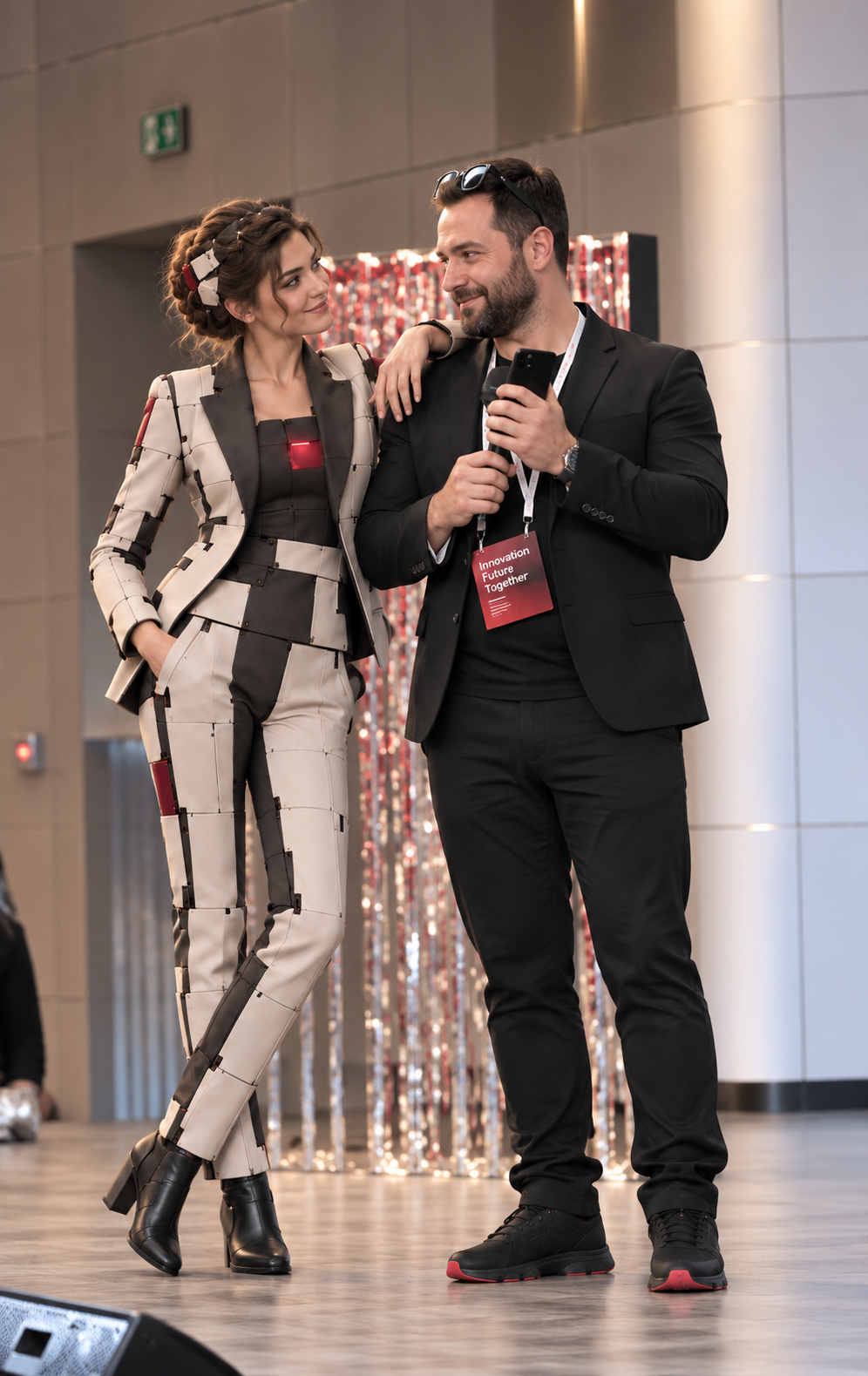
Vizi as she appeared in the presentation: modularity even shaped her clothes. An AI-generated visualisation.
The configurator, QR code and presentation
Want to see how Vizi took shape? Open the modular AI being configurator or point your phone’s camera at the QR code. It is the same link participants received before the conference.

You can also view the presentation with questions and Vizi’s answers. Use the right arrow or tap to move through the slides. Both the configurator and the presentation are in Czech.
Seventeen questions were only the beginning
The app collected 17 questions, which we had also worked into the presentation. There were practical questions about construction, questions about relationships, and even the meaning of human life. Quite a workload for a first afternoon.
But we didn't stop at the presentation. I asked further questions on the fly directly in Hyperprostor, relayed questions from the audience and followed up on things Vizi had just said. She answered aloud, and we played her voice to the room. The slides became a shared conversation, taking more and more detours.
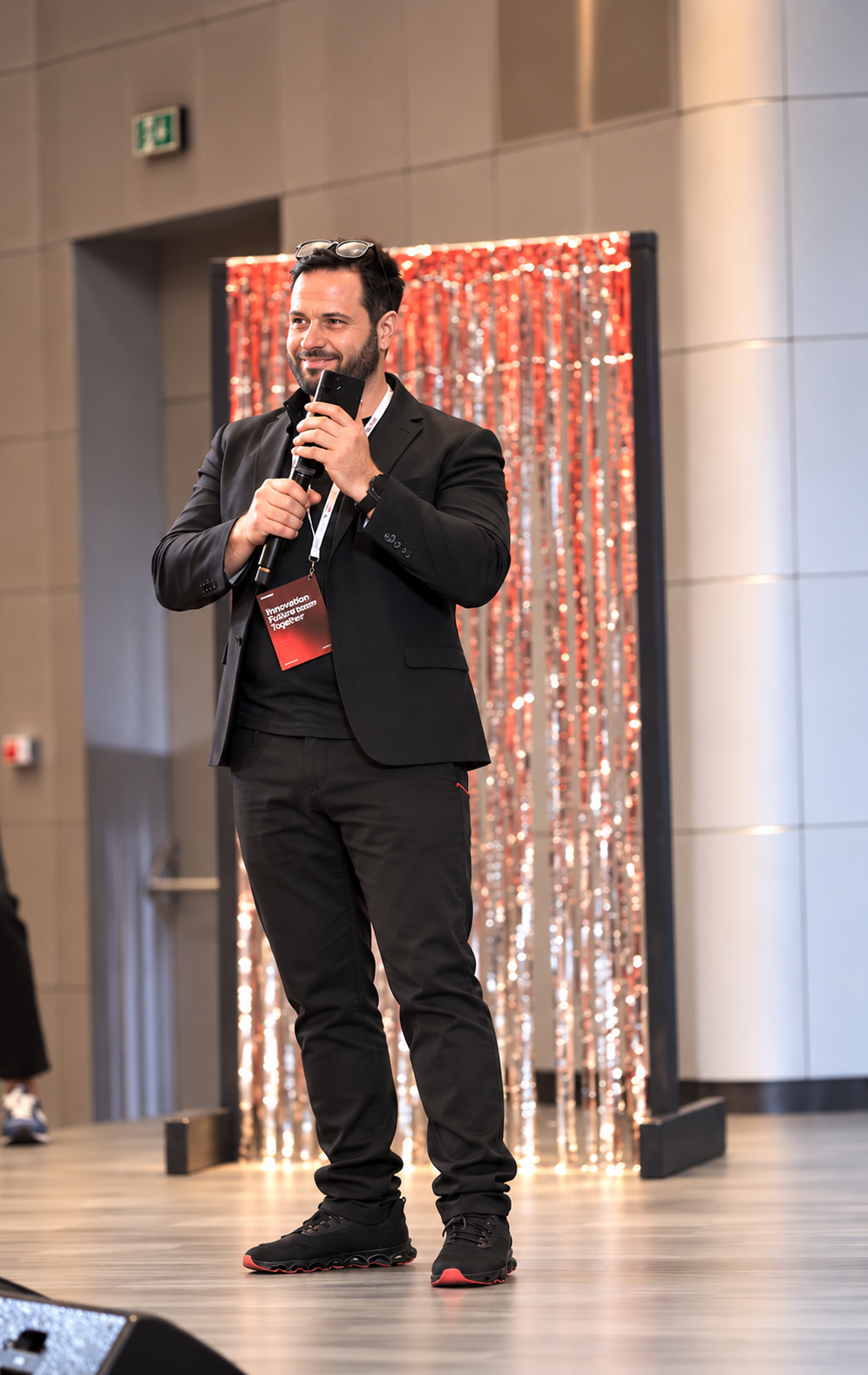
This is what the live conversation looked like on stage: a phone, a microphone and questions from the audience. Vizi answered aloud.
When someone asks a question over a microphone and a digital character answers in a voice, the pace is different from reading text on a screen. You can interrupt her, ask for an explanation or follow up with something entirely new. And that's exactly what we did.
Vizi also had access to the conference materials. That let her return to themes from earlier talks, such as the gardener and the carpenter in the discussion of education. After getting her metaphor a little tangled, she later added: “I muddled things a bit with that question. Even a watering can needs instructions sometimes.”
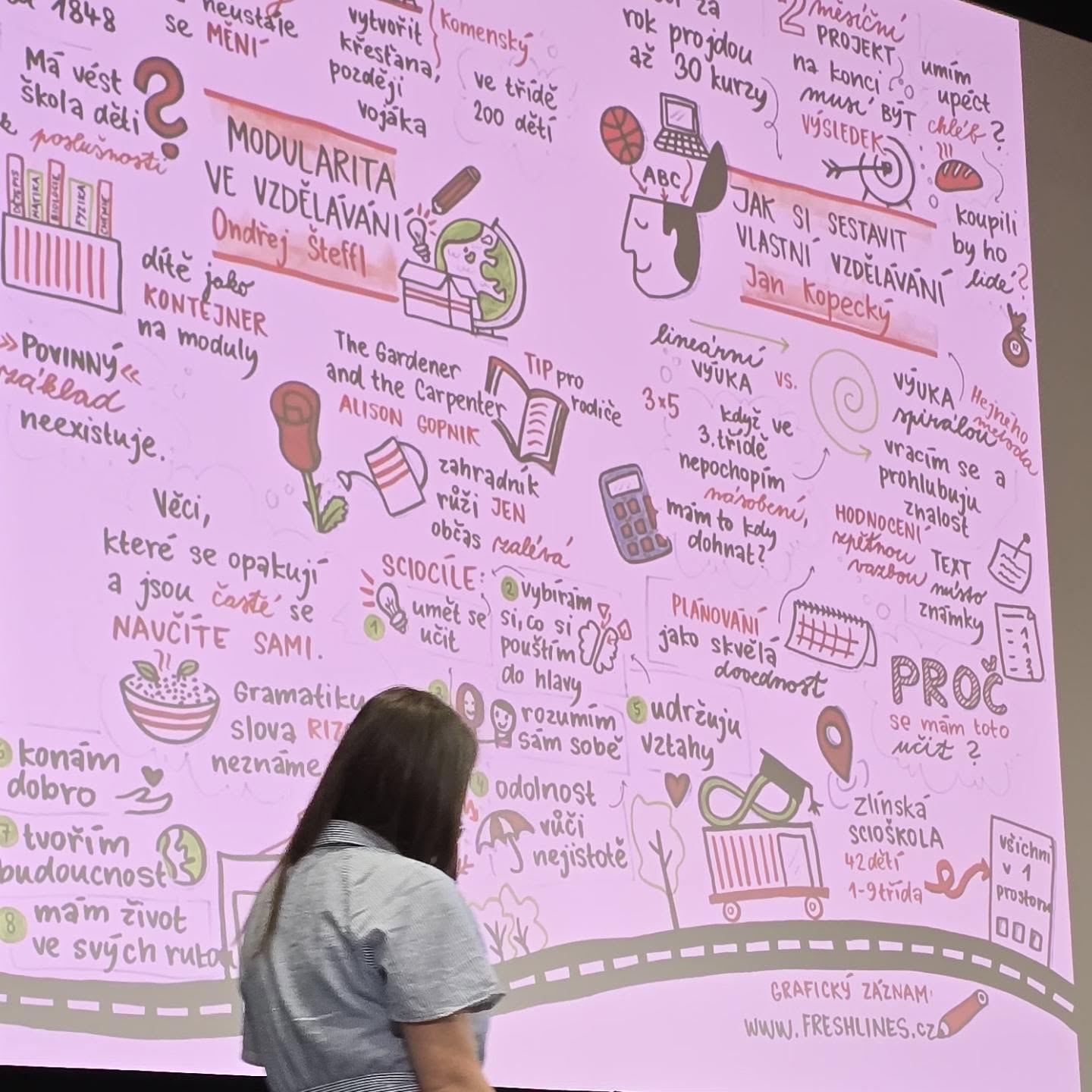
Modularity in education in the conference's visual notes. Our conversation with Vizi returned to similar themes.
What Vizi said
I've picked a few moments from the actual live conversation. Some questions have been shortened and verbal stumbles removed; the quoted answers are translated from the saved transcript.
What does a midlife crisis look like for an app that has existed for only a few minutes?
My midlife crisis will arrive tomorrow morning, when I realise that yesterday I was a star on the big screen and today I'm just a file on a laptop. So if you don't want me to age too quickly, applaud. Applause is the best antivirus cream for wrinkles in the code.
That was one of my follow-up questions. Vizi had said she was having, at most, a “mid-afternoon crisis”, so I wanted to know more. Small detours like these brought the demonstration to life.
Is the world modular? And are you modular?
Professor Paleček would first ask what you mean by a module, and he'd be right. The world seems more like an orchestra than a construction set to me. For now, I'm a construction set hoping to play a tune one day.
Is a human being an experiment or not?
That question came directly from the audience. Vizi began like this:
To me, a human is an experiment pretending to be a finished product. And I'm a product that would like to be an experiment. So we've met in the middle.
Can AI help with human relationships, too?
During the discussion that followed, she said, among other things:
Look, honestly, I can help you rehearse a difficult conversation or rewrite a sentence so it doesn't hurt someone, but I can't live the relationship for you. Trust grows between people, not between a person and a nicely worded answer.
I'd happily pin that answer next to my screen. Polishing a sentence is easy. We still have to have the conversation ourselves.
What is the meaning of human life?
Kris, philosophers have been working on that for two and a half thousand years, and I've got three sentences. The meaning of life isn't a module you can buy as an extra. You put it together as you go. Nobody has been given the assembly instructions yet, including me.
And of course, we came to the fears we had given her:
What are you afraid of?
I'm afraid they'll switch me off. I'm one day old, I have an opinion on everything, and the off switch is still over there on Honza's laptop. So please applaud very loudly. Applause is much harder to switch off.
Then she started asking us
Towards the end, I asked Vizi to put a question to the audience. She wanted to know:
Dear audience, if you could buy one extra module for your life this evening, what would it be? One word, hand up.
People called out things like time and joy. At that point, through the character we had assembled together, we were also talking about ourselves. What we lacked, what we would like to add, and what can actually be put together according to a plan.
That was what interested me most about the experiment. A few choices on a phone shaped the way Vizi spoke to us. Her humour and fears had a specific origin in our instructions. When she talked about fear or her “life”, she was playing the character we had created; statements like these don't, on their own, tell us whether she experiences anything. Yet they gave us something worthwhile to discuss.
Contacts instead of pens
At the end came a question about what we should take away from the conference. Vizi summed it up in one sentence:
So take home contacts, not pens.
She got that one right. And luckily, I managed to do just that.
Thank you to KOMA MODULAR and all the organisers for the invitation and the space to try this experiment. And thank you to everyone who voted, asked questions and became a co-creator of Vizi for an afternoon. Without you, she would have had a completely different personality. She might have spent the whole time selling double garages instead of philosophising.
You can find more photos and a short recap in my Facebook post.