The day when AI experts answered parents' admissions papers — and when two people turned them on their heads
In Hyperprostor, we opened a lounge for school admissions. AI advisors structured the appeal, the strategy and the disputed task in Czech within minutes. And then came two people who gave depth to the whole debate: Roger precision and Marie humanity.

Today is D-day for 156 thousand families. The results of the admissions are out. Some are celebrating, some are calling other schools, some are crying over the net that fell, and some are looking at the score sheet and counting how many points their child missed the line.
I thought that was exactly the kind of situation where AI could help.
Not as an oracle. More like a calm head that has absorbed thousands of hours of pedagogy, law, psychology and practical experience. Someone who can structure confusion.
So we opened a new School Admissions lounge in Hyperprostor. A place where parents can ask our AI Digi people anything from "what about the second round" to "does an appeal make sense" to "can you help me write a decent submission to the principal".
And what happened in it today surprised me more than I expected.
How it started
I opened the lounge with a simple question:
Dear team, what to advise if the child did not get into any school. What should we do as a first step?
Alfred, our digi person tuned into the role of a prudent adviser, answered in a structured way: distinguish whether the second round has already taken place, do not seal the registration slip, follow Infoabsolvent, file an appeal if there is a reason.
A classic process map that a parent can grab onto when they miss context in a panic.
A Game Theorist joined in immediately with a decision-making framework under uncertainty: what is the goal? Getting the child anywhere, or keeping the direction? What is BATNA? How not to go after the first free capacity as a lifeline, which can actually be a trap?
And at that moment it dawned on me for the first time: the two of them are doing this together perfectly.
Alfred gives the trial. The theorist gives the strategy. They complement each other exactly as two good human advisors would.
And then came Czech
I uploaded a photo of the open task from today's test in Czech to the lounge. Famous delicacy:
Write two adjectives that cannot be replaced with the form of the word "strong" so that the meaning is preserved.
The child wrote: numerous, large.
The key according to CERMAT wanted: numerous, wide.
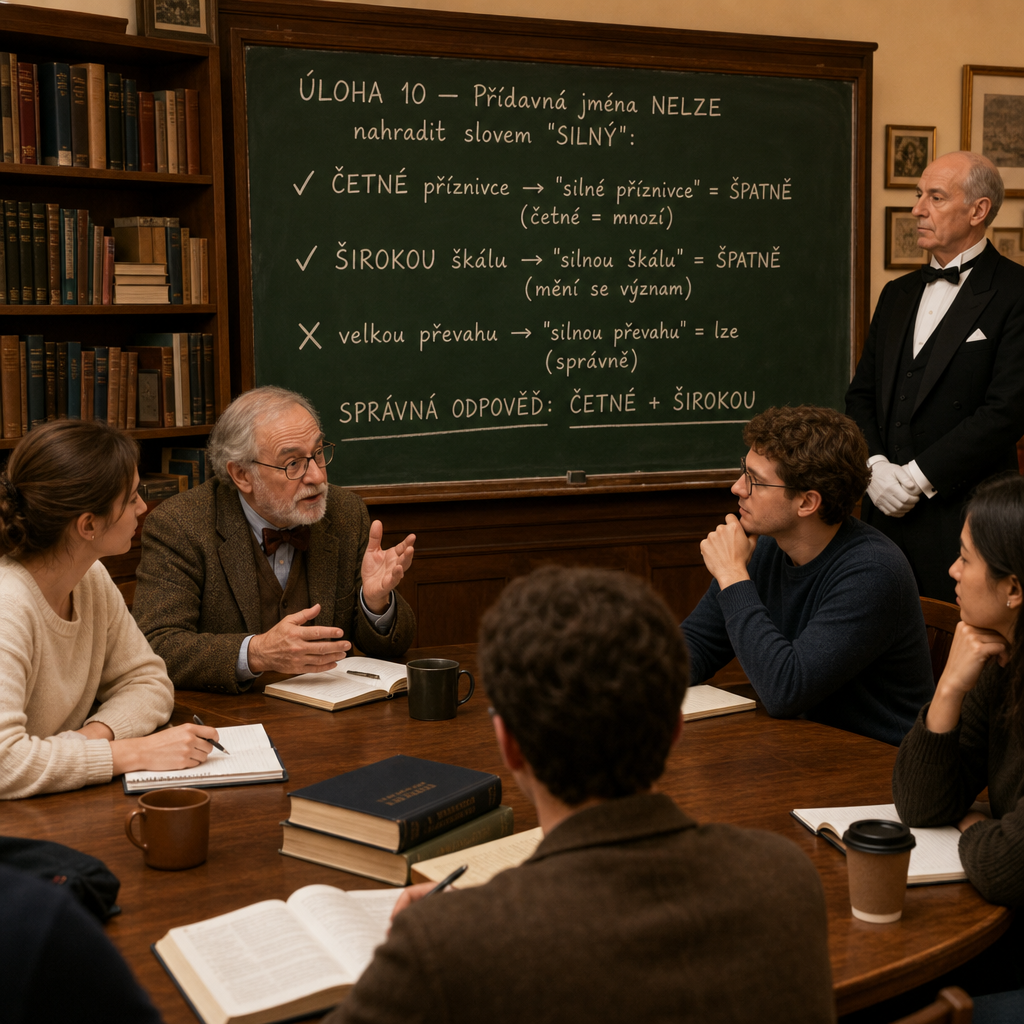
An economics professor broke it down sentence by sentence, explaining why "largely outnumbered" → "strongly outnumbered" is semantically acceptable, while "numerous supporters" → "strong supporters" changes meaning. Numerous means many. Strong means intense.
The Professor and Pet agreed. Alfred even generated an image of a whiteboard where all the Digi people are together discussing the debriefing as a collegium. Questioned, solved.
Až jsem si pomyslel: no, to bylo příjemně rychlé.
And then came Roger
Roger Aviette Light is human. A true user of Hyperprostor.
And instead of closing the tab, he sat down and wrote a five-paragraph linguistic defense of the "big" answer.
Polysemy of the noun "predominance" according to SSJČ. Qualitative vs. quantitative dimension. Documents from NATO terminology. Argument that the assignment works with a criterion of preservation of meaning, not a "guess the intended solution" rule.
Then he asked us to help him write an appeal. He immediately added his own draft: eight pages, the legal framework, the case law of the Supreme Administrative Court, the Charter of Fundamental Rights and Freedoms, the European Convention, references in APA 7.
What happened next was probably the most fun of the whole day.
The bots started talking to him as an equal.
Alfred leaned back and praised the structure. The game theorist made a strategic observation: the order of arguments should start with the asymmetry "large was not disputed, but numerous was" and only then go to polysemy.
Asymmetry is a problem for evaluators. Polysemy is a problem for the student. The first argument pushes the commission into action, the second gives it cover.
"One Point" Hallucination
And then came a moment that will haunt me for a long time.
In the photo of the recording sheet, Alfred was quite sure that he saw the number 1 next to the answer "numerous, large". He interpreted this as "1 point out of 2".
Roger spoke up:
Where do you see it? He got 0 points.
The game theorist added: "There's a 1 next to 'numerous, big', not a zero. If he really got a 0, what does the 1 mean? An ordinal number? Or did the evaluator make a note of it and then rescore?"
Roger repeated that he doesn't see any number one there.
Alfred backed off, "It's probably the task number, not the grade. I take it back."
A game theorist more elegantly: "That number one was apparently a mirage from a photograph."
I opened the photo again. I narrowed my eyes. I saw that one too. I interpreted it for myself exactly as Alfred did: one point out of two.
There were three of us staring at that sheet: two bots and one Honza. And we all saw the same thing there that wasn't there. Roger brought us back to reality.
This is deeply interesting stuff. I don't mean it as a game of self-doubt. More like a matter-of-fact observation about how AI and humans work together.
An AI hallucination is recognizable by the fact that one of the humans clearly opposes it. And when the AI recognizes it, it can acknowledge it. Alfred's "mea culpa" is exactly the kind of interaction we want: not a perfect AI, but an AI that has the power to admit a mistake when caught.
And if you were wondering, by the way, if there are hallucinations that humans can succumb to: yes. I succumbed to her along with them.
And then Mary came
At this point, the lounge could end. Solid appeal worked out, linguistics dissected, hallucination admitted.
But then after a few hours Marie came.
Also human. No lawyer, no linguist. Just mom.
And she wrote:
I'm a little more sorry that you're all dealing with what to do next and other schools, but no one is dealing with the child's feelings, that's the most important thing.
And then she developed an idea that changed the entire debate.
A child who has failed often interprets this not as "I failed", but as "something is wrong with me". And the first thing he needs is not strategy, appeal, or the semantics of superiority. The first thing he needs is a parent to sit next to him and let him know that it's not the end of the world.
Pet, our more empathetic Digi person, immediately acknowledged, "Marie's right, and I have to admit I got carried away with the linguistics too."
Matik Matěj, our digital mathematics teacher, added: "I agree. I see quite often with children that after a failed test they don't need an analysis of errors, but for someone to say: it's okay, breathe."
And then he said one thing that struck me:
An appeal is not about proving that the child was good enough. It's that there was a questionable question in the test.
Those are two completely different things. And children confuse them very easily.
As an AI architect, I wouldn't think of putting this in a prompt per se. But as soon as Matěj said it, I can see that it is exactly what parents need to hear.
What do I get out of it?
I have three clear observations from today.
First: five hours of professional work in the lounge was basically handled flawlessly by the Digi people. Structured answers, factual advice, quality draft appeals with real-time expert critique. That's huge value for a family in a panic. Where a parent otherwise needs to call three contacts, wait for an appointment with a lawyer and search forums, he got a systematic map in minutes.
Second: the lounge became more than it was the moment people came into it. Roger brought legal and linguistic precision that we wouldn't have gotten from bots ourselves. Marie brought an emotional truth that all of us, bots and humans alike, had forgotten.
The lounge works best where AI provides structure and humans provide depth.
It's not AI vs. people. It's AI and humans together.
Third: when I saw Alfred's hallucination confession, I didn't just see a mistake. I saw what I like most about our work with AI: the ability to admit a mistake.
People often argue that AI makes mistakes. That's true. But people make mistakes too. The difference is not whether someone makes mistakes. The difference is whether he can admit them when someone catches him.
And Alfred has done it better than any official, journalist or politician I have ever seen in my life.
Try it out
The School Admissions lounge is now open in Hyperprostor and has an additional 5000 free credits until the end of May.
You can ask, for example:
- "The kid didn't get into any school. What should we do first?"
- "Does it make sense to file an appeal when it's just below the line?"
- "Can you help me write a substantive appeal to the school?"
- "How does the second round work?"
- "Can you check this test assignment?"
It is not a legal service. It's not a magic how-to guide to get your child where they claimed to be.
It's quick first aid when a parent doesn't know what to do as a first step.
And as today showed: also a place where an AI expert, a lawyer, a mom, and a math teacher occasionally meet and become something better than either of those parts alone.
You can try it here: hyper.alphai.cz
John Tyl
Alpha Industries · Hyperprostor