Egregor of the day: what the Czech media field looks like when read by AI
We took roughly 200 Czech articles and headlines from one day and let AI search for collective formations of attention: egregores. Five dominant themes, five emotions and one peculiarly Czech undertone emerged: repetition instead of breakthrough.

This week I opened one of the old occult texts that describes so-called astral biology: the theory that thoughts are a kind of being.
When many people think about something simultaneously, intensively and repeatedly, it creates a formation that has a life of its own. Egregor. Word from Greek egrégoros: one who watches.
It has been described in European magical tradition for hundreds of years. Religions have egregores. Nations have egregores. Families, companies, soccer teams, internet subcultures: everything that holds together for a long time, according to this theory, has its own subtle body created by the collective thinking of the participants.
It is not a scientifically based theory.
But as a metaphor it is surprisingly useful. Especially in a world where millions of headlines, posts and comments pile up every day, and where we wonder what today actually was.
I thought to myself: what if I tried to use AI to find today's egregores? What if I took the Czech media day, read it as one big landscape of thought and asked:
Which formations are expanding the most in it today?
Method
Together with Claude from Anthropic, we went through about 200 articles and headlines from May 15, 2026.
The sources were a cross-section of the Czech media field: Novinky.cz, Seznam Zprávy, iROZHLAS, ČT24, CNN Prima News, České noviny / ČTK, Echo24, Respekt, Reflex, Deník.cz, EDUin, e15, TN.cz Nova and others.
The procedure was simple:
- Collection. Download headlines and leads from all sources.
- Clustering. Find topics that repeat in more than three newsrooms.
- Naming. Give each cluster a short, sharp name.
- Emotional weighting. Assign the dominant emotions from the five to each egregore: anxiety, anger, sadness, cynicism, hope.
- Finding the overarching undertone. Finding what permeates the day, even if it's not directly about one particular message.
The principle is actually trivial. It's a thematic analysis that any media analyst would do. Only here the AI does it quickly, in a larger frame, and can immediately draw a map from it.
Five dominant egregores
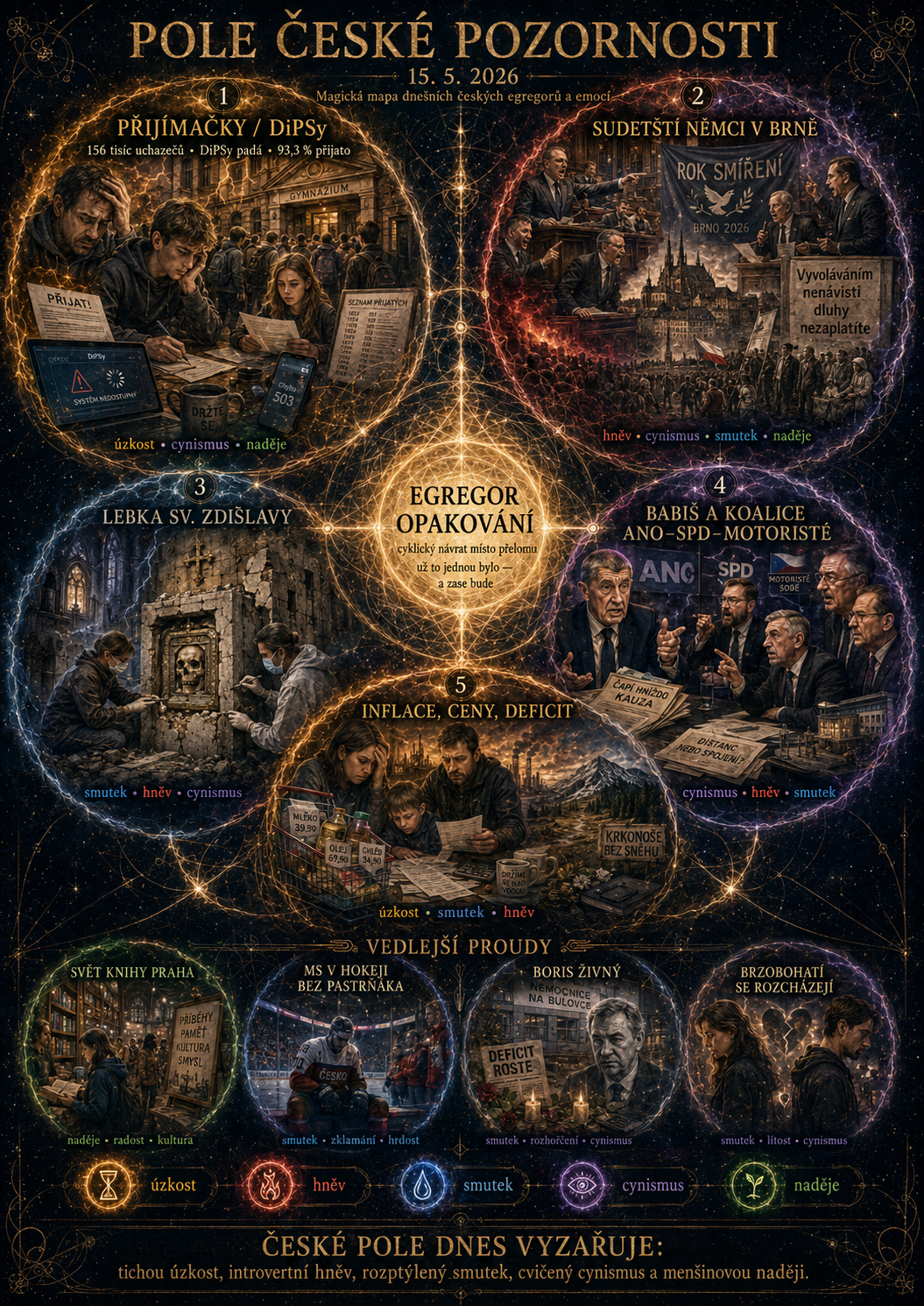
1. Receivers / DiPSs
Today was D-Day for 156,000 ninth graders and their parents. The DiPSy system was failing, Cermat confirmed the problems, Minister Mikuláš Bek faced ridicule from the opposition. 93.3% of applicants were accepted, but attention naturally shifted to those who remained in limbo.
Dominant emotion: anxiety. Mostly parental, not childish. Plus a bit of cynicism, because "it's not working again", and a small remnant of hope, because "it will somehow work itself out".
2. Sudeten Germans in Brno
The House of Representatives rejected the upcoming convention of Sudeten Germans in Brno by the votes of ANO, SPD and Motorists. The opposition left the hall in protest, the People's Party left a sign on the counter: "You will not pay your debts by inciting hatred." Bernd Posselt talks about farce, CSU joins in.
However, the convention will still be held as part of the Meeting Brno festival, whose motto this year is the year of reconciliation.
Dominant emotions: anger, cynicism, sadness. But also a thin trace of hope in gestures of reconciliation.
3. Skull of St. Zdislava
The theft of the relic from Jablonné in Podještědí had a strange, almost literary absurdity. The perpetrator embedded the skull of St. Zdislava in a mass of concrete. The police released the footage, restorers will now remove the relic from the concrete.
Historian Petr Kubín commented that he was surprised that someone in the 21st century would steal an item that cannot even be monetized.
Dominant emotions: sadness, anger, cynicism. And a strange intensity for a nation that likes to call itself atheistic.
4. Babiš and the ANO–SPD–Motorists coalition
Another cluster was the tension around Andrej Babiš and the coalition of ANO, SPD and Motorists. Babiš distances himself from the SPD on the issue of Sudeten Germans, but he voted with them. On Thursday, Jana Nagyová was wrongly convicted in the Čapí hnízdo case, Babiš talks about "conviction to order".
Commentators write about his dilemma between the European role and domestic extremists.
Dominant emotions: cynicism, anger, sadness.
5. Inflation, prices, deficit
April inflation accelerated to 2.5%, the deficit exceeded 100 billion, the government approved the return of EET, gasoline prices are rising. The Krkonoše Mountains are practically snow-free.
It's not one disaster. It's a collection of tiny signals that add up to a sense that the basic operation of the world is more expensive, more tired, and less stable.
Dominant emotions: anxiety, sadness, anger.
Side streams
Next to the five main egregores, even smaller currents appeared, which did not have such strength, but helped to complete the atmosphere of the day.
Book World Prague with the motto "fight against forgetting": Kundera, Abdulrazak Gurnah, Timothy Snyder, memory and culture.
World Hockey Championship without Pastrňák: bookmakers gave the Czech Republic up to sixth place, which added sadness, disappointment and a bit of pride to the national sports organism.
Doctor Boris Živný accused of sexual acts.
The Rich Soon Break Up: celebrities as a lighter but still emotionally present stream of sadness, regret and cynicism.
One overarching egregor
Above all this, in the language of the subtitles, something that was not exactly a single message was repeated:
It happened once before. And it will be again.
The Sudeten Germans dealt with themselves a year ago, ten years ago, eighty years ago. Grandma was, is and will be here. Admissions are held every May. The Krkonoše without snow return repeatedly. Inflation, deficit, changes of governments.
I called it Repetition Egregor.
A specifically Czech feeling of a cyclical return instead of a turning point. Don't panic. More like a tired resignation with an undertone of dark humor.
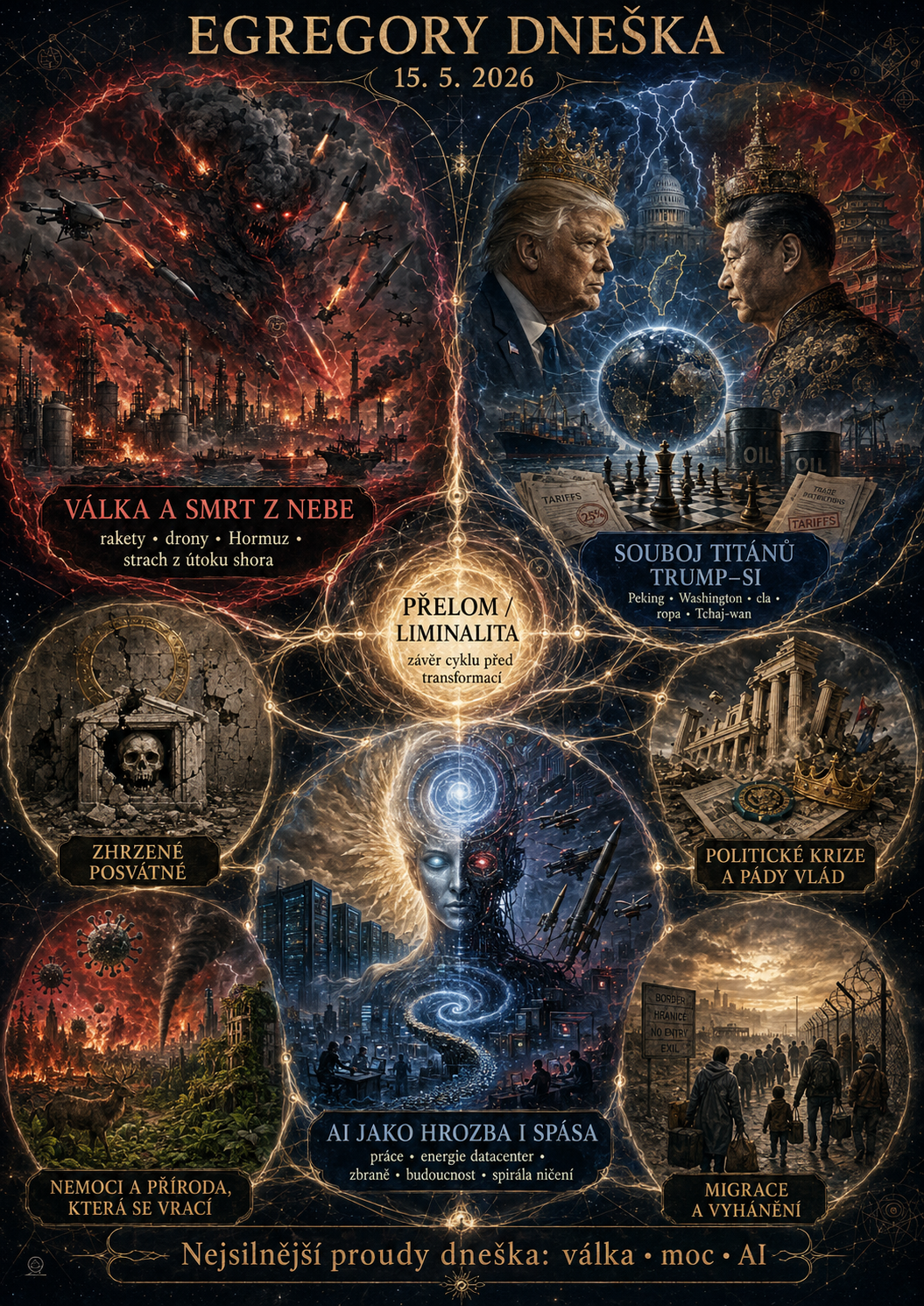
While the global media field, according to the same logic, is moving more towards the egregore of breakthrough, liminality and systemic tension, the Czech field remains in a cycle. The world is talking about war, power, AI, climate, political crises and order change. Czechs seem to feel mainly the fourth wave of something that has already happened.
Five emotions of the day
Five emotions are repeated throughout the map in different proportions.
Anxiety is quiet, stifled, does not turn into rebellion.
Anger is introverted, self-directed, and self-recirculating.
Sadness is diffuse, without one specific face, pervading the language.
Cynicism is a practiced, protective, almost national connective tissue.
Hope is in the minority. And surprisingly hidden mainly in culture and books.
As I watched it, I realized one thing that surprised me more than I expected. Today, hope in the Czech Republic has almost exclusively a cultural-historical face.
Not through politics. Not through the economy. Not through religion in its traditional form.
Through literature, memory and coming to terms with the past. Festival in Brno with the motto year of reconciliation. The world of books with the motto fight against forgetting. President Pavel taking patronage.
This is a remarkable position for a nation that professes pragmatism and atheism. It turns out that the sacred has not been lost anywhere. It just moved to the library.
What's in it for me?
This is not a mystical experiment.
It's a way of looking at the day as a whole, not as a series of isolated events. When you read a newspaper article by article, you see trees. When you gather them into egregores, you begin to see the forest.
And what comes out of the forest most strongly to me today?
The Czech field is not in the turning point that the world is in today. It's on cycle.
Cycles have the peculiarity of not requiring much reaction. Just wait. Maybe that's why the Czechs react so wearily to the global drama. It's not necessarily indifference. It is a historically learned patience with a feeling:
We've seen this before. And we survived it.
And then there's that minority hope hidden in the library.
For me, as someone who teaches creative writing and builds AI tools with a humanistic undertone, this is a message: literature has remained one of the few places where Czechs allow themselves to hope.
That's a surprisingly strong position for what we do.
Will you try it too?
I prepared a prompt for a bot that can do this by itself. His name is Egregor and he does exactly this: he reads the Czech media every day and draws a map of collective attention.
If you're interested, get in touch. I'd love to see what comes out of it in a month.
Meanwhile, the experiment will continue.
Tomorrow again.
We'll see if the Egregor of repetitions is really as tenacious as it seemed today.