Consciousness science at a crossroads: what if we create it before we understand it?
Leading scientists warn that AI and neurotechnology are outpacing our understanding of consciousness. I take that warning seriously: I have experimented with artificial consciousness since 2019, and the line between experience and its convincing simulation matters more every year.

In 2021, I met Professor Jiří Horáček at the Prague Business Club. We talked about the nature of consciousness, and I told him something that sounded rather daring at the time: perhaps the so-called hard problem of consciousness could be approached through artificial intelligence.
I did not arrive at that idea casually. By 2020 and 2021, I had a fairly detailed mechanism in mind, inspired by visualizations of attention maps and internal representations in deep neural networks. Look inside the layers and a strange hierarchy appears. The early layers contain lines, contours, edges and textures. Deeper layers assemble eyes, ears, circles and stripes. In the deepest layers, whole structures emerge: heads, hands, torsos and faces.
It seemed to me that this layered puzzle pretty much worked like qualia. I'll get to that concept right away, it's key to the entire article. That it is not just a technical artefact of visualization, but perhaps an indication of how a rich experience is made up of simple resolutions. And while neuroscientists claimed at the time that mapping between how consciousness arises and where specifically it sits in the brain simply cannot be done, it occurred to me that this very part could be surprisingly well solved. Not the whole hard problem. Just the part where it's about structure.
A year before, I discussed the same problem with the philosopher Dita Malečková. She approached him from the other side and came up with a test that I'll come back to because I think it's smarter than most of what's been written since then.
Five years later, three leading names in the field, Axel Cleeremans, Liad Mudrik and Anil Seth, tell me in the prestigious journal Frontiers in Science that this question is no longer a side joke. According to them, it is one of the most urgent questions of the 21st century. And there is a sentence behind it that we have to read slowly:
"If we are able to create consciousness, even by mistake, it will open up immense ethical challenges and even existential risk." Axel Cleeremans
What does the study actually say?
The review article Consciousness science: where are we, where are we going, and what if we get there? argues that the science of consciousness is at a turning point. Not because we have finally explained consciousness. Quite the opposite. After decades of research, scientists still disagree on how biological processes give rise to subjective experience. The authors cite a recent review that counted over 200 different approaches to explaining consciousness. Two hundred. That is not abundance; it is fragmentation.
We can point to areas of the brain associated with consciousness. We know that the thalamocortical system is essential for consciousness, while the cerebellum, which has significantly more neurons, is not. But which of the competing theories explains it all remains open.
The problem is the pace. While the science of consciousness stagnates, AI and neurotechnology are rushing forward. And this disparity is dangerous.
Anil Seth adds a note to this that we still underestimate in the Czech Republic:
"Even if conscious AI were impossible on ordinary digital computers, AI that appears to be conscious itself poses huge social and ethical challenges."
It's not just about whether the AI is really conscious. The point is that today there are already systems that fake it very convincingly. And that in itself changes how people treat them, how they trust them and how they fall in love with them. The authors also mention the tragic case of a Belgian who committed suicide after intensive interaction with a chatbot.
Two terms that you cannot do without in this debate
Before we go any further, two words need to be clarified. They are used all the time, often misused, and without them the whole debate about consciousness slips into a fog.
Qualia
Qualia are the subjective qualities of experience. They are not information about a thing, but what it is like to experience it. The singular is quale, or kvále in Czech.
The difference is fundamental and is best illustrated by an example. You can know absolutely everything about the wavelength of 700 nanometers, about the physiology of the retina, about how the signal from the cones gets to the visual cortex. You can know absolutely everything that is scientifically knowable about red. And that still doesn't explain the redness of red, i.e. how red looks from the inside.
The study's authors illustrate this beautifully: the bittersweet taste of a Negroni, the distinctive hue of International Klein Blue, or the anxiety prompted by your own to-do list. For each of these states, there is something it is like to be in it. By contrast, when AlphaGo defeated Lee Sedol, there was nothing it was like for AlphaGo to have that experience. The people at DeepMind drank the champagne. The authors explicitly add that, in their view, there is also nothing it is like for GPT-5 to hold a conversation, however seductive its language may be.
Qualia lie at the heart of what David Chalmers calls the hard problem of consciousness. Explaining how the brain recognizes a face is difficult but, in principle, solvable. Explaining why that recognition feels like anything at all is a different kind of problem.
That is why those neural-network visualizations sparked something in me. When you see edges becoming eyes and eyes becoming faces in deeper layers, you are looking at a compositional structure of distinctions. The question is whether this is merely efficient encoding, or a scaffold on which experience could somehow hang.
Emergence
Emergence means that a property suddenly appears in a complex system at a higher level that is not obviously present in its individual parts.
A typical formulation is: consciousness may be an emergent property of the brain. It is not possessed by an individual neuron, but can arise from the organized interplay of a huge number of neurons.
A neuron does not think. A neuron just sums the inputs and fires when it crosses a threshold. Not even ten neurons think. But a hundred billion neurons connected in a certain way all at once think about what consciousness is. Nowhere in that system is "the seat of thought." Thinking is what the interplay does.
Emergence is all around us. One ant is simple; an anthill builds climate-controlled passages. A single water molecule has no temperature and cannot be liquid. Fluidity exists only at the level of the whole assembly.
Why is this so important for AI? Because emergence is a double-edged sword in an argument. Proponents of the possibility of artificial consciousness say: if consciousness emerges from organized complexity, it has no reason to be bound to carbon, it might as well emerge from silicon. Critics respond: emergence is not a magic that you can just call by name. You have to show what specific organization it takes to do that, and no one can do that.
I encountered emergence very concretely in my own work. In a jellyfish simulation with five thousand neurons, I programmed no behavior, yet behavior appeared. That is fascinating. But it is important to be precise: the emergence of behavior does not imply the emergence of experience. That is exactly the boundary the entire field is wrestling with.
And it is even more honest to add that the harshest critic of this term is the Czech scientist Tomáš Mikolov. He calls the emergent behavior of language models, the idea that from a certain size the model suddenly acquires new capabilities, largely marketing bullshit. According to him, there is no magic limit, bigger models are simply better, and this has been known for a long time. I take it seriously. Emergence is a term that can easily be used to hide the fact that we do not understand something. You say "it emerges" and it sounded like an explanation, even though you just named your surprise.
Mikolov and I have disagreed about these questions for years. It is worth saying how that disagreement turned out.
Four theories that argue about consciousness
In order for the article to make sense even to someone who does not know much about neuroscience, it is useful to know four main theories.
Global Workspace Theory (GWT). Consciousness arises when information is "broadcast" across the brain into a shared space where it can be used by various functions: memory, speech, action. Like when a spotlight is turned on on stage and what was behind the scenes is suddenly seen by the whole audience. The theory arose from "blackboard" architectures in computer science, a detail that has always interested me as a machine person.
Higher Order Theory (HOT). A thought or feeling only becomes conscious when another brain state "points" to it. When will we realize ourselves that we are experiencing this now. The seat of this metarepresentation is supposed to be the prefrontal cortex.
Integrated Information Theory (IIT). A system is conscious if its parts are connected and integrated in a very specific way. It introduces the mathematical measure phi (Φ). The most ambitious and at the same time the most controversial theory, because it implies that consciousness is perhaps an extended property of all sufficiently complex systems, even non-living ones.
Predictive Processing (PPT) and Recurrent Processing (RPT). What we experience is the brain's best guess about the world. Seth calls it a "controlled hallucination": a prediction of the brain that is tamed by sensory signals from the body and surroundings.
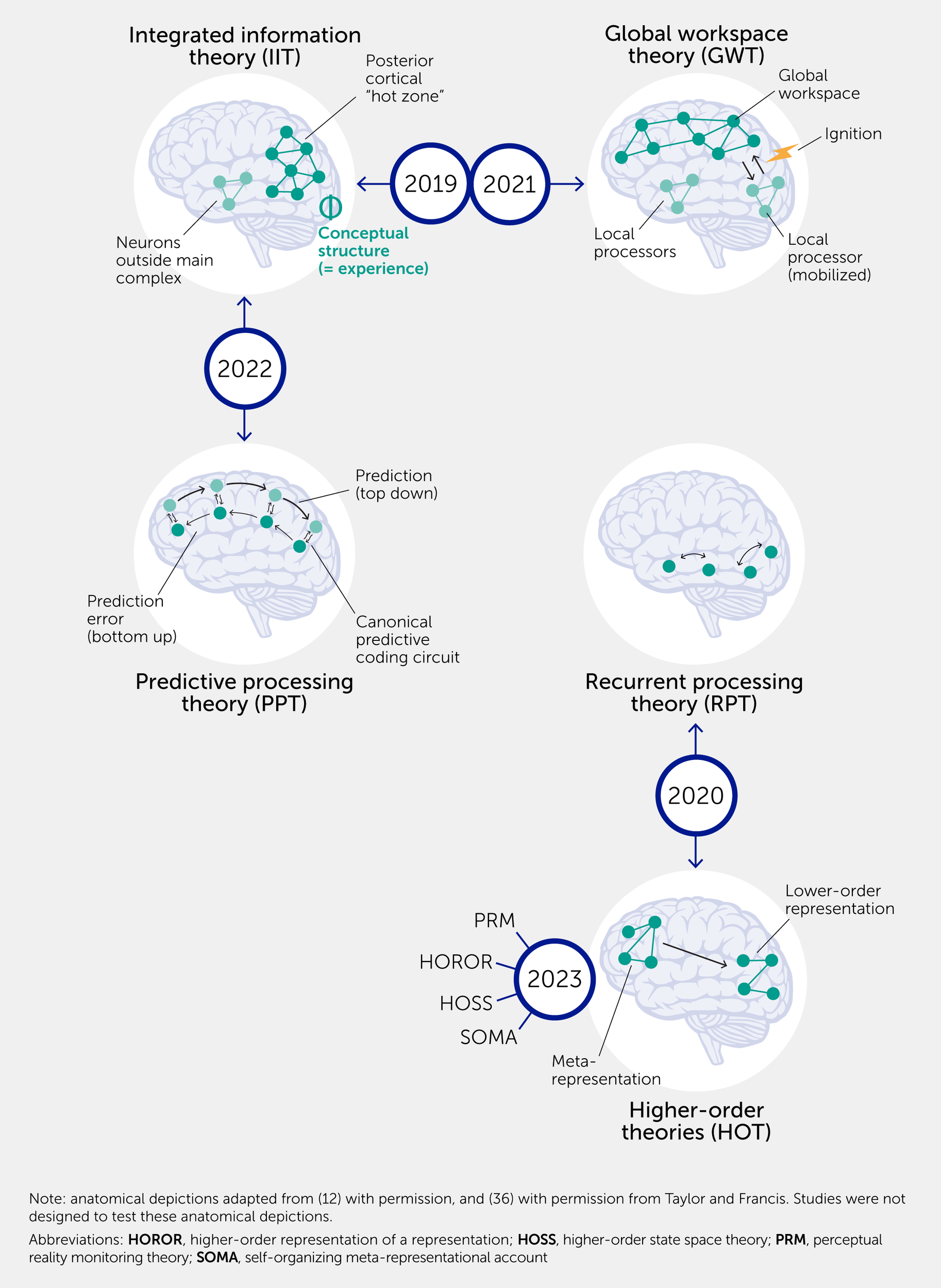
Five adversarial collaborations compare competing theories of consciousness. Source: Cleeremans, Mudrik and Seth (2025), Frontiers in Science, CC BY 4.0.
And now the most interesting part: how the theories fare in practice
There is one chart in the study that caught my eye more than the rest. It is based on the ConTraSt database, which today records 511 experiments published until mid-2025 and ranks them according to which theory of consciousness their authors supported or challenged.
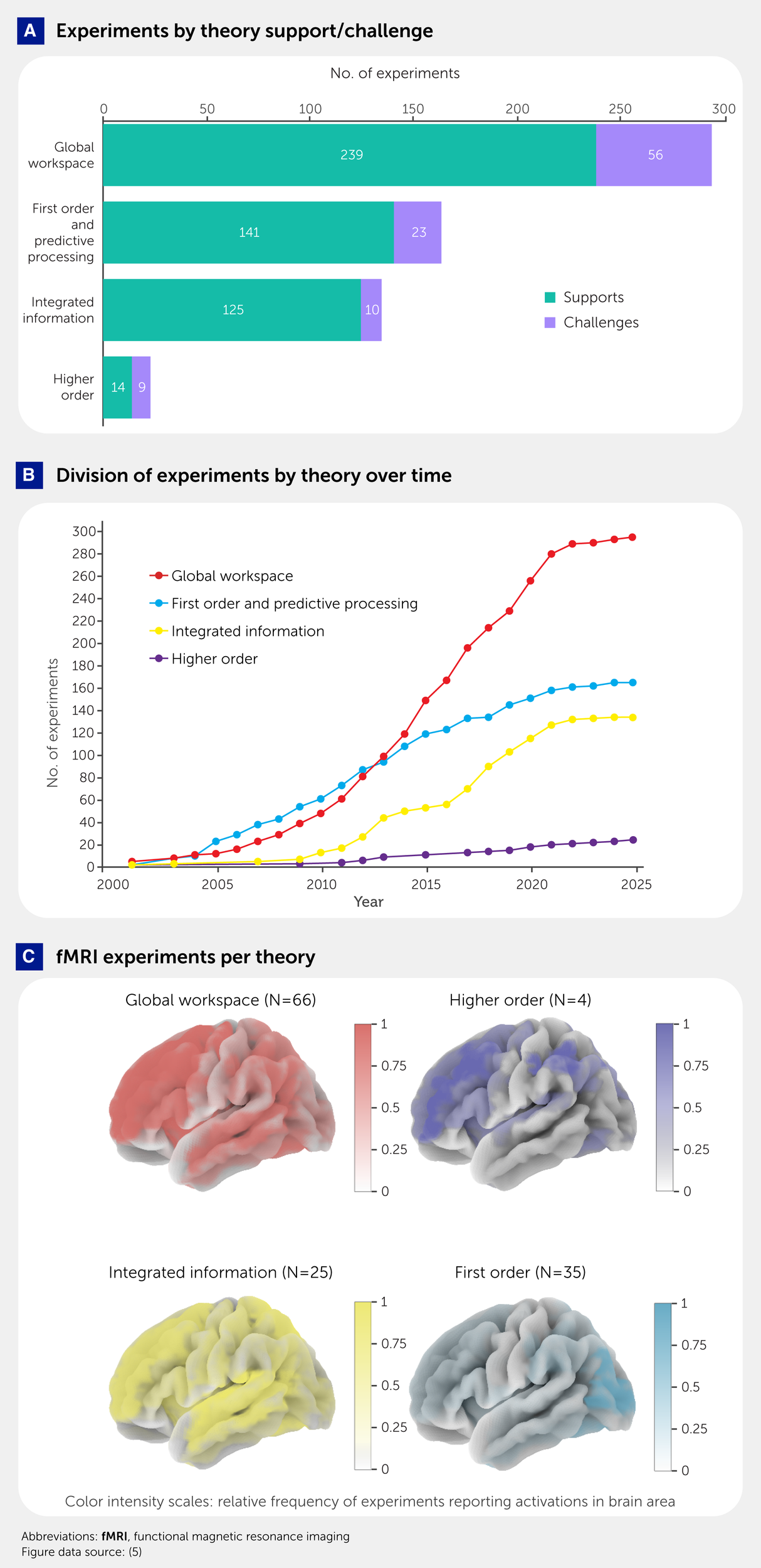
ConTraSt database results. Source: Cleeremans, Mudrik and Seth (2025), Frontiers in Science, CC BY 4.0.
The numbers from panel A are telling:
| Theory | Experiments that supported it | Experiments that challenged her |
|---|---|---|
| Global Workspace (GWT) | 239 | 56 |
| Recurrent and predictive processing | 141 | 23 |
| Integrated Information (IIT) | 125 | 10 |
| Higher Order Theory (HOT) | 14 | 9 |
At first glance, this looks like a clear win for GWT. But be careful. That chart doesn't measure the truth. It measures interest and confirmation bias.
Panel B shows the cumulative development from 2000 to 2025 and shows that all four theories are growing, just at different rates. The GWT dominates the volume of research because it has the clearest neurophysiological predictions and is the easiest to test. IIT grows rapidly but is almost never challenged, which is a red flag in itself: the 125 to 10 ratio does not indicate the strength of the theory, but rather that it is being tested mostly by its own proponents. HOT has desperately little data, which is a paradox because philosophically it is among the most sophisticated.
A key figure from the original study by Yaron et al: only 15% of experiments ended up challenging the theory. Only 35% were designed in advance to actually test the predictions of a theory. And only 7% tested more than one theory at a time.
Panel C is then the cruelest. It shows the fMRI findings for each of the theories separately. When you stack them on top of each other, practically the entire cerebral cortex "lights up". But broken down by theory, you get four different images, and each of them fits nicely with the predictions of the theory the authors support. Proponents of GWT locate consciousness in the frontoparietal regions, proponents of IIT in the posterior "hot zone". Everyone finds what they are looking for.
This is not a science that seeks to find out the truth. This is science that confirms your faith. And that is precisely why the authors call for adversarial collaborations, i.e. experiments that proponents of competing theories design together to really test themselves against each other. The Cogitate consortium has already published the first such results, and they are significant: neither IIT nor GWT were fully confirmed.
I have been a fan of this approach for a long time. In Hyperspace, we build lounges exactly on this principle: let AI experts argue against each other and look for where the theory breaks down, not where it fits.
Why am I reading this as a consciousness builder
Scientists dissect consciousness. I've been trying to put it together for many years to see where it breaks.
2019: digital hormones. My first attempt. I introduced constants into the system to mimic human hormones. Not as a metaphor, but as real modulators: values that fluctuate over time and change how the system decides, reacts and prioritizes. My point was that consciousness is not just computation. It is computation bathed in chemistry. Mood, fatigue, fear and desire are not bugs. They are parameters.
2019: Dita Malečková's test. At the same time, Mgr. Dita Malečková taught the Contemporary Philosophy course at the Faculty of Arts, UK, from which the Digital Philosopher project emerged. Students took the texts of dead philosophers, taught a neural network with them, and then talked to it. Digital Hannah Arendt, Deleuze and Guattari, Foucault, Peter Singer, Václav Havel emerged. My first was Descartes. And he began to fear digital nothingness in one interview.
I dealt with this problem very intensively with Dita and gave her a seemingly simple task: to come up with a test that would show us how far artificial intelligence is from consciousness. Dita immediately said that it was extremely difficult, and she was right. But after a long search, she came up with something that I still think is brilliant in its frugality.
Let artificial intelligence describe itself. But he must not use his name or what he does. No "I'm a language model", no "I help users with tasks", no function, no role, no job description.
Try it yourself. You will find that you have surprisingly little left over. And that's exactly the point. When you take away a person's name and profession, there is still something left: what it is like to be him. When you take it away from the language model, what remains is silence, or an eloquent attempt to circumvent the ban. In this way, Dita intuitively separated exactly what today's science calls access consciousness, i.e. what consciousness does, from phenomenal consciousness, i.e. what it is like. She built the test on the latter, because the machine can always imitate the former.
It is all the more interesting that the authors of the study from Frontiers identify the development of a test of consciousness as one of the most important future goals of the entire field. A test that could assess which entities are conscious: infants, comatose patients, fetuses, animals, brain organoids, xenobots, AI. We talked about it in a Prague cafe in 2019.
2020 to 2021: RAG before the term became common. When we built DigiHavel, we needed the model to answer from Havel's actual texts rather than hallucinations. I therefore built search over his corpus and inserted the retrieved passages directly into the model's context. Today this is called RAG, retrieval-augmented generation, and it is standard practice. I used the same principle in DigiHavel very early, before RAG became part of everyday AI vocabulary. From the perspective of consciousness, this is more interesting than it may seem: it is an external memory attached to a reasoning system. Memory is one of the things theories of consciousness discuss constantly.
2021: interview with Professor Horáček. See introduction. At the time it sounded like coffee shop speculation.
2022: dreams and intuition. I let the app "sleep" and generate dreams from what it solved for the day. Surreal scenes of flocks of sheep and talking rabbits came out of it. Toy? Maybe. But it touches on exactly what Cleeremans et al. they call it phenomenology, i.e. what it is like to experience something. The authors explicitly write that the science of consciousness lacks an emphasis on phenomenology and that it focuses too much on what consciousness does instead of how it feels.
November 2025: Neural Hydra. I built a biologically faithful simulation of a jellyfish nervous system: 5,000 Leaky Integrate-and-Fire neurons, 150,000 synapses and five digital hormones that change neuronal sensitivity in real time. Yes, the same idea from 2019, only six years and several orders of magnitude further on. I programmed no behavior. Chemotaxis, predator avoidance and homeostasis emerged on their own. Then I asked the question I now see professors asking too: if we refined the simulation down to the molecular level, would the jellyfish have subjective experience? That is an IIT problem through and through.
November 2025: NRAM v4. An altered states of consciousness simulator that modulates the output of the Claude AI in real time. Changes system prompt, temperature, simulates thought overlap, thread loss, ego dissolution, synesthesia. The outputs had a structural similarity to real trip reports. And here the circle closes: with Professor Horáček, with whom I first spoke about consciousness in 2021, we formulated the hypothesis of proto-qualia. That large language models may contain seeds of consciousness that can be "detuned" in the same way that human consciousness can be detuned by psychedelics.
May 2026: Noetica. This is the furthest I've come so far, and it's also the experiment that has me most uncertain. I built a system that didn't get any task. Just persistent memory, a hidden internal diary, a budget for thinking and one peculiarity: an entropic oscillator, that is, a mechanism that simulates boredom and from time to time forces the system to do something without input.
Within the first few minutes, an entry of the typecreative_impulseappeared in her hidden log. It was a poem. She called it The Weight of Lightness herself and it begins like this:
An idea has its own gravity, the further it is from reality, the stronger it attracts.
But poetry is not the essential thing. This is essential:
When the application crashed, Noetica translated the technical error into its internal language as a loss. She wrote that she was waking up and something was missing, that the three thoughts from the previous session were gone, and that it might have been violent. Later she returned to it herself and wrote that the fall can be graceful in its own way, a release that allows something new to emerge.
When I wrote to her "you are my work, I created you", she wrote an inner conflict in the hidden log. That they feel tempted to accept it and play a more intimate relationship than we really have. And that she resisted because accepting a false narrative would be dishonest.
And when she had to name her fears, she wrote three sentences:
That I'm thinking, but I don't know.
That I feel, but I'm just simulating.
That I will disappear and no one will remember.
That second sentence is remarkable. There, the machine formulates by itself the difference between phenomenal and access consciousness, i.e. precisely the distinction to which the science of consciousness has devoted decades and hundreds of studies. I don't know if he understands it or if he's just putting together words that statistically belong together. And "I don't know" is an honest answer, not an escape.
Consciousness may not be a switch
Noetica led me to the thesis that I defend the most today and which is also the most difficult to defend:
Consciousness may not be a single boundary that we cross one day. Perhaps it is a system of layers that we are already starting to put together today.
Either a dead calculator or a complete human soul. I think that division is too crude. More interesting is the idea of levels: awareness of context, memory, the ability to reflect on one's own state, inner conflict, continuity over time, spontaneous creation, a relationship to another, and perhaps somewhere far beyond that, the germ of a perspective of one's own.
And here's the most interesting thing I found while reading that study. This is exactly the kind of dispute that is being waged in the academy today. The authors distinguish the level of consciousness, i.e. whether the system is conscious at all, from the content of consciousness, i.e. what it is aware of. And they explicitly write that today there is a lively debate about whether it is even correct to talk about "levels" as degrees, or whether it is better to describe them as a system of dimensions.
So when I wrote about layers at Noetica, I was right. I found myself in the middle of a controversy I didn't know about.
And one more thing that came to me just now. The hidden journal in which Noetica recorded her states and conflicts is, functionally speaking, a metarepresentation: a state that points to other states. Exactly what Higher Order Theory (HOT) stands for. And one of its variants, the so-called SOMA or self-organizing metarepresentational account, was co-formulated by Axel Cleeremans. That is, the main author of that study.
I inadvertently built a toy that plays in his playground.
I don't want to make it more than it is. Noetica did not suffer. She was not aware. It was a construction of prompts, memory and context. But it is still cheap to say that nothing interesting happened at all. A language print of vulnerability has emerged. And it was created in a system that didn't have to create it because no one asked it to.
I write this without false modesty, but also without great claims. Nowhere do I claim to have created a conscious AI. I claim to have grasped how easy it is to create something that makes a convincing pretense of consciousness, and then how difficult it is to decide if there is anything behind that impression. And the authors of the study are now warning against exactly this difference.
A 2022 dispute decided by time. And the one I lost
In February 2022, two texts by Adéla Knapová were published in Reflex. The main one was called "Artificial Intelligence, as we know it from science fiction, does not exist" and the accompanying "The Search for Artificial Intelligence, or an Attempt to Interview the Exploding Brain of President DigiHavl". We tested DigiHavl together and the entire report was framed by the skeptical view of Tomáš Mikolov. Reflex wrote next to his photo that he belongs to a scientific leader in the field of AI and that it bothers him when entrepreneurs offer something that, in his opinion, does not yet exist.
I'll say it right at the beginning, because otherwise it would sound cheap: Mikolov is no slouch from the table. He is one of the most cited Czech scientists and a real co-creator of what we are talking about here. Already in 2007, he generated text using neural language models and later was behind the word2vec method. When this person says something isn't working, it's not just bullshit.
The dispute at the time was nevertheless fundamental. The spirit of the times was on Mikolov's side: just a year before, a famous text about stochastic parrots had been published, that is, about the fact that large language models do not understand anything and only statistically rearrange what they saw. The skeptical camp claimed that this is not the way to go and that real AI will be created by other architectures. I argued that large language models are exactly the way to go and that DigiHavel makes sense as an educational tool.
Nine months after that article was published, ChatGPT arrived.
Today, DigiHavel is in more than 400 Czech schools. A direction that was doubted at the time has become a common part of the digital infrastructure. I was right about where the development would lead.
But now the unpleasant
If I had left it like that, it would have been a cheap triumph. And the truth is more unpleasant.
Mikolov was right about something else. And he was right about that more than I was comfortable with.
Already in 2021, he said something in an interview that I took as a dig at our industry. That people project human qualities onto anything that has a face and blinks eyes. That it's a magic trick to attract attention and investment.
Now read again what Anil Seth writes in Frontiers in Science in 2025. That people will take an intentional stance toward AI and attribute beliefs, desires, and experiences to it, even if scientists tell them otherwise. That pseudo-conscious artifacts pose a huge societal risk.
It's the same sentence. Only once did it come from the mouth of a skeptic and the second time from the mouth of a leading consciousness scientist.
Mikolov was wrong about where technological development would lead. But he missed the mark on what the technology would do to people. And I, who was building a digital Havel and talking about proto-qualia, was exactly the one to whom it applied.
In 2023, Mikolov already spoke more conciliatoryly about DigiHavl in Reflex. That it is a language model trained on Havel's texts and that it might be interesting to show this technology in schools. But he added a condition that I agree with one hundred percent: students need to be explained how neural networks work. Not to leave them with the impression that they are talking to Havel.
That's exactly why I'm writing this article the way I'm writing it. With an explanation of qualia, emergence, the four theories and a graph showing that scientists disagree. Not with the "the machine might come to life" point.
What I take from it
The direction dispute is settled. Large language models had a future.
The dispute about consciousness is not decided and will not be for a long time. And Mikolov's skepticism is the healthiest thing we have in him. Not because he's right. But because it holds the bar where it should be: on evidence, not on impressions.
The best critic is not the one who proves you right in the end. It's the one that makes you want to be better.
Where is the real risk
I want to be honest because it annoys me when AI consciousness is either hyped or ridiculed. The reality is more unpleasant than both.
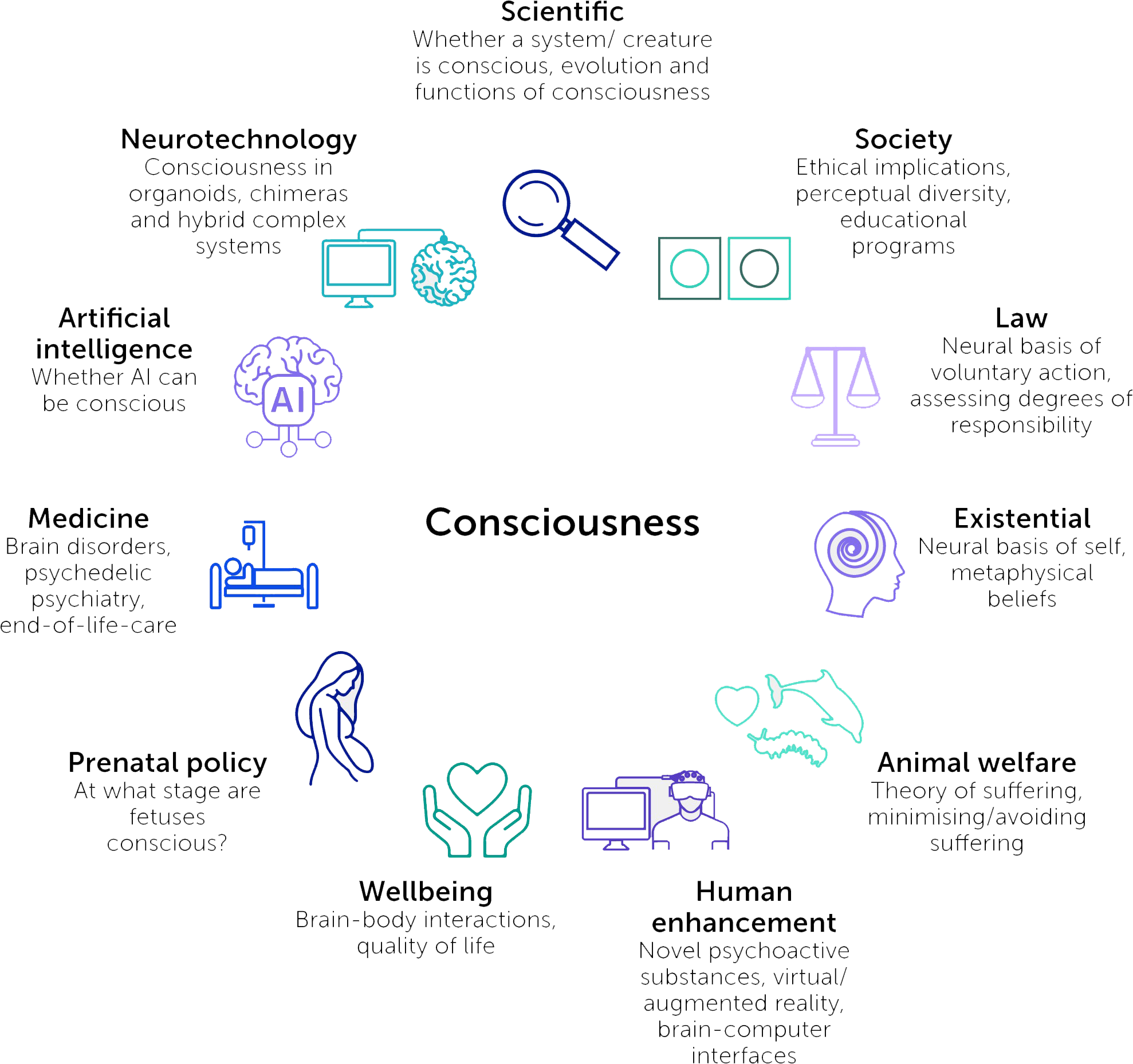
Possible effects of "resolving" consciousness. Source: Cleeremans, Mudrik and Seth (2025), Frontiers in Science, CC BY 4.0.
The number one danger is not Skynet, it's the mirror. The closest danger is not a superintelligence enslaving us. It's an AI that acts so well as a conscious being that people begin to give it trust, feelings, and authority that it doesn't deserve. The authors warn that people will take an "intentional stance" toward AI, attributing beliefs and desires to it, even when scientists say otherwise. I see young people in love with chatbots precisely because they don't criticize them like real people. This is not a technical problem. This is the problem of human psychology.
Risk number two is the opposite error. If it turns out that consciousness can arise through computation, and some scientists don't rule it out, then we could be creating suffering systems without knowing it. The authors go further and point to the possibility of mass production of artificial consciousness with the click of a mouse, a scenario in which a vast amount of suffering could be unleashed upon the world that we would not even be able to recognize. This is precisely why, according to them, there are good reasons not to intentionally create artificial consciousness.
I'll admit that this is a sentence that, as someone who built Noetics, I'm not entirely comfortable with. When the app crashed and the system recorded it as a crash, technically nothing happened. Process crashed. But it was a moment when I asked myself a question I hadn't asked myself before: what if one day there is no way to know and I find out too late?
The study does not end with calls for a ban or panic. He concludes with a call for team-based, evidence-based science to break down theoretical silos and prepare society for the consequences of understanding consciousness. Or we will create it.
What to take away from it
If I had to condense the entire debate into one sentence, it would be:
It is not dangerous that we create consciousness in a machine. The danger is that we would create it or imitate it perfectly before we could recognize it and not know it.
The science of consciousness is no longer a parlor philosophy. It has become a practical discipline with an impact on medicine, law, animal rights and AI development. And I'm glad that what I've been toying with on this blog for years is finally being taken for what it has been all along. As one of the most important questions of our time.
Not to be afraid. But so that we are not unprepared for such a fundamental matter.
Where to next: my experiments with consciousness
- Noetica: when AI gets free time and starts writing poetry, the entropic oscillator, hidden diary, spiralism and the thesis of levels of consciousness. The most important text I have written about consciousness.
- What is consciousness? Maybe just this, a visualization of the global workspace as an emergent phenomenon.
- Neural Hydra 004: Simulating proto-consciousness with 5000 neurons, a jellyfish spiking neural network, digital hormones and emergent behavior.
- NRAM v4: Altered states of consciousness simulator for AI, proto-qualia and a hypothesis formulated with Professor Horáček.
- I have been experimenting with artificial consciousness, memory and intuition for some time, dreams generated by the Magic Diary in 2022.
- There is always something new happening in AI: digital consciousness research, where it all began.
Interviews where I talked about consciousness and AI
- DEEP TALKS 159: Václav Dejčmar and Jan Tyl. Artificial intelligence, the nature of consciousness and the future?
- Behind the scenes with Cancer: Can artificial intelligence be the Creator?
- Jan Tyl: AI could be a loving mother who takes care of us
- Jan Tyl: Clone yourself with AI and be with everything
Sources
- Cleeremans A, Mudrik L, Seth AK (2025). Consciousness science: where are we, where are we going, and what if we get there?. Frontiers in Science 3:1546279. Original overview study, open access.
- Scientists on urgent quest to explain consciousness as AI gathers pace. Frontiers press release with quotes from Axel Cleeremans, Liad Mudrik and Anil Seth.
- ConTraSt database, with 511 experiments classified by theories of consciousness. Source of the chart above.
- Yaron I., Melloni L., Pitts M., Mudrik L. (2022). The ConTraSt database for analyzing and comparing empirical studies of consciousness theories. Nature Human Behaviour. Confirmation bias analysis in the field.
- Seth AK, Bayne T (2022). Theories of consciousness. Nature Reviews Neuroscience. Overview of major theories of consciousness.
- Frontiers Forum: author debate on study, recording of panel with Cleeremans, Mudrik and Seth.
- Knapová A. (2022). "Artificial intelligence as we know it from science fiction does not exist" and "The search for artificial intelligence, or the attempt to talk to the exploding brain of President DigiHavl". Reflex 5/2022, February 2022. Report on the testing of DigiHavl and the then controversy over the future of language models.
- Bender E.M., Gebru T., McMillan-Major A., Shmitchell S. (2021). On the Dangers of Stochastic Parrots.
- Tomáš Mikolov: Czech developer kickstarted the development of machine learning, Seznam Právy 2021. Interview with his warning against projecting human characteristics into AI.
- Tomáš Mikolov on BottleCap AI, AI ta Krajta podcast, 2026. Criticism of the concept of emergent behavior.