Czechia under paws: 100,000 black cats nibble away at our landmarks
A birthday experiment for Mařenka: up to a hundred thousand black cats, shrinking castles, disappearing breweries and simple rules that produce surprising collective behaviour. Run it right here in the article.

I dedicate this research and experiment to Mařenka on her birthday, and to all black cats on their special day. Happy birthday, Mařenka. This little world is for you.
October 27 is National Black Cat Day, established by the British charity Cats Protection. I decided to celebrate in my own way: by releasing 50,000 black pixel cats into Czechia.
The original experiments used fifty thousand cats. You can now increase the population to 100,000; the measurements below still refer to the original control runs.
First the food runs out. Then the world itself starts to disappear.
Pieces fall off Prague Castle. Ještěd shrinks. The breweries in Plzeň and České Budějovice slowly vanish beneath thousands of paws. Where a city's landmark stood a moment ago, a few stones remain — and a contented cat.
It is a game, of course. But underneath this slightly absurd birthday invasion lies an interesting question: how complicated a story can simple rules create when enough individuals follow them?
Release the cats
Press Start invasion. Use Landmark to zoom in on the castle, Petrov, Ještěd or a brewery. The line below the map shows how much of the building remains. The simulation starts paused and runs in your browser.
Full screen expands the map and its main controls. Return with Exit full screen or Esc, without restarting the experiment.
Open the cat experiment on its own →
Choose anything from one cat to 100,000. Enter a number, press Apply count, then Start invasion. Applying a new count prepares a fresh start. The default of 50,000 matches the experiments described below.
At country scale you see streams and clusters. Zoom in to see ears, tails and yellow eyes. Find a cat selects an individual whose energy and destination you can follow. The FPS counter shows how smoothly it runs. On a slower device, reduce the population and leave time at 1×: performance depends on both the graphics hardware and the processor calculating behaviour.
A landscape that remembers every bite
The cats appear around five starting points. Each has its own position, energy, state and destination. When looking for food, it considers distance, available supplies and crowding. It may also copy the destination of a more successful neighbour. A well-fed cat lies down; a hungry one keeps searching.
Supplies are finite. Fields change colour, houses deteriorate, and exhausted locations start losing structural integrity. Eleven large landmarks now show that damage: their façades develop holes, their colours fade, and they shrink into rubble. Dust and falling crumbs reveal where something is happening.
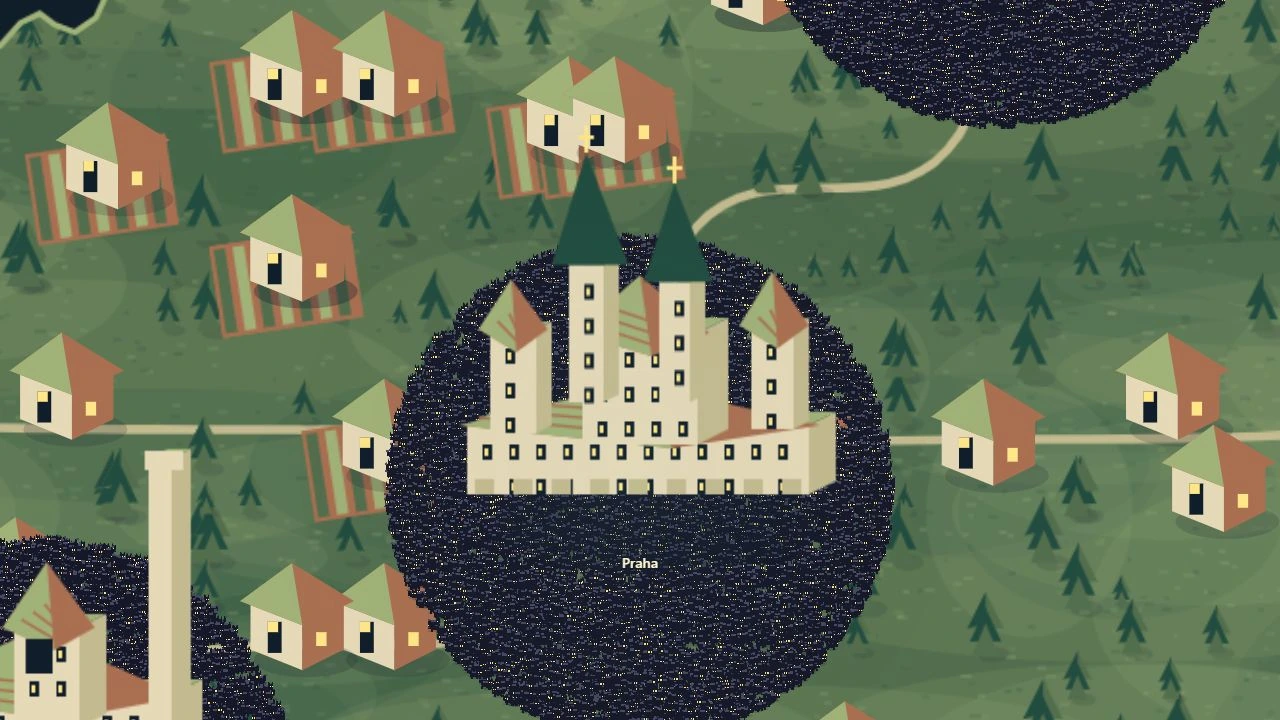
Before the invasion. Prague's stylised landmark is fully intact.
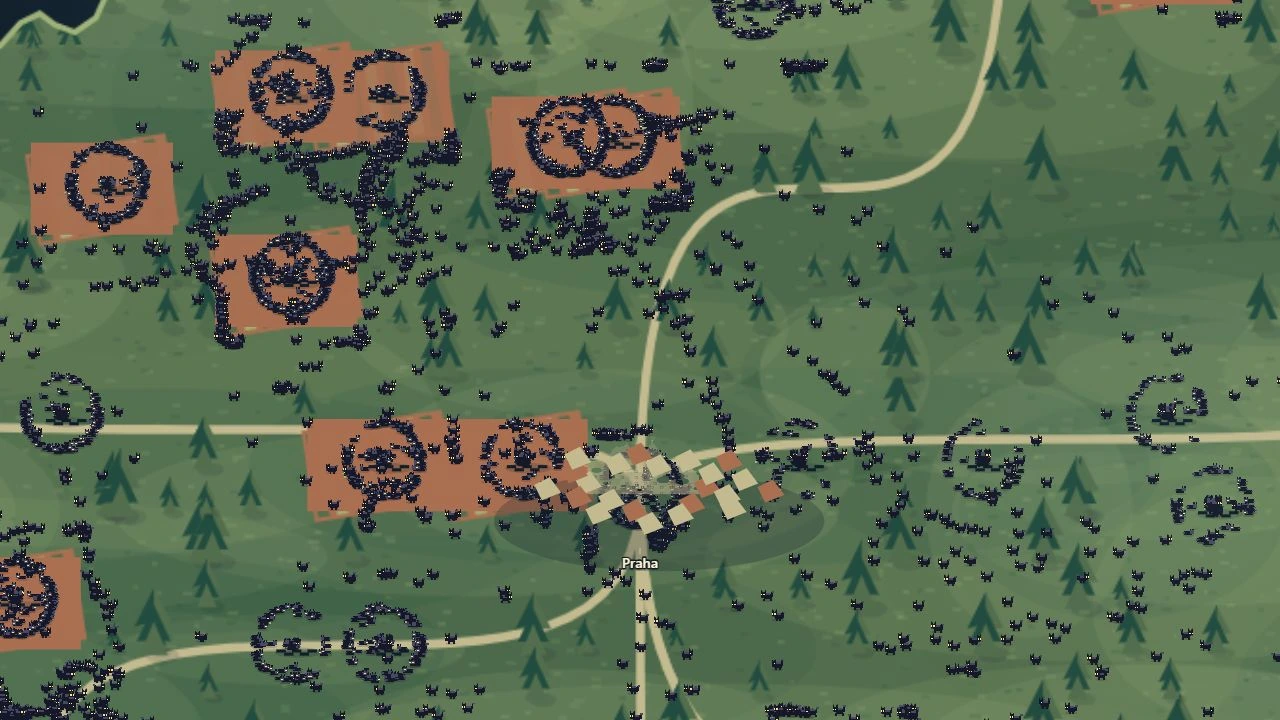
After the invasion. A frame from an actual simulation run, not a predetermined animation ending.
The map uses Czechia's real outline. The landmarks are stylised representations near their cities, deliberately exaggerated in scale. Roads, farms and supplies form a game world. The cats neither judge architecture nor drink beer: every object is a resource with limited capacity in this model.
You can intervene. Drop kibble creates a new food source, the laser lure redirects nearby cats, and cold rain changes movement and energy costs. The laser has an Enable laser / Disable laser button. Click the map to move it; it remains active until you turn it off. Interventions are logged with their time and, where relevant, location. That makes placing one pile of food and watching the consequences more interesting than rescuing everything at once.
Why did the whole town start going hungry?
The cat republic follows two earlier experiments. Initially I wondered how many lemmings and fighters would fit on one screen. Now I am more interested in what happens inside that crowd.
The living town has eight professions. Houses have more detailed roofs and windows, smoke rises from chimneys, and lamps light up after dark. Beneath it all, food supplies are being consumed. Drought reduces the harvest; when food is scarce, explorers can switch to farming or fishing.
Run the living town — Czech interface →
In the battle of angels and demons, three bridges connect the two sides. Holding a crossing provides a supply advantage: each controlled bridge increases its side's attack power by 12%. A badly wounded unit can retreat once, recover and return. But that retreat may open a route for the opponent.
Run the battle of angels and demons — Czech interface →
All three worlds raise a similar question: does the group benefit when everyone acts reasonably for themselves? And when does it need something no individual can see from their own position?
Three recent papers that made me change the rules
Three recent publications inspired the design. Their findings do not automatically become findings about our cats; they help us formulate more interesting experiments.
Cold as a reason to stay together
Emergent Cooperative Thermoregulation in Lunar Swarm Robotics, by Jeger, Holt and Puck, a preprint dated October 22, 2026, studies robots that reduce heat loss in the cold through collective arrangements. Learned behaviour includes clustering and moving between the edge and centre. The connection between environment, nearby neighbours and energy inspired our cold rain. The cats use hand-written rules, not a transferred learned policy or a physical simulation of robots.
Can an entire crowd learn?
The hive mind is a single reinforcement learning agent, by Soma and colleagues, Swarm Intelligence, October 17, 2026, connects local imitation with population-level learning under particular assumptions. Hence the cats' experience-sharing control: they can adopt a more successful neighbour's destination. This is not an implementation of Maynard-Cross Learning and does not inherit its theoretical guarantees. It does raise a useful experimental question: when does copying help, and when does it merely create a bigger crowd?
The environment changes clusters, and clusters change the environment
Self-organization and collective migration of active condensates, by Vahid, Sommer and Sharma, Communications Physics, October 14, 2026, examines the movement, breakup and reformation of active-particle clusters in environments with varying activity. It inspired a landscape that changes as resources are depleted and replenished, redirecting movement. The cats are not Brownian particles, and this model does not reproduce the paper's equations.
Fifty thousand cats do not mean fifty thousand language models. Each individual executes a short program. Interesting behaviour emerges when their decisions interact. The experiment needs no login, API key or paid AI calls.
The same cats, three different endings
Three control runs used the same seed, 281026, the same 50,000 cats and experience sharing at 70%. Only resource regeneration changed. No extra kibble, laser or rain. After 120 seconds of simulated time, the results were:
| Resource regeneration | Supplies remaining | Resource damage | Cats with low energy |
|---|---|---|---|
| 0% | approximately 0.0% | 100.0% | 8,194 |
| 30% | 4.4% | 99.9% | 3,989 |
| 100% | 82.9% | 53.8% | 2,448 |
Rapid regeneration preserved supplies but did not protect everything. Some damage occurred before food could be replenished. Enough food in total does not guarantee enough in the right place at the right time.
These results belong to this game model and one seed. “Low energy” means below 12% of modelled energy. Damage is the average loss of resource integrity, not the percentage of real Czechia destroyed. The updated landmarks change the rendering, not the rules used in these control runs.
Download measurements as CSV · Detailed JSON record
Try saving one brewery
Let the invasion run for a while and press Save comparison run. Change one rule, then choose Same starting point. A dashed line preserves the previous supply history. The same seed gives you the same initial distribution.
Try three small experiments:
- Turn off experience sharing. Will pressure on supplies spread out, or will the cats wander needlessly?
- Place kibble away from a threatened landmark. Can you divert the flow, or will the lure arrive too late?
- Increase regeneration. Will the buildings survive too, or will you simply end up with well-fed cats among the ruins?
For me, the best moment is when moving pixels become something we start giving a story. A moment ago we were watching an algorithm. Now we have a favourite cat and are trying to save a brewery.
Mařenka, I hope you enjoy discovering how it turns out.
Geographic outline: Natural Earth, public domain. City locations are approximate; landmark illustrations are not precise architectural models. The images come from the running simulation. This is a playful artificial-life experiment, not an ecological or historical prediction.